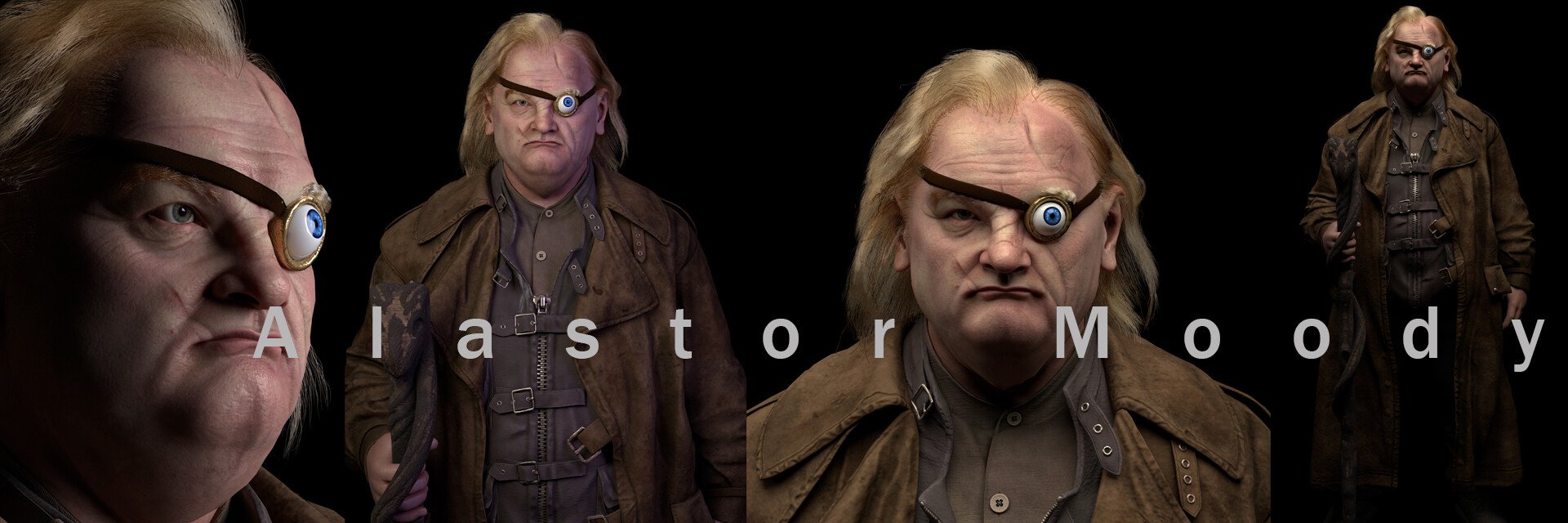
He’s a bit of a mess. Honestly, when you first see Alastor Moody in The Goblet of Fire, he's more of a walking collection of trauma and paranoia than a human being. He’s got the scarred face, the chunk of his nose missing, and that electric blue eye that spins around like it’s trying to escape his skull. It’s iconic. But here’s the thing that always trips people up when they talk about Alastor Moody: for the majority of his most famous screen and page time, he wasn't even there.
It’s one of the weirdest narrative choices J.K. Rowling ever made. She introduces this legendary Auror, builds him up as the ultimate "Dark Wizard catcher," and then immediately stuffs him in a trunk for a year.
We spent an entire book getting to know Barty Crouch Jr. pretending to be Alastor Moody. We didn't get the real guy until much later, and even then, he was a shadow of his former self. But if you look at the lore—the stuff buried in the Fantastic Beasts era notes, the Wizarding World archives, and the original seven books—Moody is actually the most successful soldier the Order of the Phoenix ever had. He's the guy who filled half the cells in Azkaban. He's also the guy who basically invented the "constant vigilance" lifestyle that probably kept the wizarding world from collapsing during the first war.
The Man Behind the Magic Eye
The real Alastor Moody was a pure-blood wizard, though he clearly didn't care about blood status. That wasn't his vibe. He was a career lawman. During the First Wizarding War, he was the Ministry of Magic's equivalent of a one-man army.
He didn't just arrest people. He survived them.
Think about the physical toll. He lost a leg. He lost an eye. He lost a significant piece of his nose during the struggle to take down Evan Rosier. Most wizards would have retired to a nice cottage in Hogsmeade and started a knitting hobby at that point. Not Moody. He kept going until the Ministry basically forced him out because he started seeing enemies in every shadow. And to be fair? He was usually right.
One of the most impressive things about Alastor Moody's career is his body count. Or rather, his lack of one. He was known for bringing people in alive whenever possible. That’s a massive detail. In a world where the Killing Curse is a literal flick of the wrist away, Moody took the hard road. He chose the struggle of the capture over the ease of the execution. It shows a level of discipline that even the "good" wizards like Sirius Black or Remus Lupin didn't always maintain when things got heated.
Constant Vigilance: A Defense Mechanism or a Mental Health Crisis?
"Constant Vigilance!"
He shouted it. A lot. It’s his catchphrase. But if you look at it through a modern lens, Moody was clearly suffering from severe PTSD. He wouldn't eat anything he hadn't prepared himself. He wouldn't drink from a cup that wasn't his own hip flask. People in the books laugh it off as "Mad-Eye being Mad-Eye," but it’s a direct result of decades spent fighting a war where your neighbors could be Death Eaters in disguise.
The irony is that his paranoia didn't save him from Barty Crouch Jr. It’s the ultimate "life is unfair" moment. The most paranoid man in England was jumped in his own home because he was targeted by the one person he probably didn't see coming: a dead man's son using his own reputation against him.
What Alastor Moody Taught Harry Potter (Without Being There)
Even though Barty Crouch Jr. was an impostor, he was a good one. He had to be. He spent months around Albus Dumbledore, the greatest wizard of the age, and didn't get caught until the very end. This means the "lessons" Harry learned in his fourth year were technically curated by a Death Eater, but they were rooted in Moody’s actual philosophy.
Harry learned how to resist the Imperius Curse. That was huge.
He learned that the world isn't divided into good people and Death Eaters.
He learned that "constant vigilance" isn't just about looking over your shoulder; it's about being prepared for the worst-case scenario at all times.
When the real Alastor Moody finally shows up in The Order of the Phoenix, he's different. He’s grumpier. He’s less "cool teacher" and more "grumpy grandpa who’s seen too many funerals." He treats Harry like a soldier, not a child. While Mrs. Weasley wanted to protect Harry from the truth, Moody was the one showing him the old photograph of the original Order. He wanted Harry to know exactly what they were up against. He didn't sugarcoat the fact that people die in wars. He was the cold splash of water Harry needed to grow up.
The Death of a Legend
The way Alastor Moody died in The Deathly Hallows still bothers a lot of fans. It wasn't some grand duel in the Ministry. It wasn't a heroic sacrifice in front of a crowd. He fell from the sky during the Battle of the Seven Potters.
Voldemort targeted him first because he assumed Harry would be with the most powerful wizard. Moody was the decoy's protector, but in Voldemort's mind, Moody was the biggest threat after Dumbledore.
Think about that. The Dark Lord, who feared almost no one, prioritized Alastor Moody as the primary target.
His body was never even recovered by the Order. Harry later found his magical eye embedded in Dolores Umbridge’s office door, being used to spy on her employees. It’s a grisly, disrespectful end for a man who spent his life fighting for justice. Harry’s act of burying the eye under an old tree was one of the most underrated moments of respect in the entire series. It was the only funeral Mad-Eye ever got.
Why We Still Talk About Him
Moody represents the cost of the struggle. If Dumbledore is the wisdom and Harry is the hope, Moody is the grit. He’s the reminder that doing the right thing isn't always glamorous. Sometimes it just leaves you scarred, lonely, and jumping at shadows.
He also serves as a bridge between the generations. He knew James and Lily. He knew the Longbottoms. He saw the first rise of Voldemort and lived long enough to see the second. His presence in the books gives the world a sense of history. He isn't just a character; he's a living record of the wizarding world’s darkest days.
How to Apply "The Moody Method" (Safely)
You don't need a spinning magical eye to learn something from Alastor Moody. While you shouldn't live in a state of perpetual fear, his core philosophy—preparation and skepticism—is actually pretty useful in the real world.
Practical takeaways from the Mad-Eye philosophy:
- Trust, but verify. In the digital age, this is more important than ever. Don't take information at face value. Check your sources.
- Preparation is half the battle. Moody always had a plan B. Whether it's your career or your personal life, having a backup doesn't mean you're pessimistic; it means you're smart.
- Resilience is a choice. Moody could have quit a dozen times. He didn't. He kept showing up, even when he was physically falling apart.
- Don't let your tools define you. His eye and his leg were just gear. His real power was his mind and his refusal to back down from what was right.
Next time you’re re-watching the movies or flipping through the books, pay attention to the moments where the real Moody actually speaks. It’s rare, but it’s powerful. He was the one who kept the Order moving when Dumbledore was gone. He was the one who didn't let emotion cloud his judgment. He was, quite literally, the eye of the storm.
To truly understand Alastor Moody, you have to look past the scars and the eccentricity. He was a man who gave everything—his body, his mind, and eventually his life—to a cause he believed in. He wasn't looking for thanks. He wasn't looking for fame. He was just looking for the next Dark wizard. And in a world of magic and wonder, he was the grounded, gritty reality that reminded everyone that freedom isn't free.
Moving Forward with the Legend
If you want to get deeper into the Moody lore, start by re-reading the "Seven Potters" chapter in The Deathly Hallows. Look at how the other characters react to his leadership. They don't just follow him because he's scary; they follow him because he's the only one who knows how to survive. You can also check out the Wizarding World (formerly Pottermore) archives for the backstory on the Rosier fight. It adds a whole new layer of respect for what the man endured.
The best way to honor a character like Moody isn't just to remember his name, but to remember his dedication. Keep your eyes open. Watch your back. And for heaven's sake, don't put your wand in your back pocket. Better wizards than you have lost buttocks, you know.
Actionable Insights for Fans and Researchers:
- Audit the timeline: Notice that the "Moody" we see in Goblet of Fire is actually Barty Crouch Jr. using Polyjuice Potion. Every action he takes is a calculated move to help Voldemort, even when it looks like he’s helping Harry.
- Study the Rosier encounter: This is the specific event that cost Moody his nose and is a key piece of lore found in the books' Pensieve memories and background notes.
- Examine the "Seven Potters" strategy: Analyze why Moody was the one Voldemort targeted. It confirms his status as the most dangerous tactical threat in the Order after Dumbledore’s death.
- Respect the "Constant Vigilance" mantra: Recognize it as a survival strategy born from the First Wizarding War, not just a quirky character trait.