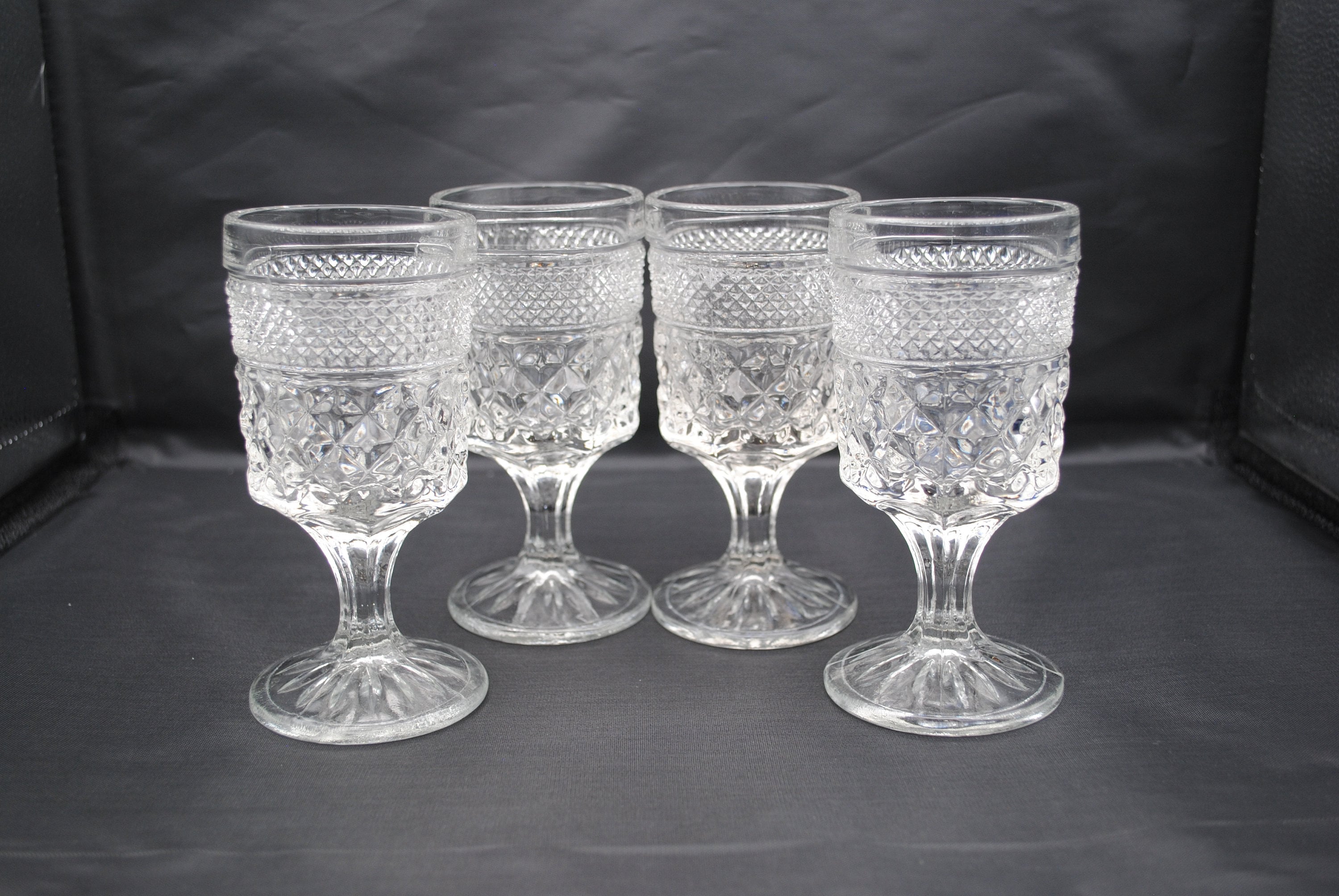
Walk into any thrift store in America, and I guarantee you'll see it. That chunky, diamond-patterned glass catching the fluorescent light from a bottom shelf. It’s heavy. It feels like it could survive a nuclear blast, or at least a very rowdy toddler's birthday party.
You’ve probably drank orange juice out of one at your grandmother's house without even realizing you were holding a piece of Mid-Century design history. We’re talking about Anchor Hocking Wexford glasses, the "workhorse" of American glassware that somehow managed to be both fancy and indestructible at the same time.
Honestly, it's kind of hilarious how ubiquitous this pattern is.
The Glass That Defined an Era
Anchor Hocking launched the Wexford line in 1967. They kept making it until 1998, which is a staggering 31-year production run. Most glassware patterns flicker out after five years. Wexford didn't just survive; it dominated.
Why? Because it hit the sweet spot between "I want my table to look like I have money" and "I need a glass that won't shatter if I look at it wrong."
The design is unmistakable. It’s got that dual-diamond vibe—tiny, sharp diamonds on the top half and much larger, bolder diamonds on the bottom. In between, there’s usually a smooth horizontal band or a series of vertical "criss-cross" cuts.
It was designed to mimic expensive lead crystal. Real crystal, like Waterford, is hand-cut and rings like a bell when you flick it. Wexford is "pressed glass." It’s made by pouring molten glass into a mold. It doesn't ring; it thuds. But under a dining room chandelier? It sparkles just as much as the expensive stuff.
A Ridiculous Variety of Pieces
If you think Wexford is just about water goblets, you're missing the bigger picture. Anchor Hocking went absolutely wild with this line. Collectors have identified over 130 different pieces.
You’ve got the basics:
- Water goblets (the big 6.5-inch ones)
- Iced tea glasses
- Juice glasses
- Wine and claret stems
But then it gets weirdly specific. There are Wexford decanters with massive plastic-ringed stoppers. There are butter dishes, candy jars, and punch bowls that could hold enough spiked eggnog to floor an entire neighborhood association. I once saw a Wexford toothpick holder at an estate sale in Ohio and wondered who, in 1974, decided their toothpicks needed to live in a diamond-encrusted fortress.
Is Wexford Actually Safe to Use?
This is a huge question in the vintage community right now. Everyone is terrified of lead.
The good news? Wexford is generally considered lead-free. Because it was mass-produced for the "everyman" and made of soda-lime glass rather than leaded crystal, it doesn't carry the same risks as that fancy decanter your great-aunt left you.
Many collectors have actually used XRF (X-ray fluorescence) scanners on these pieces. Results almost always show 0 ppm for lead. The "press lines"—the visible seams where the two halves of the mold met—are actually a good sign here. They indicate a manufacturing process that rarely involved lead.
Still, use your head. If you find a piece with a weird iridescent film or gold-painted rims, maybe stick to using it as a planter instead of a drinking vessel.
Identification: Don't Get Fooled by "Imposter" Glass
Not everything with a diamond pattern is Wexford. People often confuse it with "Miss America" or "Early American Prescut" (EAPC), also made by Anchor Hocking.
Here is the dead giveaway: The Band.
Wexford almost always has that distinct horizontal division. The top diamonds are significantly smaller than the bottom ones. If the diamonds are the same size all the way down, you're looking at something else.
Also, look at the base. Wexford glasses often have a starburst pattern on the bottom. It looks like a little sun exploding under your drink. If the bottom is plain, keep walking—or buy it anyway if it’s a dollar, I’m not the glass police.
The 2026 Collector's Market
Prices are weird right now. You can still find a set of four goblets for $20 at a garage sale, but on sites like Etsy, people are asking $50 or $60 for the same set.
Rarity is the name of the game.
- The Colors: Clear is common. If you find Wexford in "Pewter Mist" (a smoky gray) or "Royal Ruby," you’ve hit the jackpot.
- The "Unicorns": There are rumored prototypes, like the Wexford cocktail shaker, that barely made it to market.
- The Condition: Because these were daily drivers, they often have "dishwasher haze"—that cloudy, permanent fog. A crystal-clear, "mint" piece is worth significantly more to a serious collector.
How to Live With Your Wexford
If you're going to buy these, use them. They were built for it.
Don't put them in the dishwasher. Please. The heat and harsh detergents will eventually etch the glass, turning your beautiful sparkling goblet into a foggy mess that looks like it’s been sandblasted. Wash them by hand in warm soapy water.
They are the perfect "party glass." They have a heavy base, so they don't tip over easily when a guest gets a little too animated during a story. Plus, if one does break, you're out five bucks at the local thrift store, not $100 at a boutique.
Next Steps for Your Collection
If you're ready to start your own Wexford hoard, start by checking your local Goodwill or Habitat for Humanity ReStore. These are heavy pieces, so buying them online usually involves a shipping fee that costs more than the glass itself. Look for the "starburst" on the bottom to confirm the identity. If you're feeling ambitious, try to track down the 14-inch "Torte Plate"—it’s arguably the most beautiful piece in the entire collection and makes a killer centerpiece for a holiday dinner.