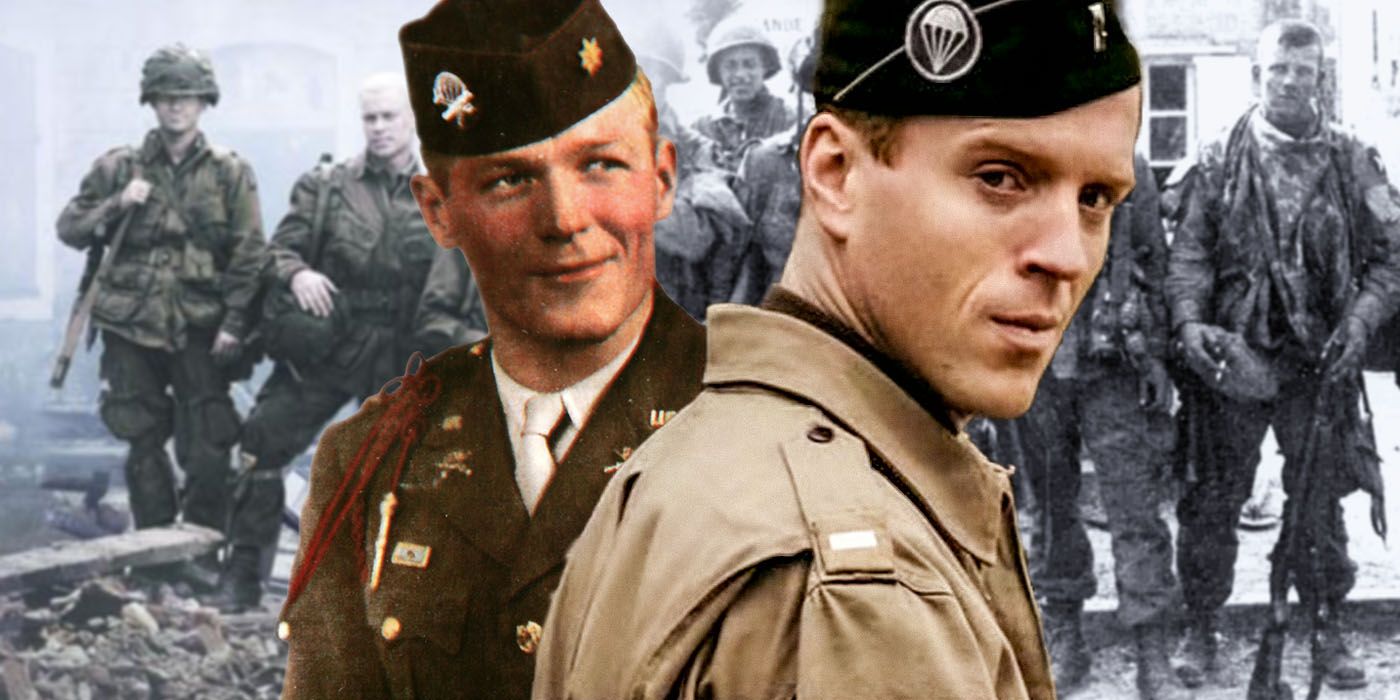
If you’ve watched Band of Brothers, you probably have a visceral reaction to the name Norman Dike. You remember the scene. It’s January 13, 1945. The snow is thick around the Belgian town of Foy. Men of Easy Company are shivering, waiting for the order to charge. Then there’s First Lieutenant Norman Dike. He freezes. He falls apart under fire. Captain Winters is screaming from the treeline, frantic, eventually sending in Ronald Speirs to take over.
It’s one of the most painful moments in the series. It paints Dike as a "political" officer, a coward, or maybe just a guy who was way out of his depth.
But here’s the thing. History is rarely as simple as a TV script.
The portrayal of Band of Brothers Lt Dike—famously nicknamed "Foxhole Norman"—has sparked decades of debate among World War II historians and veterans. Was he really the incompetent "empty suit" the show makes him out to be? Or did Stephen Ambrose and HBO do a massive disservice to a man who couldn't defend himself?
To understand Dike, you have to look past the shivering performance on screen. You have to look at the paperwork.
The Man Behind the "Foxhole Norman" Legend
Norman Dike wasn't some random kid who stumbled into the 101st Airborne. He was an Ivy League guy, an associate at a New York law firm before the war. That’s usually where the "political" label comes from. People assume he pulled strings.
He actually had a pretty solid record before he ever reached Easy Company.
Before the Bastogne campaign, Dike had already earned two Bronze Stars. You don't get those for hiding in a hole. One was for his actions in Holland during Operation Market Garden, and another for helping a wounded paratrooper under fire in a totally different engagement. Honestly, if you look at his record on paper, he looks like a hero.
So why did the men of Easy Company hate him so much?
Unit cohesion is a weird thing. Easy Company was a family. By the time Dike took over, they had lost Dick Winters to a promotion and "Buck" Compton to a mental breakdown. They were tired. They were freezing. And suddenly, they get this guy who doesn't talk to them. He was distant. He took frequent "trips" to battalion HQ, which the men interpreted as him being a coward or a sycophant.
But maybe he was just doing his job? Or maybe he was just a different kind of leader. Some veterans, like Clancy Lyall, were much harsher in their memoirs than others. It's a classic case of a "new boss" failing to vibe with a tight-knit crew that has already seen too much death.
The Disaster at Foy: Fact vs. Fiction
The center of the Band of Brothers Lt Dike controversy is the assault on Foy.
In the show, Dike halts the attack in the middle of a wide-open field because he panics. He stays behind a haystack. He can't make a decision. Winters is forced to relieve him on the spot.
In reality, something much more physical might have happened.
According to some accounts, including statements from those present, Dike was actually wounded in the shoulder during the assault. Imagine trying to coordinate a multi-pronged infantry attack while a German sniper just put a hole in your collarbone. You might "freeze" too. Or you might just be in shock.
The show completely ignores the wound.
Why? Because the narrative needs a foil. For the story of Easy Company to work, they need a leader who fails so that Speirs can look like a god when he runs through the German lines. It’s good television. It’s just not necessarily good history.
What the official records say
If you dig into the after-action reports, the language is dry. It doesn't mention a "breakdown." It mentions a transfer.
Dike didn't leave the Army in disgrace after Foy. He didn't get court-martialed. He was actually moved to 506th Headquarters and later became an aide to General Taylor. Later in life, he even stayed in the military, eventually reaching the rank of Lieutenant Colonel in the U.S. Army Reserve.
That doesn't sound like a man who was broken by a single day in the snow.
The Stephen Ambrose Problem
We have to talk about the source material. Stephen Ambrose wrote the book Band of Brothers based heavily on oral histories.
Oral history is great for "flavor," but it sucks for objective truth.
When Ambrose interviewed the veterans in the 1980s and 90s, they were old men looking back on their youth. They remembered the guys they loved (Winters, Guarnere, Toye) and they remembered the guys they didn't. Dike was an outsider. He was the "legal" guy. He wasn't one of the Toccoa originals.
The veterans told Ambrose that Dike was useless. Ambrose wrote it down. HBO filmed it.
The result? A man's entire legacy was defined by the worst 20 minutes of his life, filtered through the eyes of men who already disliked him.
Was he actually incompetent?
Let's be fair. Even if he wasn't a coward, Dike might have been a bad fit for Easy.
Some officers are great at staff work and terrible at leading "line" companies. Easy Company was a high-performance machine. They needed a leader who was aggressive, someone who would lead from the front. Dike’s style was more methodical, more "by the book."
In the chaos of the Ardennes, "by the book" gets people killed.
You’ve got to wonder if the stress of Bastogne simply broke him. It broke almost everyone. "Buck" Compton, one of the toughest guys in the unit, hit his limit. Why do we give Compton grace for his "shattered" nerves but crucify Dike for his?
Maybe because Compton was "one of the boys" and Dike wasn't.
A different perspective on the "trips"
Remember those "trips" to HQ that the men mocked?
Some historians suggest Dike was actually trying to secure more support for his men. He was trying to get more artillery, more supplies, more clarity on the mission. Easy Company saw a guy leaving the front line. Dike might have seen an officer trying to use his connections to keep his men alive.
It's all about perspective.
The Aftermath of the Show
When the series aired in 2001, Norman Dike had been dead for 12 years. He died in Switzerland in 1989. He never got to see how he was portrayed. He never got to sit for a "sidebar" interview like Winters or Lipton.
His family, understandably, was devastated.
Imagine being the child of a war veteran, knowing your dad won two Bronze Stars and a Silver Star (yes, he reportedly earned a Silver Star later), only to see him turned into a punchline on a global TV show.
It highlights the danger of "historical fiction." We feel like we know these men because we've binged the series ten times. We feel like we were there in the foxholes with them. But we weren't. We were watching an interpretation.
Moving Beyond the TV Screen
So, how should we actually view Band of Brothers Lt Dike?
First, stop calling him a coward. The word is heavy, and the evidence doesn't support it. You don't jump out of C-47s into occupied France and Holland if you're a coward.
Second, acknowledge the nuance. He was likely an officer who was overwhelmed by a specific, high-intensity command. He was a staff officer in a combat officer's boots. That's a failure of the Army's placement system, not necessarily a failure of his character.
Third, recognize that the "Easy Company" perspective is just one lens. They were an elite unit with incredibly high standards. To them, anyone who wasn't Dick Winters was a disappointment.
Actionable Insights for History Buffs
If you're a fan of the series and want to get the full story on the men of the 101st, don't stop at the HBO show.
- Read the memoirs of other units. Check out the accounts from the 501st or the 502nd. They had their own "Dikes" and their own "Speirs." It rounds out the picture of the Battle of the Bulge.
- Look for the After Action Reports (AARs). Many of these are now digitized. They give you the cold, hard facts of who was where and when they were wounded.
- Visit the 101st Airborne Division Museum. If you're ever in Bastogne, the museum there provides a much broader context of the siege than the show can provide in one episode.
- Question the "Villain" edit. Whenever a historical drama has a clear-cut villain who isn't a Nazi, ask yourself why. Usually, it's to make the hero's journey more dramatic.
The story of Norman Dike is a reminder that history is written by the survivors, and sometimes, those survivors have a grudge. Dike wasn't a perfect leader. He might not have even been a "good" one for the men of Easy Company. But he was a man who served, who was wounded, and who deserved more than to be remembered as the guy hiding behind a haystack.
To truly honor the "Band of Brothers," we have to honor the truth—even when it's not as cinematic as we want it to be.
Next Steps for Deepening Your Knowledge
To get a more balanced view of the leadership during the Bastogne campaign, research the career of Colonel Robert Sink. He was the man who oversaw the entire 506th and was the one who actually made the decisions on which officers were promoted and which were moved to staff positions. Understanding his pressures helps explain why men like Dike were placed in command roles to begin with. You can also look into the "missing" Bronze Star citations for Dike, which provide a stark contrast to his performance in the "The Breaking Point" episode.