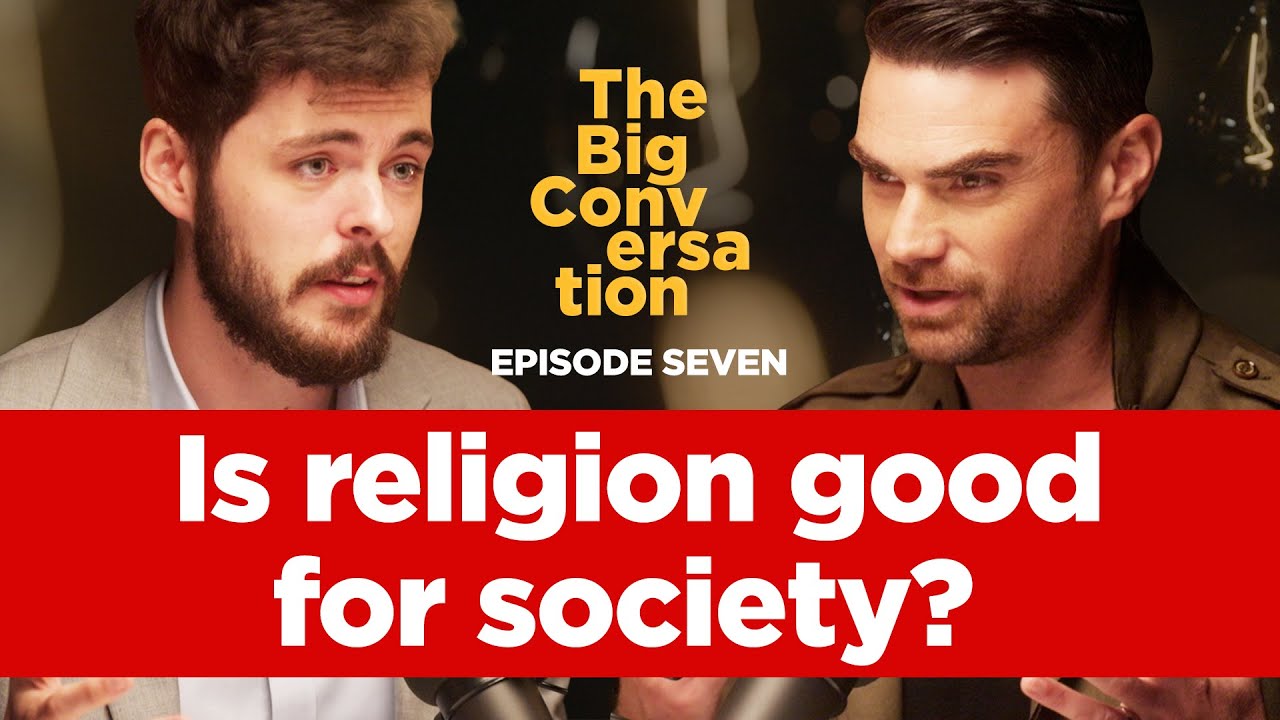
If you’ve spent any time on the "intellectual" side of YouTube lately, you’ve probably seen the thumbnails. Ben Shapiro, the fast-talking conservative titan, sitting across from Alex O’Connor, the calm, razor-sharp philosopher formerly known as CosmicSkeptic. It’s a matchup that, on paper, looks like a collision of two completely different worlds. One is a religious Jew deeply rooted in traditionalism; the other is a British atheist who built a career on deconstructing theology with surgical precision.
But honestly? Their interactions—especially their massive debate on The Big Conversation—are some of the most fascinating pieces of content to come out of the culture wars in years.
It wasn't just a shouting match. In fact, it was the opposite. While most political commentary these days feels like people yelling at a wall, the Ben Shapiro Alex O’Connor dialogue actually managed to drill down into the stuff that keeps people up at night. Things like: Does free will actually exist? Can you be "good" without a God watching over your shoulder? Is religion just a useful lie we tell ourselves so society doesn't collapse into a pile of nihilistic dust?
Let’s get into what really happened, why people are still obsessed with it, and what it says about where we’re at in 2026.
The Free Will Trap: Why Shapiro and O'Connor Can't Agree
The debate usually starts here because, basically, everything else builds on it. Shapiro’s argument is pretty straightforward, though it’s more about "utility" than pure evidence. He argues that for a society to function, we have to believe in free will. If we're just "meat computers" or "atoms in motion," then nobody is responsible for anything. Why punish a criminal if they were physically destined to commit the crime from the moment of the Big Bang?
Ben's point is that a materialistic universe—the one Alex believes in—doesn't have a spot for a "soul" or a "self" that makes independent choices.
Alex O’Connor doesn't flinch at this. He’s an "incompatibilist." He argues that our choices are either determined by prior causes (like biology and environment) or they’re random. Neither of those options equals "free will" in the traditional sense. He famously pointed out that while we feel like we’re making choices, that feeling doesn't change the underlying physics.
"I happen to be in the happy position of being able to argue that what I think is socially useful also happens to be true," Shapiro remarked during their exchange.
But Alex pushed back with a question that really stuck: If free will is an illusion, is it a good thing to lie to ourselves? He basically called Ben out for wanting to "ground" morality in something that might not even be real, just because it makes us behave better.
Is Religion Just a "Social Glue"?
This is where the Ben Shapiro Alex O’Connor dynamic gets spicy. Ben isn't just arguing that God is real; he’s arguing that religion is the only thing keeping the West from falling apart. He points to Judeo-Christian values as the bedrock of everything we value—human rights, equality, and the idea that every individual has inherent worth.
Without that religious "anchor," Ben thinks we just end up making up our own rules, which usually ends in disaster.
Alex, on the other hand, thinks that's a bit of a cop-out. He argues that we can find reasons to be good without needing a divine supervisor. He’s big on the idea that if your morality is based only on what a book says, you can’t actually be reasoned with. If someone thinks God told them to do something "bad," and they don't value secular reason, how do you talk them out of it?
One of the most viral moments happened when they discussed slavery in the Bible. Alex trapped Ben in a bit of a logical corner. If God is the source of objective morality, and the Bible contains rules for how to treat slaves, does that mean slavery was "objectively moral" back then? Ben’s response—that God was "wooing" people away from sin gradually—felt a bit weak to many viewers. It led to Alex's famous retort: "Who’s the moral relativist now?"
Why This Debate Specifically Went Viral
You’ve seen the clips. The reason this particular pairing works so well is the contrast in styles.
- Ben Shapiro: High-energy, data-driven, focused on the "macro" impact on society. He’s looking at the forest.
- Alex O’Connor: Slow, methodical, focused on the "micro" logic of an argument. He’s looking at the individual trees.
Most people who debate Shapiro try to beat him at his own game—talking fast and throwing out stats. Alex didn't do that. He just asked very, very simple questions that forced Ben to slow down. It was a masterclass in "steel-manning"—understanding your opponent's argument so well that you can argue it better than they can before you tear it down.
The "Within Reason" Follow-Up
They didn't just stop at one debate. Alex eventually appeared on The Ben Shapiro Show, and they’ve continued the conversation on Alex's podcast, Within Reason.
What’s interesting is that they actually agree on a lot more than you’d think. Both are deeply concerned about the "meaning crisis" in the modern world. They both see that young people are struggling to find a reason to wake up in the morning in a world that feels increasingly hollow and digital.
The disagreement isn't about whether we need meaning; it's about where that meaning comes from. Is it "discovered" through revelation and tradition (Ben), or is it "constructed" through reason and personal agency (Alex)?
Key Arguments Table (Prose Version)
Instead of a boring table, let's just break down the core disagreements.
On the topic of Objective Morality, Shapiro believes it must come from a transcendent source—basically, God. Without God, he says "murder is wrong" is just an opinion, like "broccoli is gross." O'Connor argues that we can use reason to realize that certain actions (like causing suffering) are objectively bad for conscious beings, no burning bush required.
When it comes to The Value of Religion, Shapiro sees it as the ultimate check on the "evils of the human heart." He thinks people are naturally inclined toward self-interest and need a higher law to keep them in check. O'Connor counters that religion often justifies those "evils" by giving them a divine stamp of approval. He’d rather trust a human who thinks for themselves than one who follows orders.
What Can We Learn From Them?
Look, you don't have to pick a side to get something out of the Ben Shapiro Alex O’Connor saga. The real value is in the way they disagree. In an era of "deplatforming" and "cancel culture," seeing two people with fundamentally different worldviews sit down for two hours and actually listen to each other is... kinda rare?
It’s a reminder that you can be intellectually rigorous without being a jerk.
Actionable Takeaways for Your Own Life
If you’re watching these debates and wondering how to apply this to your own world, here’s what I’d suggest.
1. Identify Your "Foundational" Beliefs
Everyone has them. Whether you're religious, an atheist, or something in between, you have a set of "first principles" that you take on faith. Maybe it's the idea that human life is valuable, or that science is the only way to find truth. Try to name them. It makes your own thinking a lot clearer.
2. Learn to "Steel-man"
The next time you’re in a disagreement, try to state the other person's position so well that they say, "Yeah, that’s exactly what I think." It’s the fastest way to actually get somewhere in a conversation instead of just talking past each other.
3. Accept the Dissonance
As Alex O’Connor pointed out, sometimes what is "useful" and what is "true" aren't the same thing. You might find that believing in a certain idea makes you happier, even if you can't prove it's 100% factual. Being okay with that tension is a sign of intellectual maturity.
4. Check Your Sources
Don't just watch the 30-second "Shapiro DESTROYS Atheist" clips. Go watch the full 2-hour episodes on the Premier Unbelievable YouTube channel or listen to the full Within Reason episodes. The nuance is where the real growth happens.
At the end of the day, the Ben Shapiro Alex O’Connor debates aren't just about winning an argument. They're about the age-old struggle to figure out how to live a good life in a complicated world. Whether you walk away more convinced of God or more certain of your own reason, the fact that you're thinking about it at all means they've done their job.