You probably think you know the capitals of all the states. Or at least, you think you could pass a fifth-grade quiz on them if someone put a gun to your head. But honestly? Most of us are walking around with a mental map that’s totally broken. We assume the biggest, flashiest city in a state is the boss. It’s not.
New York City? Nope, it’s Albany.
Chicago? Try Springfield.
Las Vegas? Not even close—Carson City takes the trophy.
It’s weird. Why would we put the seats of power in places that feel like afterthoughts? Usually, it was about geography, back when "geography" meant how far a guy could ride a horse in a single day. Legislators wanted to be in the middle of everything so no one had to trek three weeks through a swamp just to vote on a tax bill. Other times, it was a literal bribe. Cities fought tooth and nail, promising land and fancy buildings just to get that "capital" title. They knew the government would bring jobs, hotels, and clout.
The geography of the capitals of all the states is a total mess
If you look at a map of the capitals of all the states, you’ll notice a pattern of intentional isolation. Take Juneau, Alaska. You literally cannot drive there. There are no roads connecting Juneau to the rest of the North American road system. You fly in, or you take a boat. It’s one of the most isolated political hubs on the planet. This happened because back in 1906, the government moved the capital from Sitka to Juneau because of the gold rush and the burgeoning fishing industry. Now, it’s a beautiful, mountainous trap for politicians.
Then you’ve got the "Centrality Obsession."
In the 1800s, state planners were obsessed with the geometric center. They’d take a compass, find the dead middle of the state, and plop a building there. That’s how you get Jefferson City, Missouri. It’s halfway between St. Louis and Kansas City. It was a compromise. Neither of the big cities wanted the other to have the power, so they gave it to a small town on a bluff overlooking the Missouri River. It’s a classic "if I can’t have it, nobody can" move that defined how we organized our country.
Some of these cities are actually tiny
We think "Capital" and we think "Metropolis." Wrong.
Montpelier, Vermont, has fewer than 8,000 people. It’s the smallest state capital in the U.S. There isn’t even a McDonald’s there. Seriously. It’s the only state capital without the Golden Arches. You go there and it feels like a movie set for a cozy mystery novel, not a place where major legislation happens. Compare that to Phoenix, Arizona, which is a massive sprawling desert titan with over 1.6 million people. The scale is just completely broken.
Why big cities usually lose the capital race
It’s mostly about fear. Back in the day, rural farmers and frontiersmen absolutely hated big cities. They viewed places like Philadelphia or New York as dens of sin and corruption. They didn't want the state government "polluted" by the interests of wealthy merchants and urban mobs.
So, they moved.
Pennsylvania moved its capital from Philadelphia to Lancaster, and then finally to Harrisburg in 1812. Why? To get away from the British during the war, sure, but also to satisfy the folks living in the western part of the state who felt ignored. This happened everywhere.
- Tallahassee, Florida: Chosen because it was halfway between Pensacola and St. Augustine, the two biggest hubs at the time.
- Sacramento, California: It beat out San Francisco and San Jose during the Gold Rush because it was the gateway to the mines and felt more "connected" to the new wealth.
- Olympia, Washington: It stayed the capital even when Seattle exploded in size, mostly because the infrastructure was already built and moving it is a bureaucratic nightmare.
The deep dive into the 50 state capitals
Let's just look at the list. It's a mix of household names and "wait, where?" locations.
Alabama has Montgomery. It’s the birthplace of the Civil Rights Movement, specifically the 1955 bus boycott. Then you jump over to Alaska with Juneau. Arizona has Phoenix, which is one of the few that actually makes sense by modern standards. Arkansas gives us Little Rock. California has Sacramento, a city that feels very different from the beachy vibes of LA or the tech hills of San Francisco.
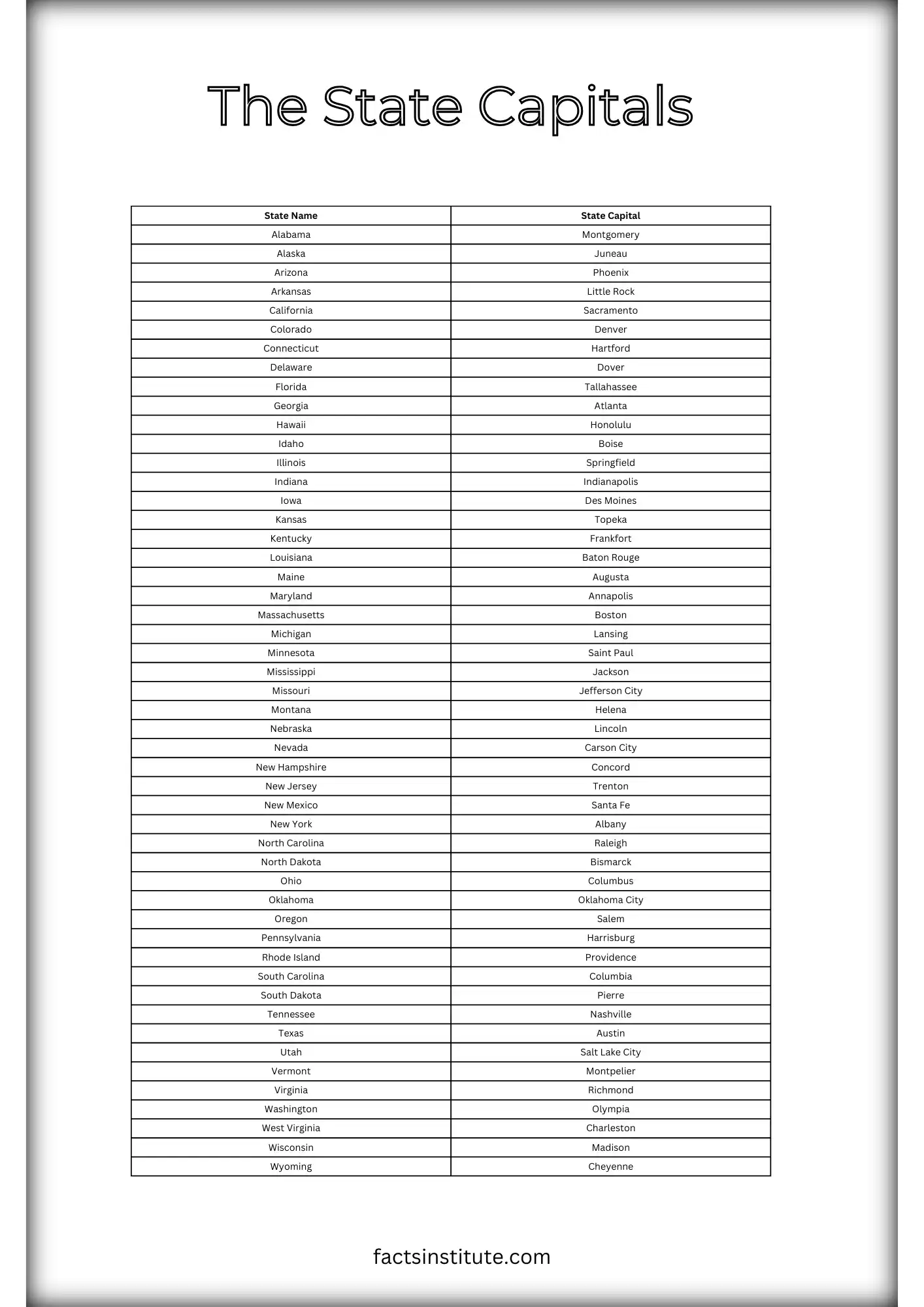
Colorado is Denver—the Mile High City. Connecticut is Hartford, once the "Insurance Capital of the World." Delaware has Dover. Florida is Tallahassee. Georgia is Atlanta. Hawaii is Honolulu. Idaho is Boise. Illinois is Springfield (Abraham Lincoln's home). Indiana is Indianapolis. Iowa is Des Moines. Kansas is Topeka. Kentucky is Frankfort. Louisiana is Baton Rouge. Maine is Augusta. Maryland is Annapolis (the "Sailing Capital"). Massachusetts is Boston. Michigan is Lansing. Minnesota is St. Paul. Mississippi is Jackson. Missouri is Jefferson City. Montana is Helena. Nebraska is Lincoln. Nevada is Carson City. New Hampshire is Concord. New Jersey is Trenton. New Mexico is Santa Fe (the highest elevation capital at 7,000 feet). New York is Albany. North Carolina is Raleigh. North Dakota is Bismarck. Ohio is Columbus. Oklahoma is Oklahoma City. Oregon is Salem. Pennsylvania is Harrisburg. Rhode Island is Providence. South Carolina is Columbia. South Dakota is Pierre. Tennessee is Nashville (Music City). Texas is Austin. Utah is Salt Lake City. Vermont is Montpelier. Virginia is Richmond. Washington is Olympia. West Virginia is Charleston. Wisconsin is Madison. Wyoming is Cheyenne.
That's the roster. Each one has a specific reason for existing where it does.
Breaking down the biggest misconceptions
One of the funniest things is how people get the "Twin Cities" wrong. In Minnesota, Minneapolis is the big brother with the skyscrapers and the sports teams. But St. Paul is the capital. They’re right next to each other, separated by the Mississippi River, but they have totally different vibes. St. Paul is older, more "European," and much quieter.
And then there's the Texas situation. Austin is the capital. People love Austin. It’s the "Live Music Capital of the World." But for a long time, it was just a small dusty town while Houston and Dallas were the real power players. The only reason it stayed the capital is because Sam Houston (the guy the other city is named after) failed to move the archives out of Austin during the "Archive War." The locals literally fired a cannon to stop the government from moving. Talk about commitment.
The weirdest capital facts you didn't know
Most people don't realize that Boston is the only state capital with a coastline that is also the state's largest city and has a colonial-era layout. Most other coastal states tucked their capitals inland to protect them from naval invasions. Think about it.
Richmond isn't on the ocean.
Albany isn't on the ocean.
Trenton isn't on the ocean.
They were scared of the British Navy.
Another weird one? Pierre, South Dakota. You pronounce it like "Pier," not the French "Pee-air." If you say it the French way, the locals will immediately know you’re a tourist. It’s also one of the hardest capitals to get to because it’s not on a major interstate. You have to want to go to Pierre.
Why we should care about these cities in 2026
In a world where everything is becoming digital and decentralized, these physical hubs still matter. This is where the laws that actually affect your life—property taxes, school funding, driving laws—get signed. While everyone is looking at Washington D.C., the state capitals are where the real "boring" work that keeps society running happens.
They are also incredible travel destinations if you're tired of the typical tourist traps.
If you visit Santa Fe, you're seeing the oldest state capital in the United States, founded in 1610. The architecture is strictly regulated to keep that Pueblo style. It doesn't feel like a government hub; it feels like an art colony. Or go to Madison, Wisconsin. It’s built on an isthmus between two lakes. The capitol building there is actually modeled after the one in D.C., but they made it just a tiny bit shorter so it wouldn't "disrespect" the national one. But inside? It’s arguably more beautiful, with hand-carved wood and insane stonework.
How to actually memorize the capitals of all the states
If you're trying to learn these, don't just stare at a list. It’s boring and your brain will reject it. Use the "Story Method."
Link the city to something famous.
- Kentucky: Imagine a Frankfurter (Frankfort).
- Idaho: Imagine a Boy (Boise) eating a potato.
- Arizona: Imagine a Phoenix rising from the desert heat.
It sounds dumb, but it works. Another trick is to group them by "Misleading Big Cities." Make a list of all the states where the biggest city isn't the capital. That covers the hardest ones like New York, Illinois, Florida, and Pennsylvania. Once you clear those hurdles, the rest usually fall into place.
Actionable Steps for the Curious Traveler or Student
If you want to actually experience the capitals of all the states, don't just look at them on a screen. Here is how to actually engage with them:
- Take a Capitol Tour: Most state capitols offer free tours. The architecture is usually the best in the state, featuring marble, murals, and history you won't find in a textbook.
- Check the "Old" Capitals: Many states moved their seats of power. Visiting places like Guthrie, Oklahoma (the original capital before Oklahoma City) gives you a weird "ghost town" vibe of what could have been.
- Verify the Pronunciation: Before you go, look up how the locals say it. It’s "Arkans-saw" for the state, but "Little Rock" is easy. However, "Concord" (New Hampshire) is said like "Con-kerd," not "Con-cord."
- Focus on the Geography: Notice how many capitals are on rivers. In the 1800s, water was the only way to move heavy stuff. Almost every major capital sits on a waterway that allowed for trade and communication.
- Use State Parks: Many capitals were built near beautiful natural landmarks because the land was cheap or government-owned. Use the trip to see the local landscape, not just the granite buildings.
The capitals of all the states represent a weird, messy, beautiful history of how America was pieced together. They aren't just names on a map; they are the result of political bickering, geographical necessity, and a whole lot of horse-and-buggy logic that still dictates how we live today.