Christopher Hitchens didn't just die. He didn't "pass away" or "go to a better place." He vanished.
In June 2010, while on a high-octane book tour for his memoir Hitch-22, the man known for his razor-sharp tongue and even sharper pens was suddenly "deported" from the land of the well. He woke up in a New York hotel room feeling like he was "shackled to his own corpse." That is how it started. A few scans later, and the diagnosis was in: esophageal cancer.
For a man who lived by his voice, the irony was cruel. Stage four.
Christopher Hitchens on mortality wasn't a theoretical exercise or a late-night debate over scotch. It was a physical, grueling reality. Most people, when faced with the "big exit," look for comfort. They reach for the divine or soften their edges. Not Hitch. He doubled down.
The Country of Malady
Hitchens famously described his transition from health to terminal illness as a forced migration. One day you’re a citizen of the world, and the next, you’re a resident of "Tumorland." It’s a place with its own customs, its own language of "mets" and "oncology," and its own weird etiquette.
He hated the "battle" metaphors. You know the ones. "He’s a fighter." "She’s lost her battle with cancer."
To Hitchens, this was nonsense.
When you’re sitting in a cold room with a bag of poison—chemotherapy—dripping into your arm, you aren't a soldier. You’re a sugar lump dissolving in water. You’re passive. You’re being acted upon. He found the idea that "fighting spirit" could cure a biological mutation to be a form of victim-blaming. If you die, does that mean you didn't fight hard enough?
Honestly, he found the whole thing boring. Banal.
The Loss of the Voice
The most devastating blow wasn't the pain. It was the "silencing."
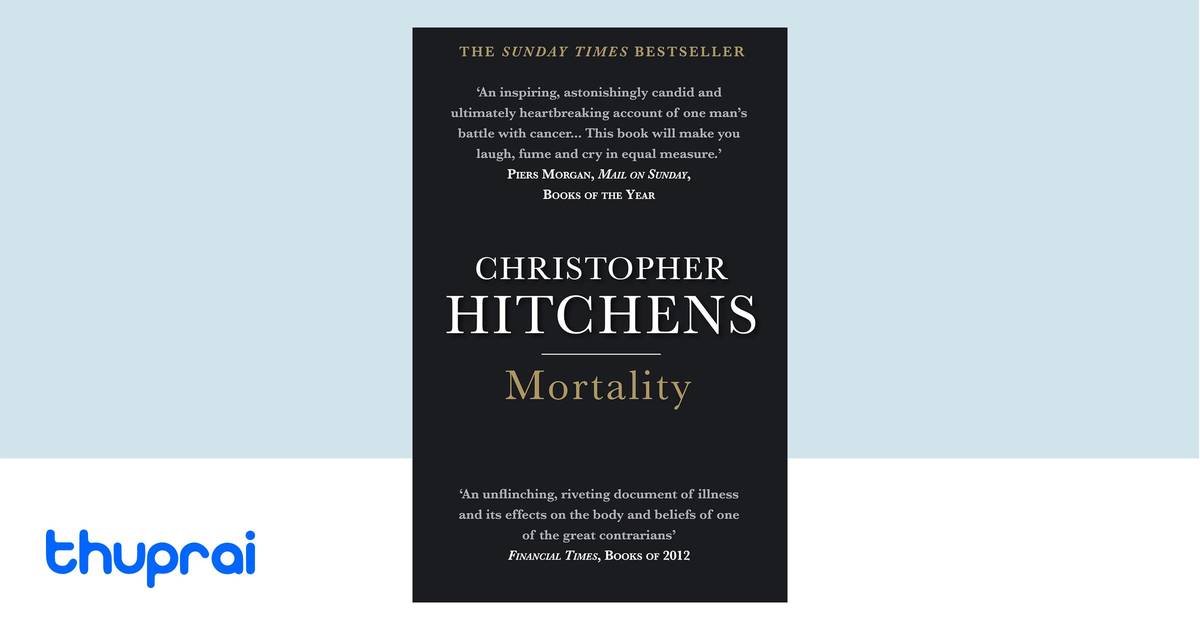
Hitchens was his voice. In his final essays, later collected in the book Mortality, he wrote about the horror of his voice turning into a "childish piping squeak." For a polemicist who thrived on the "cut and thrust" of public debate, losing the ability to project was like an amputation. It was a loss of self.
He once said, "I don't have a body, I am a body."
This is the core of his materialist philosophy. There is no "soul" floating around inside that will survive the wreckage. When the lungs fail and the throat closes, the person—the wit, the memory, the argument—simply ceases to be.
Why "What Doesn't Kill You" Is a Lie
We’ve all heard the Nietzsche quote: "What does not kill me makes me stronger."
Hitchens called BS.
In the world of stage four cancer, what doesn't kill you often leaves you weaker, more depleted, and less able to face the next round. It "etiolates" you. It stretches you thin. He argued that this kind of hollow optimism is actually a way for healthy people to feel better about the suffering of others.
He didn't want your pity. He definitely didn't want your prayers.
The Prayer Offensive
One of the strangest things about Christopher Hitchens on mortality was how the public reacted to it. Some religious groups organized "Pray for Hitchens" days. Others, more maliciously, expressed glee at his impending "judgment."
He found both sides fascinating and slightly ridiculous.
To those praying for his recovery, he asked: "Which mere primate is so damn sure that he can know the mind of God?"
He saw prayer as a form of arrogance—the idea that you can tell the creator of the universe that He’s got His plans wrong and should change them specifically for you. He remained a "firm" atheist until the very end, even warning people that if a deathbed conversion were ever reported, it would be the work of a "terrified, half-aware imbecile" and not the man he actually was.
The "Why Me?" Question
When people asked him if he ever felt like shouting "Why me?" at the universe, his response was pure, vintage Hitch:
"Why not?"
The cosmos doesn't care about your lifestyle, your books, or your politics. Almost all men will get prostate cancer if they live long enough. It's just biology. It's random.
Actionable Insights from a Dying Man
So, what do we actually do with this? Hitchens didn't leave a "how-to" guide for dying, but he did leave a blueprint for living with the end in mind.
- Write as if posthumously. He believed you should say what you mean now. Don't wait for a "safe" time to be honest.
- Reject the "battle" narrative. If you or someone you love is sick, drop the pressure to be a "warrior." It's okay to just be a patient. It's okay to feel powerless.
- Value the conversation. Until his very last weeks, Hitchens hosted friends, drank (smaller amounts of) wine, and talked. Conversation is the primary human joy.
- Trust the science, not the superstition. He spent his final months in the care of doctors like Francis Collins—an evangelical Christian, ironically—because he trusted the medicine, even if he disagreed on the metaphysics.
Facing the Party's End
Hitchens had a famous metaphor for death. He said it’s like being at a party. You’re having a great time, the drinks are flowing, the talk is good. Then, someone taps you on the shoulder and says you have to leave.
The worst part isn't that you're leaving.
The worst part is that the party is going on without you.
But consider the alternative. Imagine a party that never ends. You can't leave. The host insists you stay forever. That, he argued, would be hell. The fact that life is finite is exactly what gives it its "lovely light."
If you want to understand the man better, read his final essays in Mortality. Watch his last interview with Richard Dawkins. Don't look for a miracle. Look for the dignity of a man who refused to blink.
Next Steps for Deeper Insight:
- Read the full text of Mortality by Christopher Hitchens for the unedited essays.
- Compare his views with Anatole Broyard’s Intoxicated by My Illness to see how different intellectuals handle the "Country of Malady."
- Watch the 2011 interview with Jeremy Paxman, filmed when Hitchens was visibly frail but still mentally sharp.