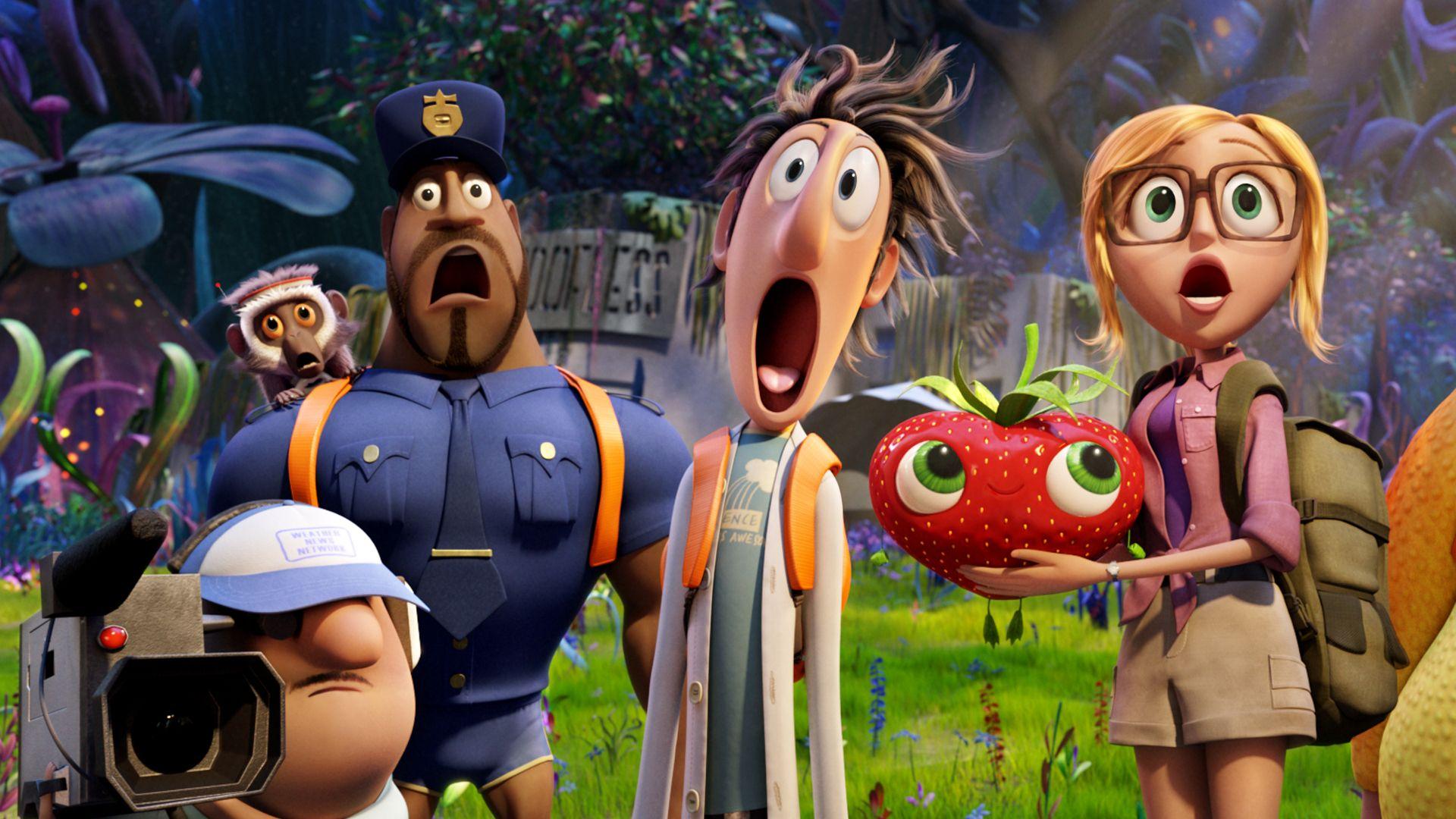
Honestly, the first time you hear the premise of Cloudy with a Chance of Meatballs, it sounds like a fever dream. Food falling from the sky? A monkey wearing a thought-translator? It’s a lot to take in. But whether you’re looking at the original 1978 picture book by Judi and Ron Barrett or the high-octane Sony Pictures Animation film from 2009, there is something weirdly enduring about this story. It isn't just a kids' movie about giant pancakes hitting a school. It’s actually one of the smartest satires of disaster cinema ever made.
People still talk about it. Why? Because it captures that specific, frantic energy of "too much of a good thing." We live in a world of excess, and seeing a town buried in Jell-O or crushed by a massive corn cob feels oddly prophetic, even if it's dressed up in neon colors and slapstick humor.
The Flint Lockwood Effect: More Than Just a Mad Scientist
Flint Lockwood isn’t your typical protagonist. He’s chaotic. He’s desperate for approval. Bill Hader’s vocal performance gave Flint a jittery, mile-a-minute personality that perfectly matched the "A-frame" animation style. The creators, Phil Lord and Chris Miller—who later went on to do The LEGO Movie and Spider-Verse—basically reinvented how animated characters move. They ditched the realistic, fluid motion of Disney for something "snappy." It feels like a comic book coming to life.
The movie works because it focuses on a universal struggle: wanting to be seen. Flint wants his dad, Tim Lockwood, to be proud of him. Tim, a man of few words and even fewer facial expressions, just wants Flint to work at the family bait shop. It’s a classic generational divide. One man speaks in fishing metaphors; the other speaks in "scientific" gibberish. This emotional core is what keeps the movie from being just a series of food puns. Without that heart, the giant meatballs would just be… giant meatballs.
The Science (or Lack Thereof) Behind the FLDSMDFR
Let’s talk about the machine. The Flint Lockwood Diatonic Super Mutating Dynamic Food Replicator. Or the FLDSMDFR.
In the story, Flint hooks the machine up to a power plant, and it accidentally shoots into the stratosphere. It starts turning water vapor into food. Now, if you look at the actual physics—which, let's be real, we shouldn't—the amount of energy required to mutate molecular structures from $H_2O$ into complex proteins like cheeseburgers is astronomical. But the movie doesn't care. It leans into the "rule of cool."
What’s interesting is how the food evolves. As the machine gets "mutated" by the town’s greed, the food gets bigger and more sentient. We see "food-animal" hybrids in the sequel, but even in the first film, there’s a sense that the atmosphere is becoming a biological hazard. It’s a colorful take on environmental collapse.
Why the Animation Style Changed Everything
Before 2009, most big-budget animation was trying to look "real." Think of the fur textures in Monsters, Inc. or the water in Finding Nemo. Sony Pictures Animation took a hard left turn with Cloudy with a Chance of Meatballs. They embraced "squash and stretch."
If a character gets surprised, their eyes don't just widen; they take up half their face. When Flint runs, his legs become a blur of lines. This "cartoonishness" allowed the filmmakers to push the visual jokes further than a "grounded" style would allow. It’s a style that has since influenced almost every major non-Disney animated project in the last decade. It’s messy. It’s loud. It’s visually exhausting in the best way possible.
The Disaster Movie Tropes You Might Have Missed
If you rewatch the film today, you'll realize it is a beat-for-beat parody of Roland Emmerich movies like Independence Day or The Day After Tomorrow.
- The Weather Map: Sam Sparks, the weather intern, uses the same high-stakes graphics you’d see in a global warming thriller.
- The National Guard: They treat a spaghetti tornado with the same gravity as a nuclear threat.
- The Hero’s Journey: Flint has to fly into the "eye of the storm" (the giant meatball) to plug in a kill code.
It’s brilliant because it plays the tropes straight. The stakes feel high even though the threat is literally brunch. When the "Spaghetti Tornado" hits Swallow Falls, the music is booming and the cinematography is sweeping. It treats the absurdity with total sincerity. That’s the secret sauce.
The Legacy of Swallow Falls
The town itself, Swallow Falls (later renamed Chewandswallow), is a character. It starts as a depressing, "gray" town that only eats sardines. The arrival of the FLDSMDFR brings color, but it also brings corruption. The Mayor, voiced by the legendary Bruce Campbell, becomes a gluttonous villain who ignores the warnings for the sake of tourism dollars.
Sound familiar? It’s a critique of short-term thinking.
Does it hold up in 2026?
Actually, yeah. The humor is fast. It doesn't rely on pop-culture references that date it (looking at you, Shrek). Instead, it relies on physical comedy and character-driven wit.
One of the most underrated parts of the movie is the relationship between Flint and Sam Sparks. Sam is a genius who hides her intelligence because she wants to be "pretty" and "accepted" as a weather reporter. Flint’s realization that she’s cooler when she’s being a nerd is a genuinely sweet subplot. It’s a message that actually sticks.
What You Can Learn from Flint Lockwood
If there’s any takeaway from the chaos of Cloudy with a Chance of Meatballs, it’s about the ethics of invention. Flint didn't set out to destroy the world; he just wanted to make people happy. But he ignored the "red zone" on his machine. He ignored the data because the feedback (the burgers) felt too good.
In the real world, we deal with this constantly. New tech comes out, we love the convenience, and we ignore the "glitch" until it's a tornado.
Actionable Steps for Fans and Creators
If you’re a fan of the franchise or an aspiring creator, there are a few ways to engage with the themes of this story beyond just rewatching the movie.
- Study the Animation Style: If you're into digital art, look up "Smear Frames." The Cloudy films are famous for them. It’s a technique where you draw a distorted version of a character to imply fast movement. It’s a masterclass in stylized motion.
- Explore the Original Book: Go back to the 1978 Judi Barrett book. It’s a much quieter, more surreal experience. The art style is cross-hatched and detailed, vastly different from the neon movie. It’s a great study in how to adapt a simple concept into a complex narrative.
- Analyze the Satire: Watch a "serious" disaster movie like Twister and then watch Cloudy immediately after. You’ll see exactly which shots Lord and Miller were poking fun at. It’s a great way to learn about cinematography and genre tropes.
- Consider the Environmental Subtext: Use the film as a starting point to talk about food waste and overconsumption. While the movie is a comedy, the visual of a town buried in "leftovers" is a pretty potent metaphor for the modern world's waste problem.
The beauty of Cloudy with a Chance of Meatballs is that it doesn't try to be a "preachy" movie. It’s a riotous, colorful, often ridiculous adventure that happens to have a brain. It’s about a guy, a monkey, and a girl in a lab coat trying to stop a giant meatball from crushing their home. Sometimes, that’s all a story needs to be.