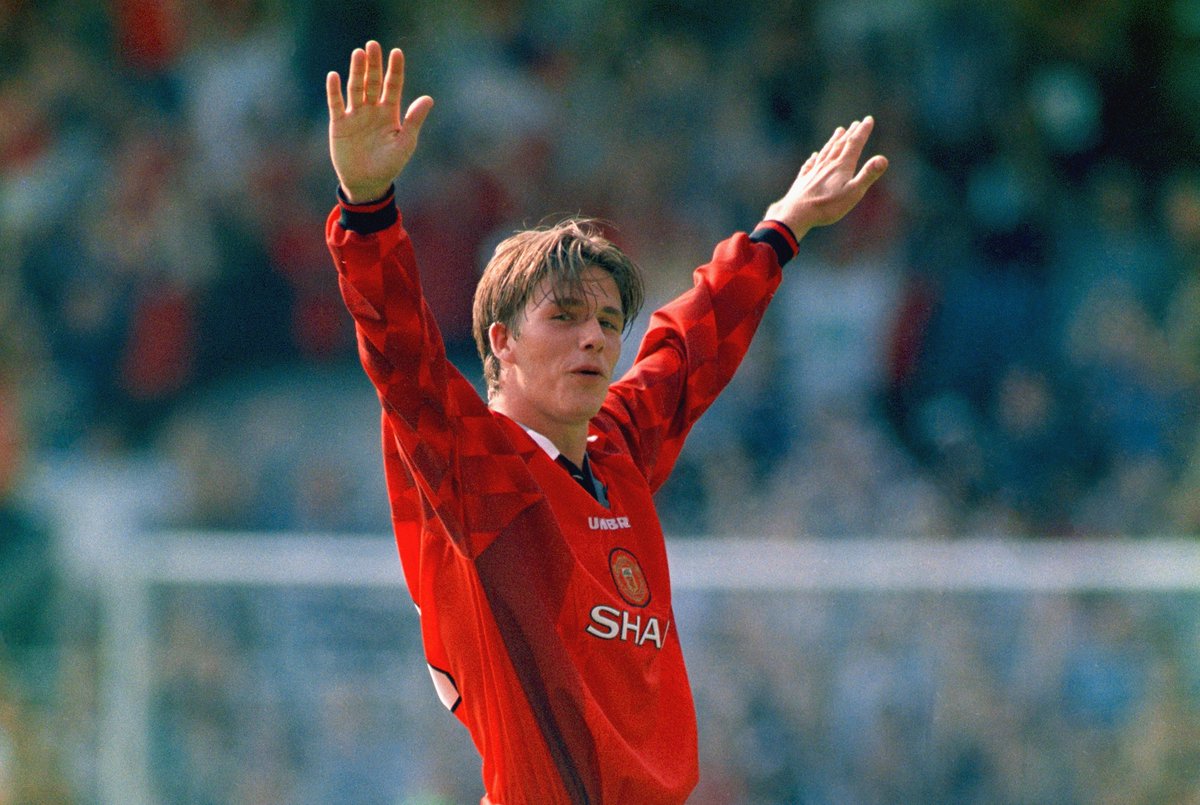
When you picture David Beckham, you probably see the floppy blonde curtains of the late '90s and that sharp red Manchester United kit with the number 7 stitched onto the back. It’s the ultimate branding match. Honestly, the "DB7" moniker became so powerful that it’s easy to forget he actually spent more than half of his professional career wearing completely different numbers.
So, what number is David Beckham? If you’re looking for a quick answer, there isn't just one. Depending on whether you grew up watching him whip crosses in at Old Trafford, bossing the midfield at the Bernabéu, or bringing "soccer" to the masses in LA, your answer changes.
He didn't just pick numbers out of a hat, either. From legendary basketball icons to locker room politics, the story behind his jersey choices is kind of wild.
The Manchester United Era: From 28 to the Iconic 7
Most people think Beckham was born with the number 7. He wasn't. In fact, he had to climb a pretty steep ladder to get it. When he first broke into the United senior squad in the early '90s, he was basically just another academy kid.
- Number 28: His first assigned senior squad number (1993/94).
- Number 24: He switched to this for the 1995/96 season.
- Number 10: This is the one most fans forget. He wore 10 during the 1996/97 season—the year he scored that goal from the halfway line against Wimbledon.
Beckham actually loved the number 10. It was the number of his idol, Mark Hughes. But football is a business. When Teddy Sheringham signed in 1997, he wanted the 10. Sir Alex Ferguson famously called Beckham while he was on holiday in Malta to tell him he was losing his shirt.
Beckham has admitted he actually cried when he heard the news. He thought he was being demoted. Little did he know, Fergie was handing him the most legendary shirt in the club's history: the number 7 previously worn by George Best, Bryan Robson, and Eric Cantona.
Real Madrid and the Michael Jordan Connection
When Beckham made the move to Real Madrid in 2003, the world expected him to keep the 7. There was just one problem: Raúl. Raúl González was the king of Madrid. You don't just walk into the Bernabéu and ask the club legend for his shirt. Beckham knew it, too. He didn't even ask.
So, why number 23?
It wasn't a "football" reason. Beckham is a massive fan of Michael Jordan. He’s often spoken about how much he admired Jordan's work ethic and global impact. Since 23 was sitting there available, he grabbed it. His wife, Victoria, reportedly played a role here too, mentioning that 23 hadn't done Jordan any harm. It was a marketing masterstroke, too—it separated "Real Madrid Beckham" from "Manchester United Beckham" instantly.
The American Dream and the Move to 32
When he moved to the LA Galaxy in 2007, he stuck with 23. It made sense. He was in the States, the home of MJ, and he’d already spent four years building the brand in Madrid. Plus, a guy named Chris Klein already had the 7 at Galaxy, and Beckham—ever the gentleman—didn't want to take it.
Then things got interesting during his loan spells at AC Milan and his final stint at Paris Saint-Germain (PSG).
By the time he arrived in Italy, 7 was taken by Alexandre Pato and 23 was taken by Massimo Ambrosini. Beckham went for number 32.
Why 32? He went back to the basketball well. He’s a big fan of Magic Johnson, who famously wore 32 for the LA Lakers. It was a neat way to pay homage to another legend while keeping his "American" connection alive during his European return. He kept the 32 for his final professional chapter at PSG, eventually retiring in that shirt in 2013.
What about the England National Team?
This is where the "7" remains purest. For the vast majority of his 115 caps, Beckham was England’s number 7.
As captain, that shirt became his second skin. Even when he was wearing 23 or 32 for his clubs, he would return to the Three Lions and pull on the 7. There was one weird exception, though. In his very last England appearance in 2009, he actually wore number 17 coming off the bench.
Summary of David Beckham’s Career Numbers
| Club / Team | Shirt Numbers Worn |
|---|---|
| Manchester United | 28, 24, 10, 7 |
| Preston North End (Loan) | 8 |
| Real Madrid | 23 |
| LA Galaxy | 23 |
| AC Milan | 32 |
| PSG | 32 |
| England | 7 (mostly), 17, 15 (early on) |
Actionable Insights for Fans and Collectors
If you're looking to buy a classic Beckham jersey or just want to win a pub quiz, keep these nuances in mind. A "Beckham 10" United shirt is a rare and highly sought-after piece because he only wore it for one full season. Similarly, if you see a "Beckham 7" Real Madrid shirt, it’s a fake—he never wore it for the Galácticos.
If you’re a player choosing a number today, take a page out of Beckham’s book:
- Respect the hierarchy: Never demand a legend’s number; it creates bad blood in the locker room.
- Think about your brand: A unique number (like 23 in a sport full of 7s and 10s) can make you stand out.
- Personal meaning matters: Whether it’s an idol like Jordan or a family connection, you play better when you’re proud of the digits on your back.
Understanding the history of his kit numbers gives you a better look at the man himself—someone who respected the traditions of the past but wasn't afraid to carve out his own identity when the situation changed.