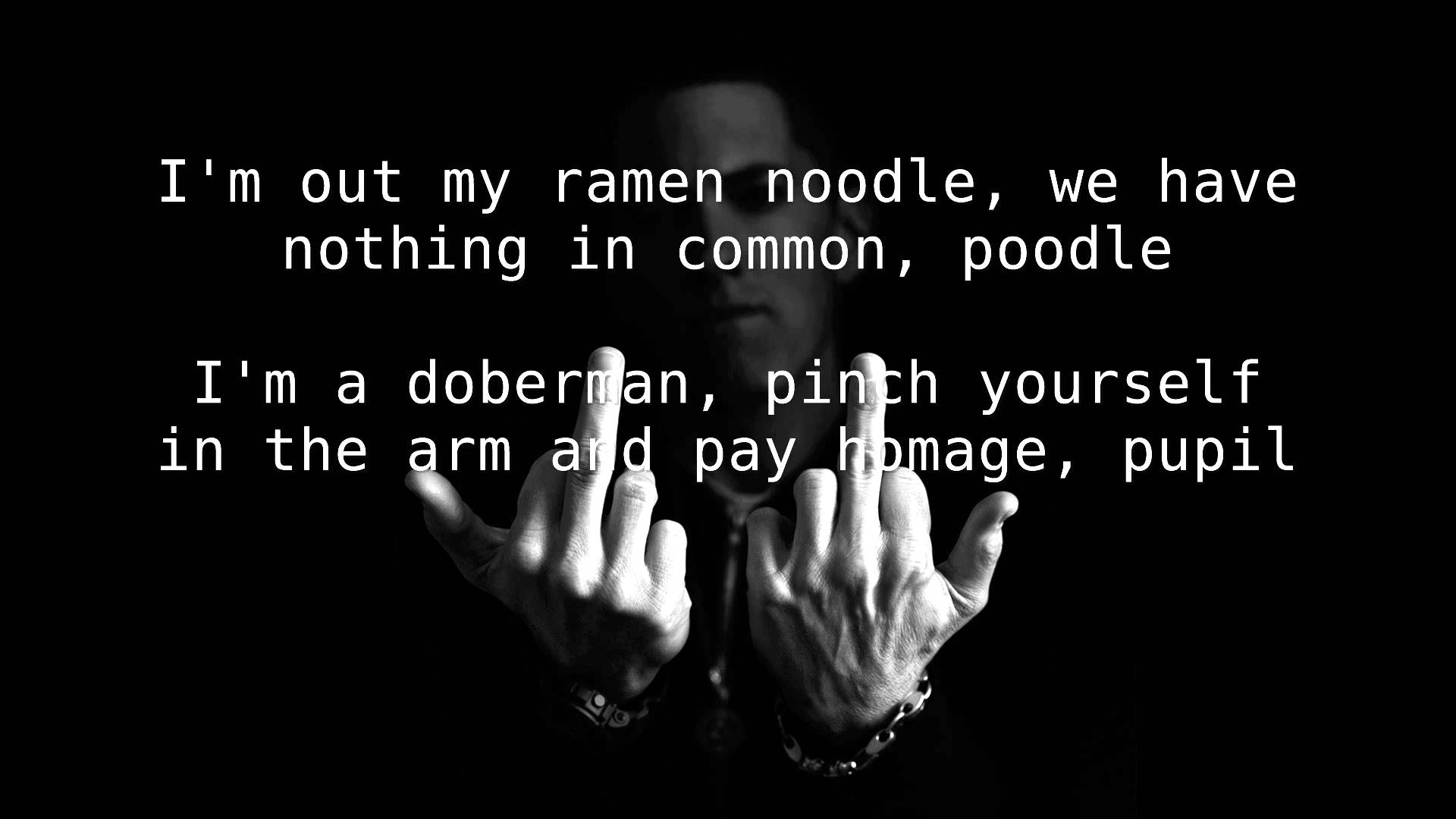
You've probably seen the clip. The one where Marshall Mathers looks like he’s about to glitch out of reality, his tongue moving faster than most people’s brains can process. It’s the "supersonic" section of Eminem Rap God, and it's basically the high-water mark for technical hip-hop in the 21st century. But here’s the thing: most people treat the song like a circus act. A gimmick. They focus on the speed and miss the fact that the track is actually a six-minute resume of a guy terrified of losing his relevance.
Honestly, it's a bit of a miracle the song even exists. When it dropped in 2013 as part of The Marshall Mathers LP 2, Eminem was 41. In rap years, that’s basically ancient. Most of his peers had already pivoted to reality TV or selling headphones. Instead, Em went into Effigy Studios in Michigan and recorded a 1,560-word manifesto.
It wasn't just a song. It was a hostile takeover.
The Math Behind the Madness
Let’s get the "Guinness World Record" stuff out of the way because that’s what everyone Googles first. Yes, it held the record for the most words in a hit single. We’re talking 1,560 words stuffed into 6 minutes and 4 seconds. If you do the math, that averages out to about 4.28 words per second.
But averages are boring.
The real magic is that 15-second burst where he hits 97 words. That’s 6.5 words per second. Some analysts, like the folks over at RapAnalysis, have pointed out that he actually hits peaks of 9.6 syllables per second during that stretch. To put that in perspective: if you tried to read your grocery list that fast, you’d probably choke.
What’s wilder is that the beat—produced by DVLP and Filthy—was actually two years old when Em finally touched it. DVLP had originally made it in 2011. It sat around waiting for someone crazy enough to ride that weird, futuristic synth line until Marshall decided he needed to prove he was still the "Odin" of the genre.
Why Eminem Rap God is a Technical Nightmare
If you ask a casual fan why the song is good, they’ll say, "He raps fast." If you ask a producer or a battle rapper, they’ll talk about the internal rhyme schemes. Look at the way he handles the "Timothy White" segment.
"Gimme the mic, let me recite, Timothy White / Every night, if he’s right, I’m just a criminal..."
He isn't just rhyming the end of the sentences. He’s rhyming 12 out of 13 syllables in that stretch. It’s a dense, multi-syllabic lattice. He uses what experts call "family rhymes"—words that don't perfectly match but share enough phonetic DNA (like "consequence" and "accomplishments") to trick your ear into hearing a perfect loop.
The Live Performance Struggle
Can he actually do it live? Sorta. It depends on which tour you caught. If you look at his 2024 performance at the Soundstorm Festival, he’s still nailing the "supersonic" part at age 52, which is frankly ridiculous. But it’s a massive strain on lung capacity. In his earlier live shows, like the 2013 MTV Europe Music Awards, you can see him leaning heavily on his hype man, Mr. Porter, to fill in the gaps so he can actually breathe.
Fans on Reddit and hip-hop forums have spent years arguing about whether he’s lip-syncing or using a "guide track" during the fast parts. The reality is usually a mix. He raps over a backing vocal track—a standard move in high-energy rap—but if you’re close enough to the stage, you can hear him gasping for air. It’s an athletic feat as much as a musical one.
The References You Probably Missed
The song is a massive collage of hip-hop history. He isn't just bragging; he's paying rent to the people who built the house. He name-drops:
- Lakim Shabazz
- Rakim
- Tupac
- N.W.A
- JJ Fad (The "Supersonic" interpolation is a direct nod to them)
He even addresses the "Vanilla Ice" comparisons head-on. He knows people think he’s a gimmick sometimes. He knows the "Rap God" title is arrogant. But he counters that by mentioning his own low points, like the Columbine line that was censored on his original MMLP back in 2000. By re-inserting those themes, he’s basically saying, "I’m the same guy, just with a bigger vocabulary."
Controversy and the "2026" Perspective
We have to talk about the elephant in the room. The lyrics haven't all aged well. Even back in 2013, groups like GLAAD criticized the song for its use of homophobic slurs. Eminem’s defense has always been that he’s playing a character—Slim Shady—and that those words are part of the "battle rap" persona he grew up with.
By today’s standards, it’s a polarizing track. Some see it as a relic of a less sensitive era, while others argue it’s a masterclass in artistic freedom. Even Eminem himself admitted on the Kamikaze track "Fall" that he maybe went too far with some of the shots he took at younger artists like Tyler, The Creator. It's a complicated legacy.
Is it Still the Fastest?
Technically, no. Eminem actually beat his own record later.
- "Majesty" (2018): 6.5 words per second.
- "Godzilla" (2020): 7.5 words per second.
In "Godzilla," he raps 224 words in 30 seconds. It makes Eminem Rap God look like a slow jam by comparison. But "Rap God" remains the blueprint. It was the first time he really leaned into the "Speed Rap" identity as his primary weapon.
How to Actually Learn the Lyrics
If you’re one of those people trying to memorize this for karaoke (please don't, for the sake of your friends), here is the actual strategy:
- Slow it down: Use the 0.75x speed setting on YouTube. You’ll realize he’s enunciating way more than you think.
- Learn the rhythm first: Don't focus on the words. Focus on the "da-da-da-da" percussion of his voice.
- The "Supersonic" trick: He isn't saying every syllable with equal weight. He’s "ghosting" certain consonants to keep the momentum.
Actionable Insight: If you want to understand the technical depth of modern rap, go listen to the instrumental of "Rap God" first. Notice how sparse the beat is. It’s designed to be a blank canvas. Then, listen to the vocal track again. You’ll see that Eminem isn't just rapping over the beat; he's treating his voice like a snare drum. To improve your own appreciation of the craft, try to identify three "internal rhymes" in the second verse—where he rhymes words in the middle of a line rather than the end. It changes how you hear music entirely.