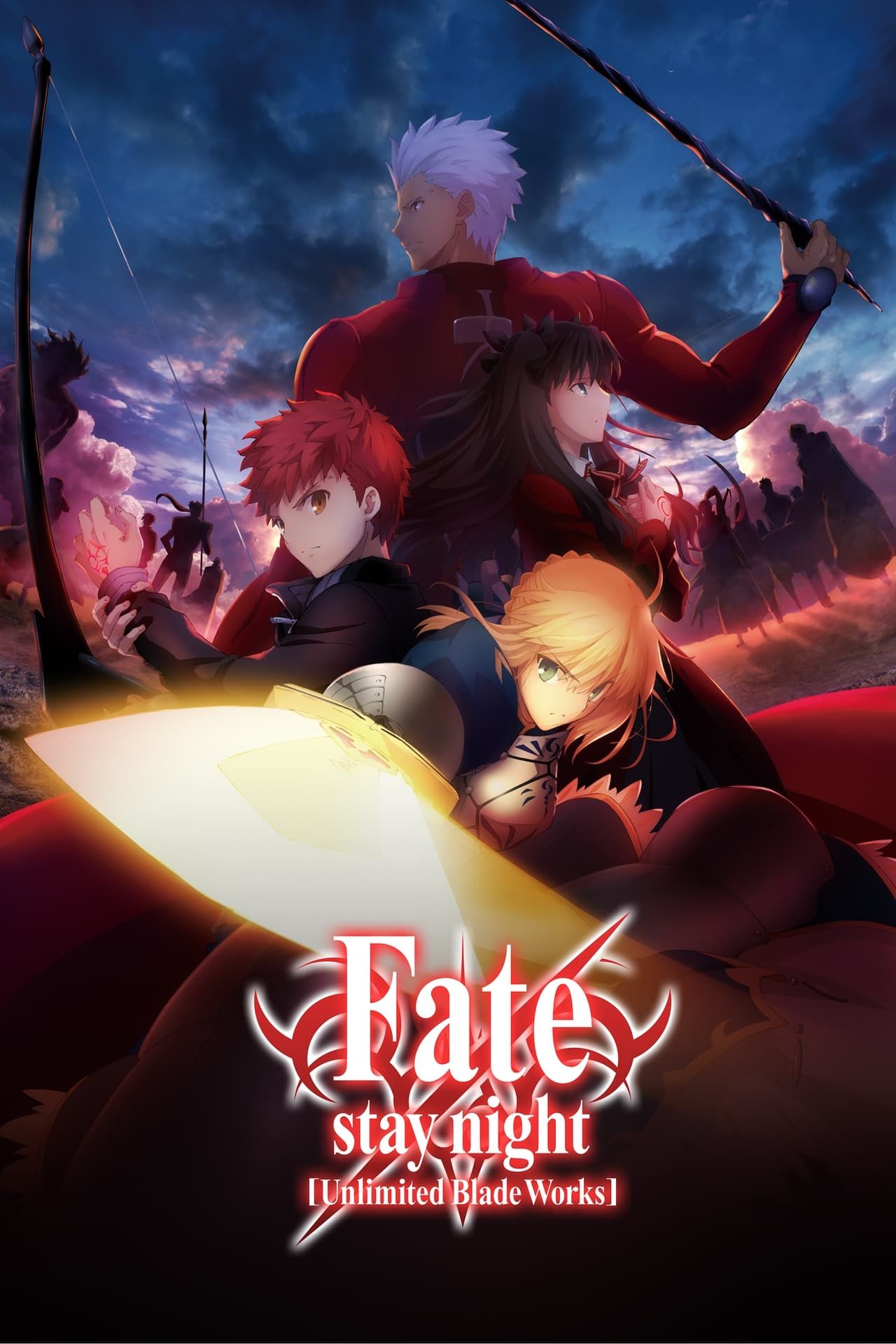
It is honestly kind of wild that we are still talking about a visual novel route from 2004 as if it’s the peak of modern fantasy. But here we are. Fate/stay night Unlimited Blade Works isn't just another entry in a sprawling franchise; it is the emotional and thematic backbone of everything Type-Moon has built. If you’ve spent any time in anime circles, you’ve seen the memes about "people dying when they are killed." You've seen the high-budget sparks flying in the ufotable adaptation. Yet, beneath the infinite swords and the "Unlimited Budget Works" reputation, there’s a deeply messy, cynical, and ultimately hopeful story about what it means to live for an impossible ideal.
The Holy Grail War is a simple setup on paper. Seven mages, seven heroic spirits, one winner. It sounds like a battle royale. It isn’t.
The Identity Crisis at the Heart of the Hill of Swords
Most stories follow a hero who wants to save the world. Shirou Emiya is different because he’s fundamentally broken. He doesn't want to save people because it’s "right"—he does it because he has a massive case of survivor’s guilt from a fire that leveled Shinto City ten years prior. This is where Fate/stay night Unlimited Blade Works shifts from a standard urban fantasy into a psychological deconstruction.
Enter Archer.
He’s cynical. He’s bitter. He wears red and wields dual blades that look nothing like what a "proper" Archer should use. The twist—which most people know by now but was a massive reveal back in the day—is that Archer is Shirou from a possible future. He’s the physical manifestation of what happens when you follow Shirou's path to its logical, miserable conclusion. He became a "Counter Guardian," a celestial janitor who cleans up humanity's messes by killing people.
The conflict in this route isn't just about winning a cup; it's a literal argument between a man and his younger self. Archer wants to kill Shirou to create a paradox and end his own eternal suffering. Shirou, knowing full well that Archer is the result of his own choices, decides to keep going anyway. It’s "kinda" insane when you think about it. Most characters would see their future self's misery and pivot. Shirou just doubles down.
Why the ufotable Adaptation Changed the Game
You can't discuss this story without mentioning the 2014-2015 TV series by ufotable. Before that, we had the 2010 Studio Deen movie. Honestly? The movie was a rush job. It tried to cram a 30-hour visual novel route into 90 minutes. It felt like a clip show.
When ufotable took the reins, they brought the "digital cinematography" that defined the era. The fights aren't just well-animated; they use lighting and particle effects in a way that makes the magic feel heavy. Take the fight between Archer and Lancer (Cu Chulainn) at the church. It’s fast. It’s brutal. You can actually feel the kinetic energy of Gae Bolg.
But the real magic of the adaptation was how it handled the "Answer."
In the visual novel, a lot of the nuance is buried in internal monologues. Shirou thinks a lot. Transitioning that to a visual medium is hard. The anime uses the environment—the literal "Unlimited Blade Works" reality marble—to show his mental state. That wasteland of rusted swords isn't just a cool superpower. It’s a graveyard. It represents the thousands of people Archer had to kill and the lonely end of a "Hero of Justice."
Breaking Down the Mechanics of the Reality Marble
Let's get technical for a second. Fate/stay night Unlimited Blade Works introduces one of the coolest power systems in fiction: the Reality Marble.
In the Nasuverse (the universe created by writer Kinoko Nasu), a Reality Marble is a "High-Thaumaturgy" that manifests a person’s inner world over the real world. Most mages can't do this. Shirou can only do this. He’s actually a terrible mage. He can’t do basic alchemy or formal craft. All he can do is "Trace."
- He analyzes the structure of an object.
- He reproduces the history and materials.
- He pulls a copy out of his "inner world" into reality.
Because Shirou isn't a "swordsman" but a "blacksmith," he is the natural counter to Gilgamesh. Gilgamesh is the "King of Heroes" who owns every original treasure in his Gate of Babylon. He’s arrogant. He’s the strongest being in the war. But Shirou’s world allows him to produce copies faster than Gilgamesh can pull out the originals. It’s the ultimate "faker" vs. "original" showdown.
The Rin Tohsaka Factor
We have to talk about Rin. She is the catalyst that makes this route work. In the "Fate" route (the first one), she’s a mentor. In "Heaven’s Feel" (the third one), she’s an antagonist/ally. But here? She’s the anchor.
Rin is a perfectionist. She’s a blue-blooded magus who tries to act cold but is actually a "bleeding heart" who can't help but save people. Her relationship with Shirou is great because she’s the only one who calls him out on his BS. She realizes that Shirou’s selflessness is actually a form of self-destruction.
While the action is what gets people into the seats, the dynamic between Rin, Shirou, and Archer is what keeps them there. The "Sunny Day" alternative ending (a hidden gem in the visual novel and an OVA for the anime) shows a timeline where they actually manage to keep Saber around and live somewhat normally. It’s a rare moment of levity in a franchise that usually ends in tragedy or bittersweet departures.
Misconceptions and the "Watch Order" Nightmare
If you look up Fate/stay night Unlimited Blade Works online, you will immediately find 500 people arguing about where to start. It’s a mess.
Some say start with Fate/Zero (the prequel). Others say that spoils the twists. Honestly? Unlimited Blade Works is a perfectly fine starting point, provided you understand that it is Part 2 of a three-part story. It assumes you know the basics of the world but does a decent job of re-explaining the stakes.
The biggest misconception is that Shirou is a "generic shonen protagonist." He really isn't. Generic protagonists want to get stronger to protect their friends. Shirou is a guy with severe PTSD who uses "saving people" as a drug to feel like his life has value. Once you realize he’s actually kind of insane, the story becomes a lot more interesting. It’s not an empowerment fantasy; it’s a character study of a broken person trying to find a reason to keep breathing.
The Legacy of the 2020s and Beyond
Even in 2026, the influence of this specific story is everywhere. You see it in the way modern "gacha" games like Fate/Grand Order handle their narratives. You see it in the "High-Fantasy Urban" genre that has exploded in light novels.
The "Answer" that Shirou finds—that an ideal can be beautiful even if it’s unreachable—is a timeless theme. It resonates with anyone who has ever felt like they’re failing at their goals. Archer says, "The ideal is just an ideal." Shirou responds, "Even so, I wasn't wrong."
That’s the core of the whole thing. It’s okay to strive for something impossible.
Practical Steps for New and Returning Fans
If you're looking to dive deeper into this world or just want to experience the best version of it, here is what you should actually do:
- Watch the ufotable TV series first. Don't start with the 2010 movie. You’ll just be confused. The TV series is titled Fate/stay night [Unlimited Blade Works] and is split into two seasons.
- Read the "Garden of Avalon" light novel snippets. It provides incredible context for Saber’s mindset, which helps explain why she reacts the way she does to Shirou’s stubbornness in this route.
- Check out the "English Patch" for the original Visual Novel. If you have the patience for a 60-hour read, the "Realta Nua" version of the VN is still the definitive way to experience the story. You get the internal monologues that the anime had to cut.
- Listen to the Soundtrack. Hideyuki Fukasawa’s work on the UBW OST is haunting. Specifically, find the track "Last Stardust" by Aimer. It plays during the pivotal Shirou vs. Archer climax and, honestly, the lyrics basically summarize the entire theme of the show.
- Look for the nuances in the fight choreography. In the final fight against Gilgamesh, notice how Shirou’s movements are unrefined compared to Archer’s. He is winning through sheer volume and the specific environment, not because he suddenly became a master swordsman.
This story isn't just about cool weapons. It's about the clash between who we are and who we wish we were. Whether you're in it for the "Huy" chants of the magic circles or the deep dive into the philosophy of heroism, Fate/stay night Unlimited Blade Works remains the gold standard for how to adapt a visual novel into a cultural phenomenon.