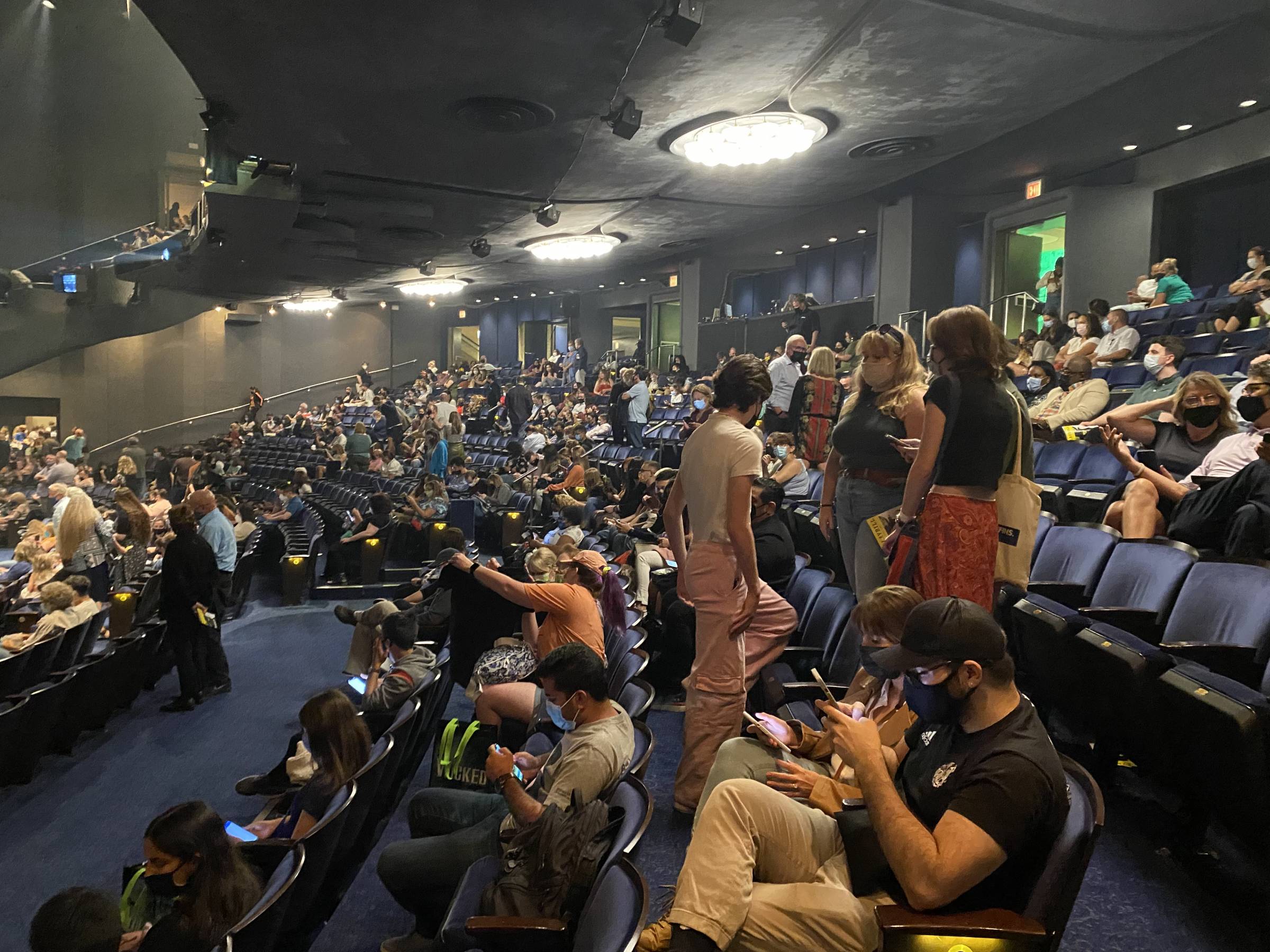
You're standing on 51st Street. The neon green glow of the Wicked sign is basically humming against the pavement, and you've got that nervous "did I spend too much on tickets" pit in your stomach. It happens to everyone. The Gershwin Theatre is a massive, cavernous beast of a room—one of the largest on Broadway with 1,933 seats—and honestly, the Gershwin Theatre seat view you choose can make the difference between seeing Elphaba's literal pores and staring at the back of a tourist’s head for two and a half hours.
People obsess over being close. They want to be in the front row. But here’s the thing: being too close at the Gershwin is actually a rookie mistake. Because Wicked is such a technical, visual spectacle with a sprawling set designed by Eugene Lee, sitting in the first five rows of the Orchestra can actually cut off your view of the "Time Dragon" clock hanging above the proscenium. You end up with a sore neck and miss half the lighting cues.
If you want the real deal on where to sit, you have to understand the weird, slightly brutalist architecture of this specific building.
The Orchestra Layout: Power Rows and "Dead Zones"
The Orchestra at the Gershwin is wide. Very wide. It’s split into three main sections: Left, Center, and Right. If you’re looking at a Gershwin Theatre seat view from the far side aisles, you’re going to run into "Partial View" territory.
Generally, any seat numbered higher than 20 on the sides is going to lose a chunk of the stage. You’ll miss the Ozian gates or some of the ensemble movement on the far wings. It’s not a dealbreaker for some, but if it's your first time, it kinda sucks. The "Sweet Spot" is Center Orchestra, Rows F through M. These are the gold-standard seats. You’re far enough back to take in the entire stage picture, but close enough to see the emotion during "For Good."
But wait. There’s a catch with the floor. The rake—the slope of the floor—at the Gershwin is notoriously shallow in the front half. If you are on the shorter side and you sit in Row G, and a tall person sits in Row F, you're basically watching the show through their ears. Honestly, it’s a gamble. That’s why many Broadway veterans actually prefer the Front Mezzanine over the mid-Orchestra.
The Mid-Orchestra Break
There is a cross-aisle behind Row L. This is a blessing. If you can snag Row M, you have unlimited legroom because there is literally a hallway in front of you. You can stretch your legs out fully, which is a rare luxury in New York theater. Plus, nobody is sitting directly in front of you to block your line of sight. It’s arguably the best value in the house, even if the tickets are priced as "Premium."
Why the Front Mezzanine is Secretly Superior
I’ll say it: the Front Mezzanine is the best Gershwin Theatre seat view for a show like Wicked.
Why? Because the Gershwin was built in 1972. It wasn't designed for intimate dramas; it was designed for spectacle. The Mezzanine hangs over the Orchestra at Row E. That means if you’re in the first row of the Mezzanine (Row A), you’re actually closer to the stage than someone sitting in the back of the Orchestra.
From up there, the choreography makes sense. You see the patterns the dancers make. You see the "Bubble" descend perfectly. You get the full scale of the Emerald City.
- Row A and B: Perfection. Unobstructed.
- The Railing Issue: Some people complain that the safety railing in Row A of the Mezzanine slightly cuts into the bottom of the stage view if you’re shorter than 5'4". If that’s you, aim for Row B.
- The Sound: Because the Gershwin is so big, the sound design is heavily amplified. In the Mezzanine, the acoustics tend to be a bit more balanced than in the "cavern" under the Mezzanine overhang in the rear Orchestra.
The Rear Mezzanine: A Long Way From Kansas
If you’re looking for budget tickets, the Rear Mezzanine is where you’ll end up. Let’s be real—it’s high. You are way up there. The performers will look small. However, because the Gershwin is stadium-style, the rake in the upper levels is much steeper. You won't have to worry about people's heads blocking you as much as you would downstairs. Just bring some binoculars if you want to see the costume details.
Side Sections and Obstructed Views
Don't let the "Side Orchestra" label scare you off entirely, but you have to be smart. In the Gershwin, the stage is framed by a massive mechanical set. If you sit in Seat 25 or 27 in the Side Orchestra, you are "looking past" the set pieces.
Sometimes, you’ll see the actors waiting in the wings. Some people find this cool—it’s like a "behind the scenes" look. Others find it ruins the magic. Usually, the box office or websites like SeatPlan or ViewFromMySeat will flag these as "Partial View." If the discount is significant (like 40% off), it’s usually worth it. If it’s only $20 cheaper, stick to the center.
Realities of the Rear Orchestra
The Rear Orchestra (Rows O through ZZ) is a different vibe. Around Row N, the Mezzanine starts to hang over your head. By the time you get to Row T, you feel like you’re watching the show through a letterbox.
You won't miss the actors, but you will miss the top of the set. In Wicked, the lighting and the overhead set pieces are a huge part of the atmosphere. If you’re tucked way back in Row Y, you lose that "expansive" feeling. It feels a bit like watching a movie in a long tunnel. If you have the choice between Rear Orchestra Row P and Rear Mezzanine Row D, take the Mezzanine. Every single time.
Practical Logistics for Your Visit
The Gershwin is located inside the Paramount Plaza building. It’s got a massive lobby—basically a mini-museum of the Theatre Hall of Fame.
- Arrive early. The security line can wrap around the block because they’re processing nearly 2,000 people.
- Bathrooms. They are downstairs. The line for the women’s restroom at intermission is legendary. It’s better to go before the show starts at a nearby cafe or hotel.
- The Gershwin "Vibe." It’s a loud, high-energy theatre. It’s not the place for a quiet, contemplative evening. It’s built for the roar of the crowd.
Making the Final Call
Choosing your Gershwin Theatre seat view comes down to what you value. Do you want to see the spit flying during a dramatic belt? Go Orchestra Rows F-K. Do you want to see the mechanical wizardry and the full "Defying Gravity" effect without craning your neck? Go Front Mezzanine.
Avoid the very last rows of the Orchestra if you can help it; the "ceiling" of the Mezzanine overhang just feels too heavy. And if you’re doing the lottery or buying last-minute, don't sweat the side seats too much—the Gershwin is wide enough that even "bad" seats are usually better than the "nosebleeds" at older, narrower theaters like the Majestic or the St. James.
Next Steps for Your Trip:
Check the specific seat numbers on a digital manifest before hitting "buy." If you are looking at Side Orchestra, try to stay under Seat 15 to ensure a "Full View" experience. If you’re traveling with kids, ask the ushers for a booster seat immediately upon entering; they have a limited supply and they disappear fast. Finally, remember that the Gershwin is chilly—the AC is industrial strength to keep those heavy costumes from overheating the actors, so bring a sweater even in July.