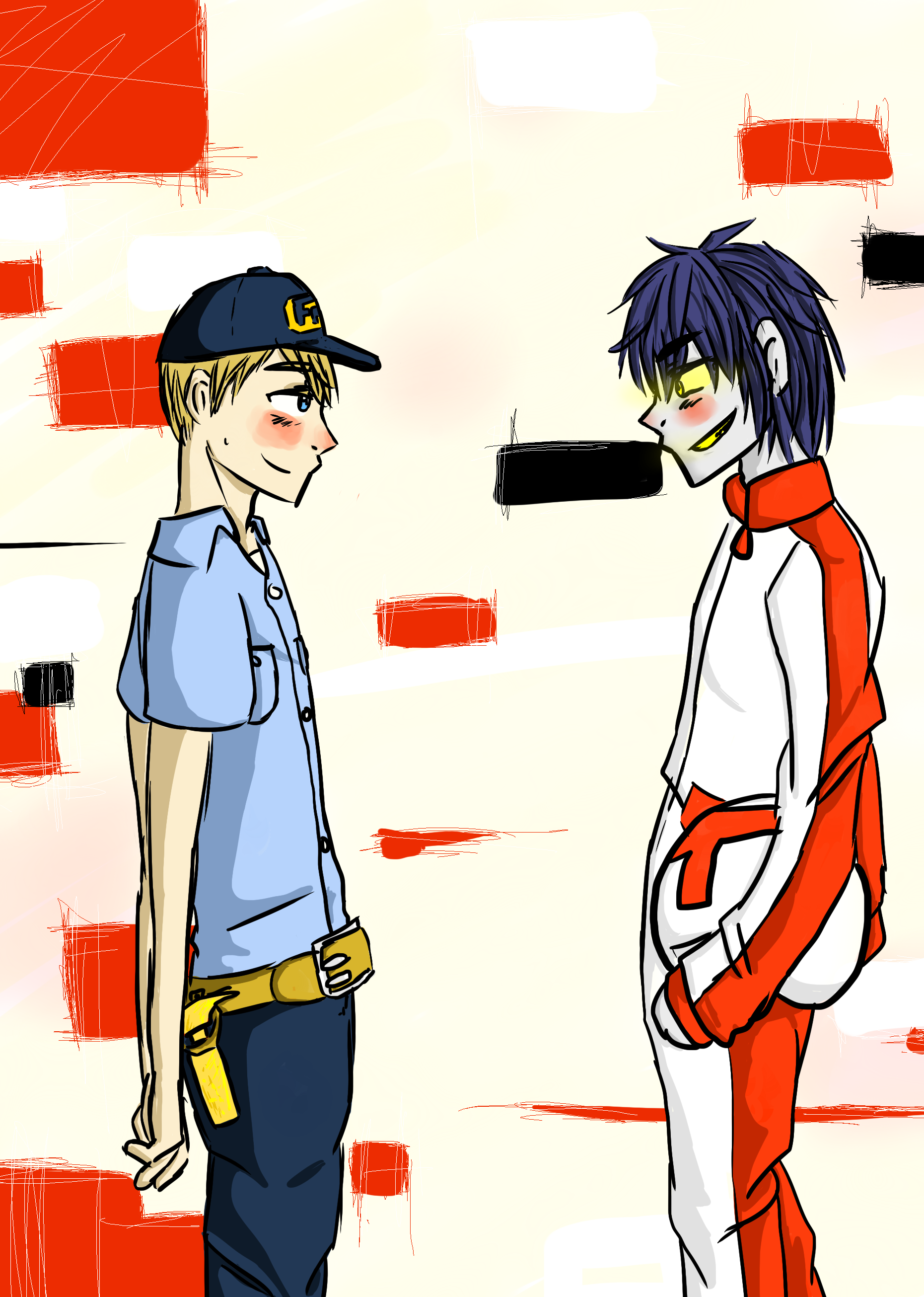
Honestly, if you sat down in a writers' room and pitched a romance between a cheery 8-bit handyman and a traumatized sci-fi soldier with "the most tragic backstory ever," you'd probably get laughed out of the building. It sounds like fan-fiction bait. Yet, here we are, years after Wreck-It Ralph first hit theaters, and the relationship between Fix It Felix and Sergeant Calhoun remains one of the most surprisingly grounded parts of the Disney canon.
It shouldn't work. Felix is a guy who lives in a world of nicotine-free milk and "shucks." Calhoun spends her days being eaten by Cy-Bugs and screaming at recruits.
But it does work.
The High-Definition Beauty of Fix It Felix and Sergeant Calhoun
When Felix first sees Sergeant Tamora Jean Calhoun, he’s basically short-circuiting. He calls her a "high-definition beauty," and while that’s a cute gag about the graphics gap between their games, it’s also the first time someone in the movie looks at Calhoun as something other than a killing machine.
Think about her programming. Calhoun, voiced with iconic gravel by Jane Lynch, isn't just a tough leader. She's a character designed to be a parody of every gritty, brown-and-gray FPS protagonist from the early 2010s. She literally has a programmed memory of her fiancé, Dr. Brad Scott, being eaten by a Cy-Bug at the altar. That’s heavy for a PG movie.
Felix, on the other hand, is the quintessential "Good Guy." Jack McBrayer brings that same 30 Rock Kenneth-the-page energy to the role, which makes him the perfect foil for Calhoun's intensity. He doesn't have a tragic backstory. He has a magic hammer and a sense of duty that’s so simple it’s almost refreshing.
That Nesquik-Sand Scene is Peak Romance
You remember the scene. They’re in Sugar Rush, sinking into the "Nesquik-sand." Calhoun is doing what she does best: panic-firing and getting aggressive. Felix is just... Felix.
The moment she starts slapping him to make the "Laffy Taffy" vines laugh so they can escape? That’s where the shift happens. It’s weird, sure. But it’s also the first time Calhoun realizes that Felix’s "unbreakable" optimism isn’t just a lack of awareness—it’s a tool. He can literally fix himself. He can take the hits.
By the time he calls her a "dynamite gal," he’s accidentally tripped over the exact phrase her dead fiancé used. It’s a gut punch for her, but it’s the catalyst that forces her to see him as a real person (or a real program) rather than just a tag-along from a vintage cabinet.
What Happened in the Sequel?
A lot of people felt let down by Ralph Breaks the Internet because Fix It Felix and Sergeant Calhoun were sidelined. We got a glimpse of their life as parents—adopting fifteen glitchy racers from Sugar Rush—which is a hilarious concept that deserved more than a few minutes of screen time.
Co-director Phil Johnston actually mentioned in interviews that there was a much larger subplot planned for them. They were supposed to have a whole B-story about their parenting struggles and even a bit where Felix encounters a different version of Calhoun from a console version of her game.
Ultimately, it was cut for time. Total bummer.
We did get to see them "fix" the unruly kids, though. There's a long-standing fan theory—and a bit of a joke in the community—that Felix used his hammer to "fix" the kids' personalities. While the movie frames it as them teaching the racers about friendship and discipline, the idea of Felix just bonking a problem until it's "fixed" is much more in character for an arcade hero.
Why Their Dynamic Still Matters
The reason people still talk about this pairing isn't just because it's funny. It's because it subverts the typical Disney romance.
- The Role Reversal: She’s the warrior; he’s the support. Usually, the "handy" guy is the one rescuing the damsel. Here, she’s the one with the pulse-rifle and the tactical training.
- Healing Through Humor: Felix doesn't try to "fix" her trauma with a speech. He just shows up. He offers a level of stability that her high-stakes game doesn't allow.
- Visual Storytelling: The contrast between his round, 8-bit design and her sharp, detailed polygons tells the whole story without a single line of dialogue.
They represent two eras of gaming coming together. One is about simple patterns and clear goals; the other is about complex narratives and cinematic loss. Putting them together is Disney's way of saying that the "soul" of gaming hasn't changed, even if the pixels have.
How to Appreciate Their Story Today
If you’re looking to dive back into the world of Fix It Felix and Sergeant Calhoun, don't just stop at the movies.
- Check the Credits: The end credits of the first film show their wedding, with Ralph as the best man and Vanellope as the maid of honor. It’s a small detail that rounds out their arc perfectly.
- Look for the "Hero's Duty" Comic: There were tie-in materials that expanded on Calhoun’s world if you really want to see how dark her "programming" actually goes.
- Watch for the Easter Eggs: In the sequel, look at the background of their apartment. You can see how they’ve blended their two very different aesthetics into one home.
At the end of the day, Felix and Calhoun are proof that you don't need to be from the same "world" to make things work. Sometimes, all you need is a magic hammer and the patience to deal with someone who’s been through a few too many boss levels.
Next time you watch, pay attention to the way Calhoun looks at Felix during the final battle in Sugar Rush. It’s not just a "dynamite gal" thing anymore; it's the look of a character who finally found a game worth playing for keeps.