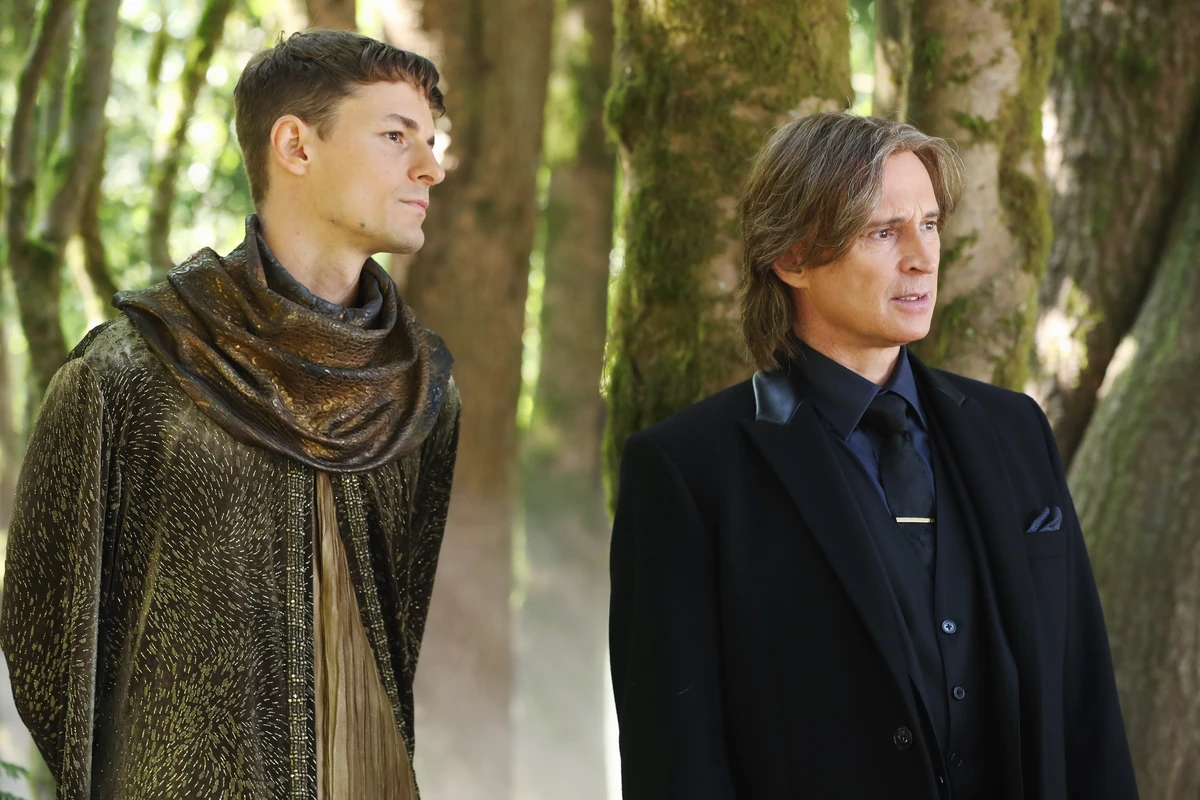
He was supposed to be the "moru" – the child of a destiny he never chose. If you watched the later seasons of Once Upon a Time, you know Gideon is a bit of a headache to track. Honestly, trying to map out his timeline is like trying to untangle a ball of yarn that's been played with by a caffeinated kitten. He’s the son of Belle and Rumplestiltskin, but he’s also a grown man, a villain, a hero, and a literal baby, sometimes all in the same episode.
Most fans remember him as the guy in the black hood who shatters the peace of Storybrooke. But there’s a lot more to him than just being a plot device for Emma Swan’s "final battle."
The Messy Origin of Gideon from Once Upon a Time
Let's be real. Gideon’s life was a disaster from second one. Born to a mother who wanted to protect him and a father who couldn't stop making deals, he was basically doomed. When Belle gave him to the Blue Fairy to keep him away from Rumple, she thought she was doing the right thing. It backfired. Hard.
The Black Fairy—Rumple’s mom and Gideon’s grandmother—snatched him up. She took him to the Dark Realm. Time works differently there. It’s a nightmare. While only a few days passed in Storybrooke, twenty-eight years of torture passed for Gideon. He didn't just grow up; he was forged in a furnace of trauma. Fiona (the Black Fairy) didn't just raise him; she broke him down and rebuilt him as a weapon.
It’s easy to look at Gideon and see a villain. He shows up in Season 6 and tries to kill the Savior. That’s a bad look. But if you look closer, he’s doing it because his grandmother literally has his heart in a box. Imagine that. Every choice you make, every step you take, is being puppeteered by the person who spent your entire childhood telling you that your parents abandoned you. It’s heavy stuff for a show that usually focuses on hope.
Why the Final Battle Wasn't Really About Emma
We spent years focusing on Emma Swan. She’s the Savior. We love her. But the Season 6 arc centered on Gideon from Once Upon a Time shifts the perspective. The conflict isn't just a "Good vs. Evil" sword fight. It’s a family drama wrapped in a curse.
Gideon’s mission was to kill Emma to gain her power, but his internal struggle was the real story. He didn't want to be the Savior's end. He wanted to save his world, the people he met in the Dark Realm who were suffering just like him. This is where the writing gets nuanced. Usually, villains in this show want power or revenge. Gideon just wanted to be a hero, but he was forced to use the methods of a monster to get there.
Think about the scene where he finally faces Emma. He’s hesitant. He’s terrified. Giles Matthey, the actor who played adult Gideon, did a fantastic job of portraying that "stuck" feeling. He’s a man-child in the most literal sense—a 28-year-old body with a soul that never got to experience a single day of kindness.
The Problem With the "Darkness" Narrative
A lot of people complain that the show got too convoluted toward the end. They aren't wrong. By the time we get to Gideon's adult form, we’ve already dealt with multiple curses, alternate timelines, and the Underworld. Adding a "super-speed-aging" plotline felt like a lot.
But Gideon represents the ultimate consequence of Rumplestiltskin’s addiction to magic. Rumple spent centuries trying to find his first son, Baelfire, only to lose him. Then he gets a second chance with Gideon and immediately messes it up because he can't let go of the Dark One dagger. Gideon is the physical manifestation of Rumple’s failures.
Is He Actually Redeemed?
The show loves a redemption arc. Regina got one. Hook got one. Even Rumple... eventually... sort of... got one. But Gideon’s redemption is different because he wasn't really "bad" to begin with. He was enslaved.
When the Black Fairy is finally defeated and the curse is broken, Gideon doesn't just get a "sorry about that" card. He gets turned back into a baby. It’s a bit of a "deus ex machina" moment, honestly. The showrunners wanted to give Belle and Rumple a happy ending, so they literally reset their son.
Does it work? For some, yeah. It’s a clean slate. For others, it’s a bit of a cop-out. It erases the twenty-eight years of suffering Gideon endured. The man who struggled and tried to resist his grandmother's influence just... vanishes. In his place is a baby who will never remember the Dark Realm. It’s a happy ending that feels a little bit like a tragedy if you think about it too long.
What Most Fans Miss About Gideon’s Power
Gideon was incredibly powerful. Like, scary powerful. Because he was trained by the Black Fairy, his magic was raw and dark. He could move between realms. He could shrink people into clocks. He could go toe-to-toe with the Savior.
But his real power was his empathy. Even under Fiona’s thumb, he tried to help his friend in the mines. He tried to find a way to kill the Black Fairy even when she had his heart. That’s the "Belle" in him. He had his father's aptitude for magic but his mother's heart—literally and figuratively.
The Legacy of the Character
In the series finale, "Leaving Storybrooke," we see a glimpse of Gideon’s future. He’s a young man again, seemingly happy, living a life of peace. It’s a brief moment, but it’s essential. It proves that the cycle of trauma in the Gold family actually ended.
Unlike Baelfire, who died without ever seeing his father truly change, Gideon gets to grow up with a father who eventually chose to sacrifice everything for the greater good. It’s the one part of the story where the writers actually let a character escape the "cycle of the dagger."
Actionable Insights for Your Next Rewatch
If you're heading back into a Season 6 binge, keep these things in mind to make the Gideon arc make more sense:
- Watch the eyes: Pay attention to Giles Matthey’s performance in the scenes where he’s taking orders from the Black Fairy. You can see the physical pain of his heart being controlled.
- The Weaver Arc: When you get to Season 7, look at how Rumple (as Detective Weaver) treats the memory of his family. It adds a lot of weight to the Gideon storyline in Season 6.
- Symbolism of the Sword: The sword Gideon uses to kill Emma isn't just a weapon; it’s the Hrunting, a blade from Beowulf lore. In the show, it represents the destiny that can’t be outrun—until it is.
- The Blue Fairy's Role: Notice how often the Blue Fairy’s "good intentions" lead to disaster. Gideon’s entire life of suffering started because she was supposed to be his protector. It’s a recurring theme: "good" magic can be just as dangerous as dark magic.
Gideon from Once Upon a Time remains a polarizing character because he arrived so late in the game. But as a study in parental guilt and the struggle for autonomy, he’s one of the most complex figures the show ever produced. He’s the bridge between the old Rumplestiltskin and the man who finally found peace in the afterlife with Belle. He wasn't just a villain; he was the catalyst for the show’s final moral reckoning.
Next time you see that black hood, remember it’s not a monster underneath. It’s just a kid who lived twenty-eight years in a hellscape and still managed to want to be a hero. That’s pretty impressive for a guy whose family tree is basically a forest fire.
To fully understand Gideon's impact, you should compare his journey to Baelfire’s. Both were sons of the Dark One, both were sent away to "save" them, and both were fundamentally changed by other realms. The difference is that Gideon actually got to come home.