March 31, 2013. It was a Sunday. Lucas Oil Stadium was packed, the energy was electric, and Louisville was locked in an Elite Eight battle with Duke. Then, with 6:33 left in the first half, everything stopped. Not just the game, but it felt like the whole world’s collective breath hitched.
Kevin Ware, a sophomore guard for the Cardinals, jumped to contest a three-point shot by Duke’s Tyler Thornton. It was a routine play. He’d done it a thousand times. But when he landed, his right leg didn't just buckle—it snapped. The Kevin Ware leg break became an instant, haunting part of sports history, not just because of the injury itself, but because of the bone protruding six inches through the skin. It was visceral. It was public. And honestly, it changed the way we watch sports injuries forever.
The Freak Physics of a Nightmare
People still ask how a healthy, elite athlete’s leg just gives way like that. It wasn't a collision. There was no foul.
Doctors who analyzed the footage later, like Dr. Frederick Azar from the American Academy of Orthopaedic Surgeons, noted that Ware jumped both horizontally and vertically. When he landed, there was a slight twist—a torsion—that combined with the vertical force of his weight. It was the "perfect storm" of physics.
There's a lot of talk about whether he had pre-existing stress fractures. It's a common theory. Tibial stress fractures are notorious in basketball players because of the constant jumping. If a bone already has microscopic cracks, one awkward landing can turn a minor issue into a catastrophic compound fracture. While we can’t say for 100% certainty without his private medical charts from 2013, most orthopedic experts agree it’s highly likely his tibia was already weakened.
The Scene on the Court
The reaction from the Louisville bench is something you can't forget if you saw it live. Chane Behanan, Ware’s best friend, collapsed to the floor. Wayne Blackshear was in tears. Even Rick Pitino, a man who has seen everything in basketball, was visibly shaking, wiping his eyes.
The bone was "fully protruding," as reports described it. Yet, in the middle of that trauma, Ware was the calmest person in the building. He kept telling his teammates, "I'm fine, just win the game." It sounds like a movie script, but it actually happened.
Beyond the Gore: The Medical Reality
Ware was rushed to Methodist Hospital in Indianapolis. This wasn't just about setting a bone; it was a race against infection. When a bone breaks the skin—a compound or "open" fracture—the risk of bacteria entering the bloodstream is massive.
He underwent a two-hour surgery where doctors inserted a permanent rod into his tibia.
- The Surgery: It took two hours to reset the bone and stabilize it with the rod.
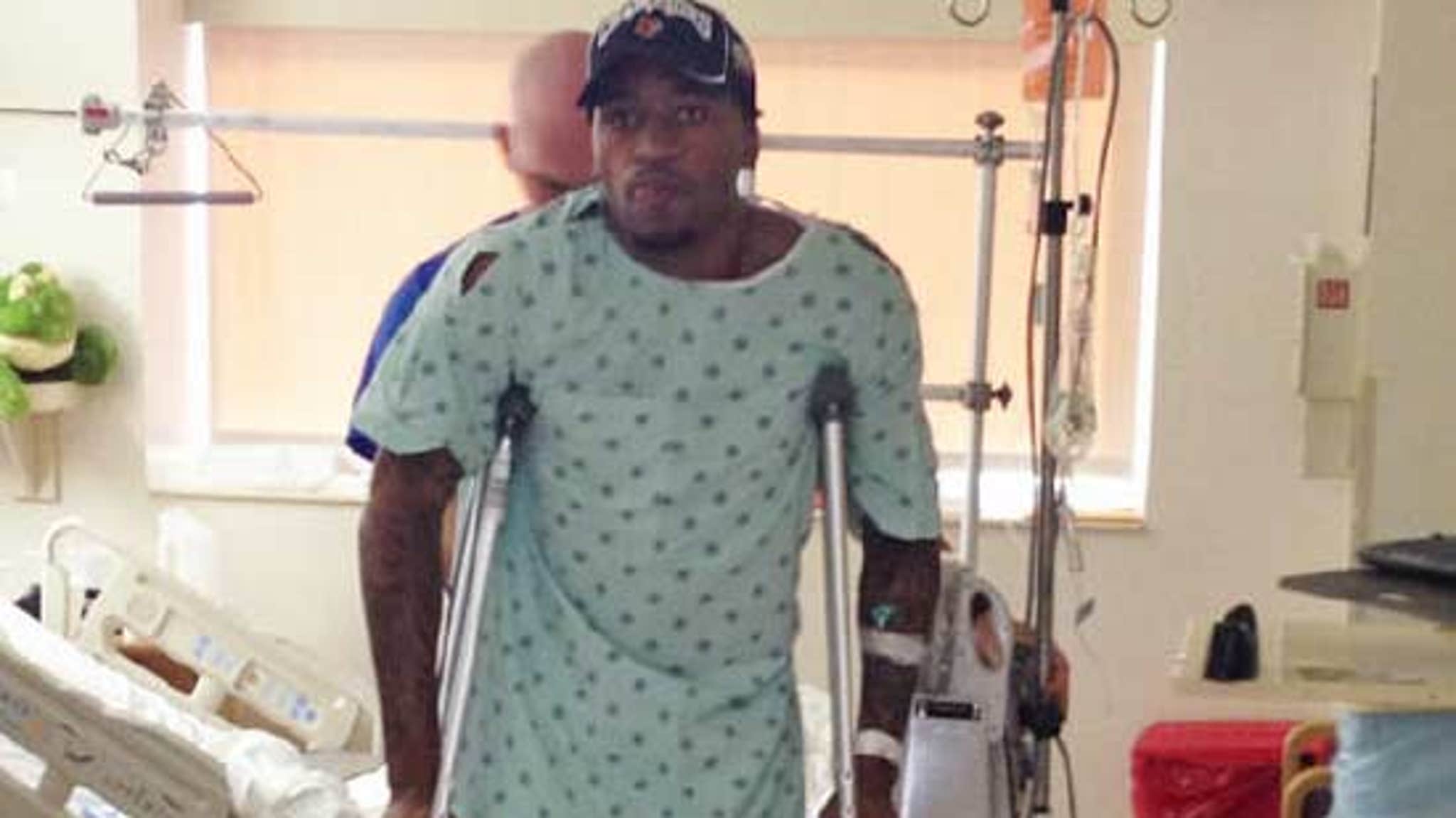
- The Recovery: He was walking on crutches just a few days later.
- The Risks: Surgeons were watching for Compartment Syndrome (pressure build-up that kills tissue) and DVT (blood clots).
He actually woke up from surgery to find the Midwest Regional trophy sitting next to his bed. Talk about a morale boost. Louisville went on to win the National Championship that year, and seeing Ware on crutches under the hoop, helping his team cut down the nets in Atlanta, is still one of the most iconic images in NCAA history.
Life After the Injury: Was He Ever the Same?
Most people remember the break, but they don't remember what happened after. Did he play again? Yeah, he did. But it wasn't easy.
Ware returned to the court for Louisville just seven months later in an exhibition game. He got a standing ovation that probably could have been heard in the next county. But the chemistry was different. The role was different. He eventually decided he needed a fresh start and transferred to Georgia State.
It turned out to be the right move.
At Georgia State, Ware didn't just "play"—he thrived. He led the Panthers to the NCAA Tournament in 2015. He was named the Sun Belt Conference Tournament MVP. If you want a story of resilience, look at his stat line from that era. He averaged 11.6 points per game in his final college season. He proved that his career didn't end on that floor in Indianapolis.
Where is Kevin Ware now?
As of 2026, Kevin Ware has carved out a long, respectable career in professional basketball, just not in the NBA. He’s a true globetrotter. He has played in:
- Czech Republic (BC Brno)
- Greece (Faros Larissas)
- London (London Lions)
- Iraq (Al Naft Baghdad)
- Mexico (Chihuahua)
He also launched his own apparel line, "Way Up Ware." He’s 33 years old now, and he’s lived a whole lifetime of basketball since that 2013 game. He’s healthy, he’s still hooping, and he’s managed to move past being "the guy with the leg injury."
Why the Kevin Ware Leg Break Still Matters
The injury changed broadcasting. If you notice now, when a player goes down with a "non-contact" or graphic injury, networks like CBS and ESPN are much faster to cut away. They don't show the replays ten times anymore. Ware’s injury was the turning point for that.
It also reignited the debate about student-athlete rights. People looked at Ware and realized that if his career had ended that night, his scholarship could have been at risk depending on the school's policy. It pushed the conversation forward on multi-year scholarship guarantees and better medical coverage for college athletes.
Practical Lessons for Athletes
If you’re a high-impact athlete, there are things you can actually do to avoid the "perfect storm" that hit Ware.
- Don't ignore "shin splints." Often, what we call shin splints are actually the early stages of stress fractures.
- Fix your landing mechanics. Ware landed with a "twist" and a locked knee. Learning to absorb impact through the hips and ankles is a literal career-saver.
- Bone density matters. Proper nutrition—calcium, Vitamin D, and phosphorus—is non-negotiable for basketball players who live in the air.
Kevin Ware’s story is often filed under "Tragedies," but it shouldn't be. He won a ring. He graduated. He played pro ball for over a decade. He’s a reminder that a single moment, no matter how graphic or terrifying, doesn't have to define the rest of your life.
If you're dealing with a sports injury yourself, the path back is rarely a straight line. Ware’s journey shows that "returning" doesn't always mean going back to exactly who you were before; sometimes it means becoming something new and equally successful elsewhere. Focus on the immediate rehab, listen to the surgeons, and remember that the mental recovery usually takes twice as long as the physical one. Keep moving forward.
Next Steps for Injury Prevention:
- Assess your footwear: Ensure your court shoes have adequate arch support to reduce tibial stress.
- Consult a PT: If you have persistent lower-leg pain, get a bone scan to rule out stress reactions before they become fractures.
- Monitor workload: Use a training log to track "jump volume" and avoid sudden spikes in high-impact activity.
[/article]