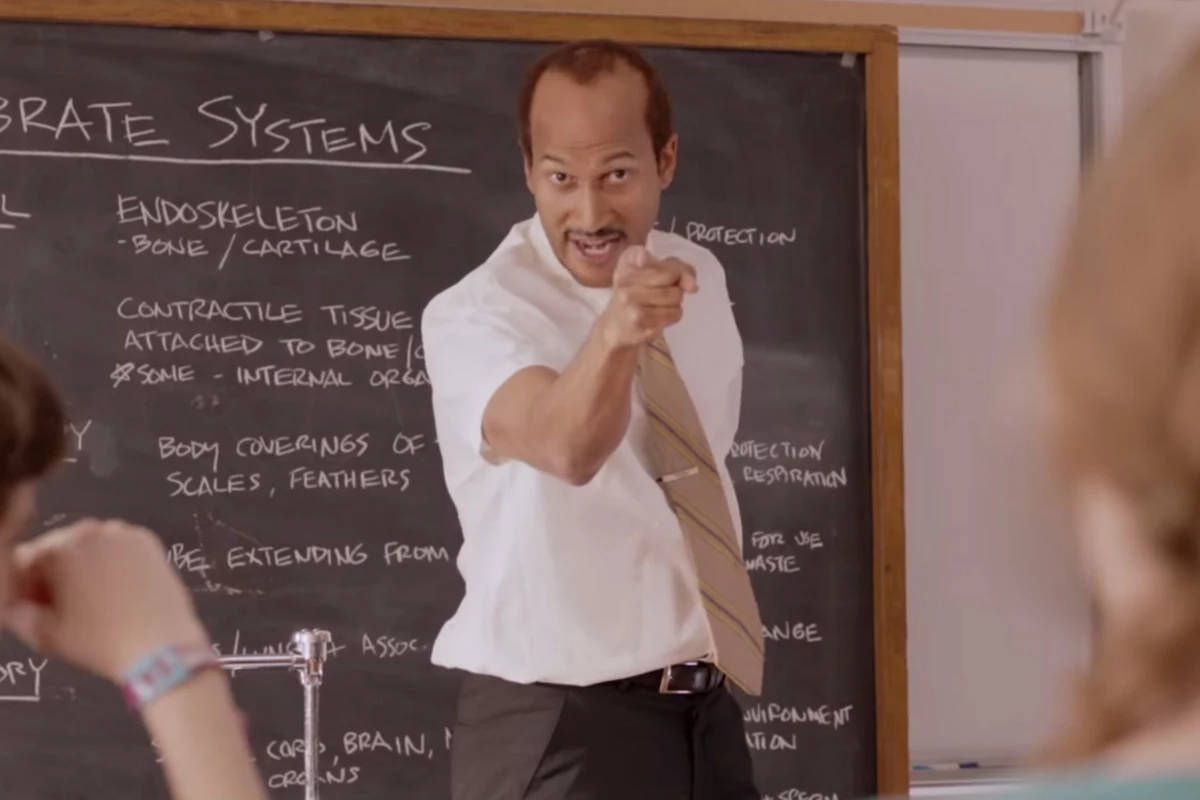
You've seen it. Even if you haven't watched a full episode of their Comedy Central show, you’ve seen the clip. A middle-aged man with a receding hairline and a short tie stands at the front of a classroom, vibrating with an intensity that feels bordering on a nervous breakdown. He looks at a clipboard and screams "A-A-Ron!" into the face of a bewildered teenager.
The Key and Peele substitute teacher sketch—officially titled "Substitute Teacher"—is one of those rare moments where lightning didn't just strike; it stayed in the bottle and started charging everyone's phones.
Honestly, it’s been over a decade since it first aired in 2012, yet the cultural footprint is massive. We aren't just talking about a funny video. We’re talking about 200 million views on YouTube alone. It’s a sketch that changed how people named Blake, Aaron, and Denise have to live their lives. If your name is Aaron and you go to a Starbucks today, there is a 40% chance the barista will yell "A-A-Ron" when your latte is ready.
That’s the kind of power Mr. Garvey has.
The Weird Logic of Mr. Garvey
The premise is dead simple, which is why it works. Keegan-Michael Key plays Mr. Garvey, a man who has spent 20 years teaching in the "inner city" and is now subbing in a predominantly white, suburban high school. He is convinced the students are trying to "play" him by giving him fake names.
But here’s the thing: the names are as basic as they get.
- Jacqueline becomes Jay-Quellin.
- Blake becomes Balakay.
- Denise becomes De-Nice.
What makes it human is the sheer, unbridled conviction. Mr. Garvey isn't just wrong; he is aggressively, violently certain that he is right. He views the correct pronunciation as a personal insult. When "A-A-Ron" tries to correct him, Garvey threatens to "break his foot off" in the kid’s ass. It’s a masterclass in tension.
The humor comes from the role reversal. Usually, we see sketches about white teachers struggling with "urban" names. Key and Peele flipped the script. They took the most common Caucasian names and treated them like foreign, impossible-to-decipher puzzles.
Behind the Scenes: It Wasn't Supposed to be a Hit
Kinda crazy to think about, but the writers didn't know this would be the sketch.
During the pitch meeting, the room went into a "frenzy" once the idea of mispronouncing names was brought up. Everyone had a name they wanted to ruin. According to Keegan-Michael Key, the character’s look—the "tight and high" military-style hairline and the short tie—was meant to show a man who had been hardened by decades of classroom management.
They filmed it quickly. Most of the students were told to play it completely straight, acting like normal kids dealing with a legitimate psychopath.
There was a lot of improv, too. In the "D-Nice" segment, Shelby Fero (who played Denise) had to keep a straight face while Key screamed "Say it right!" inches from her nose. They did that exchange about 13 times. The version we see is just the edited highlight reel of a much longer, more exhausting comedic battle.
Why It Actually Matters (The E-E-A-T Perspective)
Beyond the "Churlish and Insubordinate" memes, there’s a real layer of social commentary here. Key and Peele are both biracial, and much of their work deals with "code-switching"—the act of changing how you speak or act depending on your environment.
Mr. Garvey is a man who cannot, or will not, code-switch.
He brings the survival tactics of a rough school environment into a space where they aren't needed, creating a hilarious but pointed friction. It highlights the massive cultural divide between different American school districts. It’s a "sly commentary on classroom management," as some educators have noted. It’s funny because it’s absurd, but it’s lasting because it touches on the very real anxiety of being a fish out of water.
The Legacy of "A-A-Ron"
The sketch was so big it spawned several sequels. We got:
- Substitute Teacher Part 2: Where Mr. Garvey refuses to let students leave for yearbook photos.
- Substitute Teacher Part 3: The one with the "Insubordinate and Churlish" payoff.
- The Paramount+ Ad: In 2022, Key actually returned to the role for a massive commercial, proving that the character is still a heavy hitter for the brand.
There was even talk of a feature-length movie at one point. Paramount bought a pitch where Mr. Garvey would be pitted against a rival teacher played by Jordan Peele. While the movie hasn't materialized yet, the character lives on in NFL "Roll Call" segments and late-night talk show appearances.
How to Apply "The Garvey Method" to Your Life
Okay, don't actually scream at people in a classroom. That’s a one-way ticket to an HR meeting.
However, there is a lesson here about conviction.
If you're going to do something, go all in. Mr. Garvey is the ultimate "wrong but confident" archetype. In a world where everyone is hedging their bets and using corporate speak, there is something oddly refreshing about a man who stands his ground, even if that ground is "Balakay."
If you're looking to revisit the magic, the best way is to watch the original sketch with the "Inner City" context in mind. Look at the student Timothy (played by Jordan Peele). He’s the only one who gets a pass. Why? Because he speaks Garvey’s language. He answers "Pre-sent" with the exact same cadence Garvey expects.
It’s the one moment of peace in the whole sketch.
What You Should Do Next
If you want to dive deeper into the world of Key and Peele substitute teacher lore, your next move is to check out the "East/West Bowl" sketches. It’s the spiritual sibling to the substitute teacher bit, playing with the same themes of name-based humor and social identity. You can find the full collection on the Comedy Central YouTube channel or stream the entire series on Paramount+.
Stop calling your friend Aaron by his real name. It's A-A-Ron now. It’s been 14 years. It’s not a joke anymore; it’s a law.