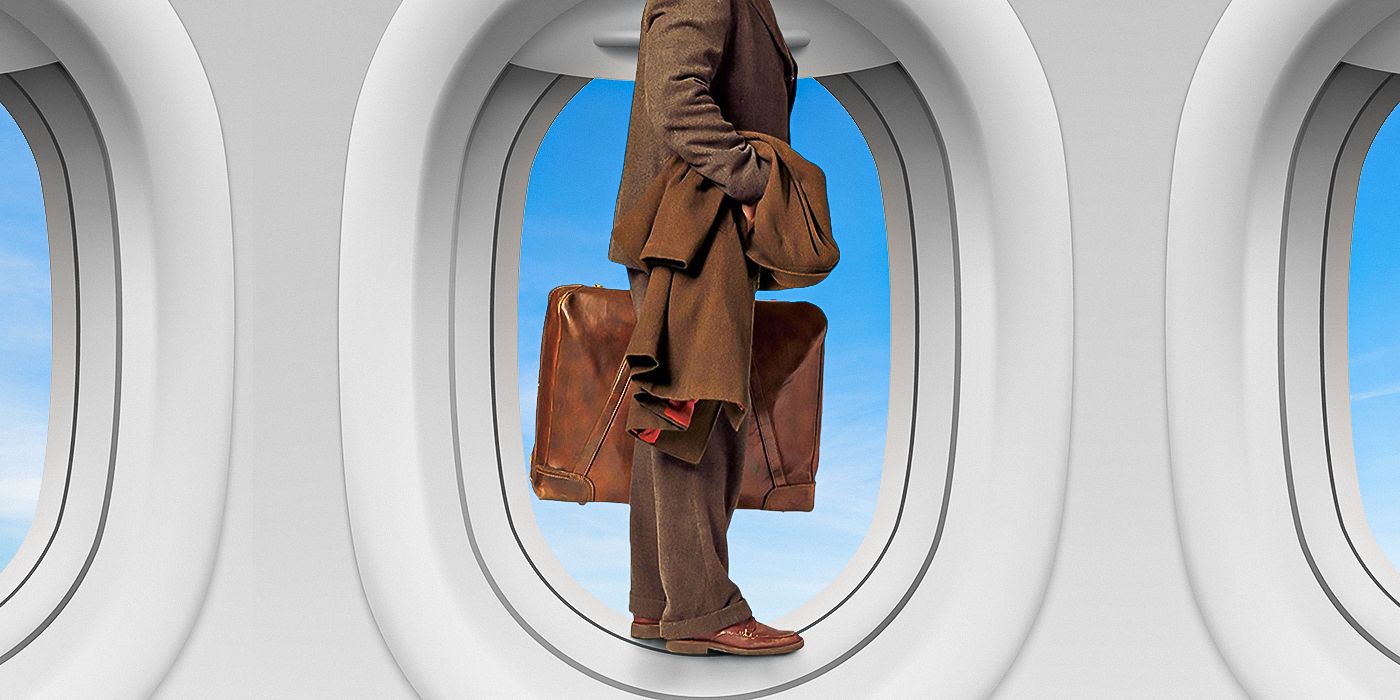
Eighteen years. Think about that for a second. That is long enough for a child to be born, graduate high school, and become a legal adult. Now imagine spending every single one of those days—all 6,570 of them—inside a single airport terminal. No fresh air. No sunlight that hasn't been filtered through thick, industrial glass. Just the hum of fluorescent lights and the endless shuffle of travelers who are actually going somewhere.
This isn't a writing prompt for a dystopian novel. It's what happened to Mehran Karimi Nasseri. Most people know the "Hollywood version" because of Steven Spielberg’s 2004 film The Terminal, where Tom Hanks plays a lovable guy from a fictional country stuck at JFK. But the real story of the man they called "Sir Alfred" is way more complicated, significantly darker, and honestly, a bit heartbreaking. He didn't live in a shiny New York airport. He lived in the basement shopping mall of Terminal 1 at Paris-Charles de Gaulle.
He stayed there from 1988 until 2006.
How a Man Becomes a Permanent Resident of Charles de Gaulle
Nasseri’s journey to the red bench in Terminal 1 didn't start with a quirky mishap. It started with a nightmare of bureaucracy. Born in Masjed Soleiman, Iran, he traveled to the United Kingdom in the early 1970s to study at the University of Bradford. This is where things get messy. Nasseri claimed he was expelled from Iran in 1977 for protesting against the Shah. He said he was stripped of his citizenship.
He spent years crisscrossing Europe, applying for asylum in different countries. Eventually, Belgium granted him refugee status in 1981. This gave him the right to live in Europe, but Nasseri wanted to get back to the UK. In 1988, he took a flight from Paris to London.
He never made it past immigration at Heathrow.
Nasseri claimed his briefcase, containing his refugee documents, had been stolen on a train in Paris. When he landed in London, he had no papers. The British authorities did exactly what you’d expect: they put him on the next plane back to where he came from. He landed back at Charles de Gaulle Airport, but since he had no documents to prove who he was or where he belonged, he couldn't legally enter France. But because he had arrived there legally from London, they couldn't deport him either.
He was stuck in a legal "no man's land." Literally.
The Reality of Life on a Red Bench
Forget the movie’s montage of Tom Hanks finding clever ways to make money or romancing flight attendants. Nasseri’s life was defined by a crushing, repetitive stillness. He lived on a curved red plastic bench in the basement of the terminal.
He didn't beg. That's a huge misconception. He was incredibly dignified, almost to a fault. He spent his days sitting on that bench, surrounded by his life packed into cardboard boxes. He wrote in his diary—thousands of pages of it. He read the newspapers left behind by passengers. He smoked a pipe. He became a fixture of the terminal, a piece of living furniture that the airport staff eventually just accepted.
The airport employees became his surrogate family. The doctors at the airport clinic checked on him. The cleaning crews moved around his boxes. The workers at the McDonald’s would bring him food. He washed his clothes in the public restrooms and sent his laundry to the airport's dry cleaners.
It sounds peaceful, maybe? It wasn't. It was a prison without bars.
The Psychology of "Sir Alfred"
As the years stretched into a decade, something changed in Nasseri. He started calling himself "Sir Alfred." He insisted that he wasn't Iranian. He even started claiming he was British or Swedish.
Christian Bourget was the French human rights lawyer who took up Nasseri’s case for free. It took years of fighting through Belgian and French courts. Finally, in 1999, Belgium agreed to send him replacement papers. He was free. He could leave. He could go anywhere in Europe.
But he didn't.
He refused to sign the papers. Why? Because the documents listed him as Iranian. He told his lawyer, "I am not Iranian. I am Sir Alfred." He had lived in the terminal so long that the "real world" outside the glass doors had become more terrifying than the red bench. Psychologists call this institutionalization. When the very thing that imprisons you becomes the only thing that makes you feel safe, you're in deep trouble.
The Spielberg Connection and the Final Years
In the early 2000s, Hollywood came calling. DreamWorks reportedly paid Nasseri roughly $250,000 for the rights to his story. It was a life-changing amount of money for a man who lived in a basement.
Did he use the money to buy a house? No. He kept living in the airport.
He did move into a hotel for a short period after the movie's release, mostly because the terminal was being renovated and he was eventually hospitalized for an ailment in 2006. After his hospital stay, he was cared for by the French Red Cross and lived in a shelter in Paris. For a few years, it seemed like the saga of the "terminal man" had finally ended with him re-entering society.
But the pull of the airport was too strong.
In a twist that most people missed, Mehran Karimi Nasseri actually returned to Charles de Gaulle Airport in late 2022. He was an old man by then, likely in his late 70s. He went back to Terminal 2F. He sat in the public area, once again surrounded by his belongings.
He died there.
On November 12, 2022, Nasseri suffered a heart attack in the terminal. He died in the place that had defined his existence for nearly forty years. Police found several thousand euros on him—the remnants of his movie money—but he had chosen to spend his final weeks exactly where he felt he belonged.
What We Can Learn From the Real Terminal Story
Nasseri’s life isn't a feel-good story about human resilience. It’s a cautionary tale about how the systems we build to manage people—passports, visas, borders—can utterly destroy a person's identity.
When you strip away a person's ability to move, you eventually strip away their ability to choose. Nasseri became a ghost in the machine. He was a man who existed between the cracks of international law.
If you're looking for the "actionable" part of this, it's about the fragility of status.
- Document Security: Nasseri’s nightmare started with a lost briefcase. In a digital age, we think we're safe, but legal identity is still surprisingly fragile. Always maintain digital backups of essential travel documents (passports, visas, birth certificates) in a secure, encrypted cloud.
- The Mental Toll of Isolation: Chronic loneliness and displacement don't just hurt; they rewire the brain. Nasseri’s refusal to leave in 1999 is a textbook example of how prolonged isolation creates a "comfort zone" out of a crisis.
- The Power of Advocacy: Without Christian Bourget, Nasseri would have remained a legal non-person forever. If you are ever navigating complex international bureaucracy, a specialized legal advocate isn't a luxury—it's a survival requirement.
We like to think of airports as places of transition. You go through them to get somewhere else. But for Mehran Karimi Nasseri, the transition became the destination. He didn't just inhabit Terminal 1; he became part of it. When we watch the movie, we see a fable. When we look at the facts, we see a man who was lost in plain sight, proving that sometimes, the hardest place to leave is the one where you were never supposed to stay.
To really understand the complexity of his case, one should look into the archival reporting from The Guardian and The New York Times from the late 90s. They capture the nuances of his legal battle that a two-hour film simply can't touch. Nasseri wasn't a hero or a victim in a simple sense. He was a man who, when the world told him he didn't exist, decided to exist in the only place that wouldn't kick him out.