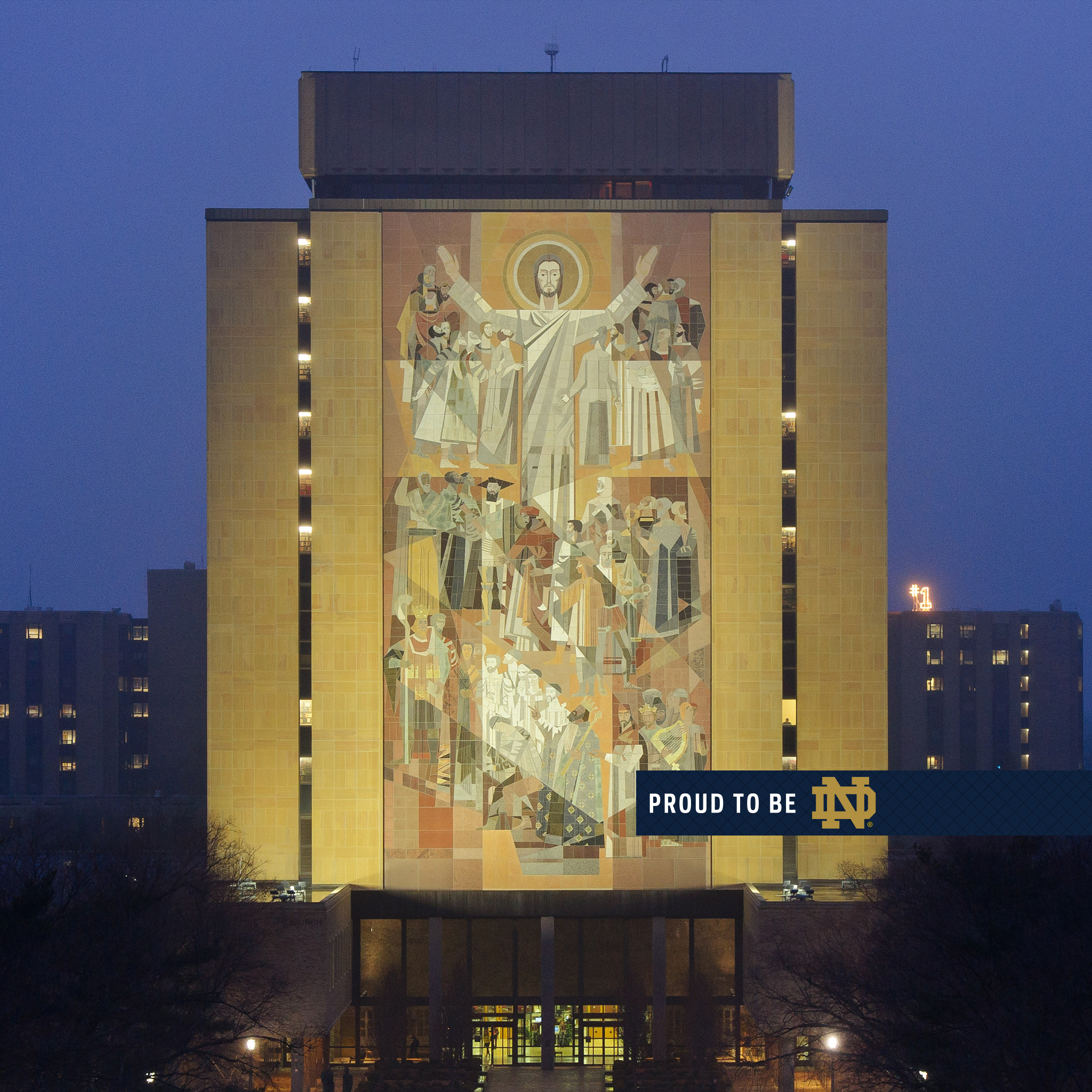
You’re sitting in the upper bowl of the house that Rockne built. The sun is dipping just low enough to catch the gold leaf on the helmets of the Irish as they trot out toward the north end zone. But if you look up—way up past the rim of the stadium—you see him. He’s got his arms raised. He’s huge. He’s technically a mosaic on the side of a library, but to every college football fan on the planet, he is simply Notre Dame Stadium Touchdown Jesus.
It’s one of those rare sports landmarks that transcends the game itself. Honestly, it’s kinda weird when you think about it. A massive religious mural looming over a 77,000-seat gridiron? It shouldn't work. It should feel out of place. Yet, it has become the defining image of South Bend. It’s not just a backdrop; it’s a silent participant in every home game. If you've ever wondered how a piece of university architecture became a pop-culture icon, the story is actually a lot more practical—and slightly more controversial—than the myth suggests.
The Real Name Most People Forget
Nobody calls it by its "real" name. Officially, the mural is titled The Word of Life. It was the brainchild of Millard Sheets, an artist who was basically the king of large-scale mosaics in the mid-20th century. When the Hesburgh Library was being constructed in the early 1960s, the university wanted something that represented the marriage of faith and learning. They didn't want a football mascot. They wanted a depiction of Christ as the Great Teacher, surrounded by a crowd of saints, scholars, and thinkers.
The mural is massive. We are talking 134 feet high and 68 feet wide. It’s composed of 81 different types of stone from 16 different countries. There are thousands of individual pieces of granite and marble. It was a massive undertaking that cost a fortune at the time. When it was finished in 1964, the intention was purely academic and spiritual. But then the football fans showed up.
How the Nickname Took Over the World
The nickname Notre Dame Stadium Touchdown Jesus wasn't a marketing stunt. It was an accident of geometry.
When the library was built, the stadium was much smaller than it is today. Specifically, the north end of the stadium was open or had lower seating. From the perspective of the field—and more importantly, from the perspective of the TV cameras—Jesus’s upraised arms looked exactly like a referee signaling a touchdown. It was instant. It was funny. It stuck.
The University’s administration wasn’t exactly thrilled at first. You have this deeply serious, multi-million dollar religious artwork, and people are comparing it to a sports signal. But over time, Notre Dame leaned into it. They realized that you can't fight a nickname that becomes that iconic. It gave the stadium a character that no other venue in the country could replicate. You have the "frozen tundra" at Lambeau and the "bushes" at Georgia, but Notre Dame has a literal biblical figure watching the goal line.
The 1997 Renovation Scare
For decades, the view was unobstructed. Then came 1997. The university decided it needed more seats. They added a massive upper rim to the stadium, and for a while, the Notre Dame community was in a full-blown panic. People genuinely thought the renovation would hide the mural from the fans inside.
There was a lot of back-and-forth between architects and the Board of Trustees. If they built the stands too high, the "Touchdown Jesus" effect would vanish. They ended up compromising. The new upper deck was designed with a specific notch so that the mural remained visible from the field. However, if you sit in certain sections of the south end zone now, you can only see the top half of the mural. It changed the "perfect" view, but it preserved the tradition. It was a reminder that even at a place as steeped in history as Notre Dame, progress sometimes nibbles at the edges of tradition.
More Than Just a Mosaic
If you look closely at the mural—and I mean really look, maybe with binoculars from the 50-yard line—you see the complexity Millard Sheets was going for. It isn't just one guy. There are 132 figures in the artwork. You have Origen, Jerome, Augustine, and Aquinas. It’s a literal "who’s who" of Christian intellectual history.
The stones themselves are a geological map of the world. You’ve got:
- Granite from Norway and Sweden.
- Marble from Italy and Greece.
- Stone from India and South Africa.
The sheer weight of the thing is staggering. It’s not painted on. It’s a jigsaw puzzle of heavy rock. This is why it hasn't faded over the decades. While the stadium turf has been replaced and the bleachers have been swapped out, the mural looks almost exactly the same as it did the day it was dedicated in May 1964.
The Cultural Weight of the Mural
There’s a reason why every visiting team takes a photo in front of it. It represents the "mystique" of Notre Dame. Whether you're a devout Catholic or a die-hard atheist who just likes sports, there is an undeniable gravity to the location.
Critics sometimes argue that it’s a bit much. They say it’s a sign of "muscular Christianity" that prioritizes sports over the actual "Word of Life." And honestly? They might have a point. But in the context of American sports, where stadiums have become sterile, corporate bowls named after banks and tech companies, having a massive piece of art—religious or otherwise—that defines the space is refreshing. It’s human. It’s weird. It’s South Bend.
What You Should Do Next Time You're There
If you're heading to a game, don't just look at it from your seat. Walk over to the library. Standing at the base of the Hesburgh Library looking up at Notre Dame Stadium Touchdown Jesus is a completely different experience. You realize the scale. You see the texture of the granite. You see the reflection in the pool in front of it (the "Reflection Pool" which, let's be honest, is mostly used for great pre-game photos).
Most people just see the arms. But if you stand right at the edge of the water, you see the "Teacher" aspect. You see the books and the scrolls. It’s a good reminder that while the game on the field lasts sixty minutes, the stuff on the wall is meant to last centuries.
Actionable Insights for Your Visit
To get the most out of seeing this landmark, keep these points in mind:
- Best Photo Op: The reflection pool in front of the Hesburgh Library. Go about two hours before kickoff. The light hits the mural perfectly, and the crowd hasn't reached peak density yet.
- The "Secret" View: If you can get into the upper levels of the stadium on the south side, you get the classic "TV view" that made the nickname famous.
- Respect the Space: Remember that the library is a working academic building. During game days, the plaza is a party, but the mural itself is still considered a sacred site by many.
- Study the Stones: If you’re a nerd for details, look for the different colors of granite. The variation isn't just for art; it represents the diversity of the "World of Life" that the university aims to represent.
Don't just treat it like a scoreboard. Whether the Irish win or lose, that mural is going to be there on Sunday morning, arms up, watching over an empty parking lot. It’s the one constant in a sport that is constantly changing.