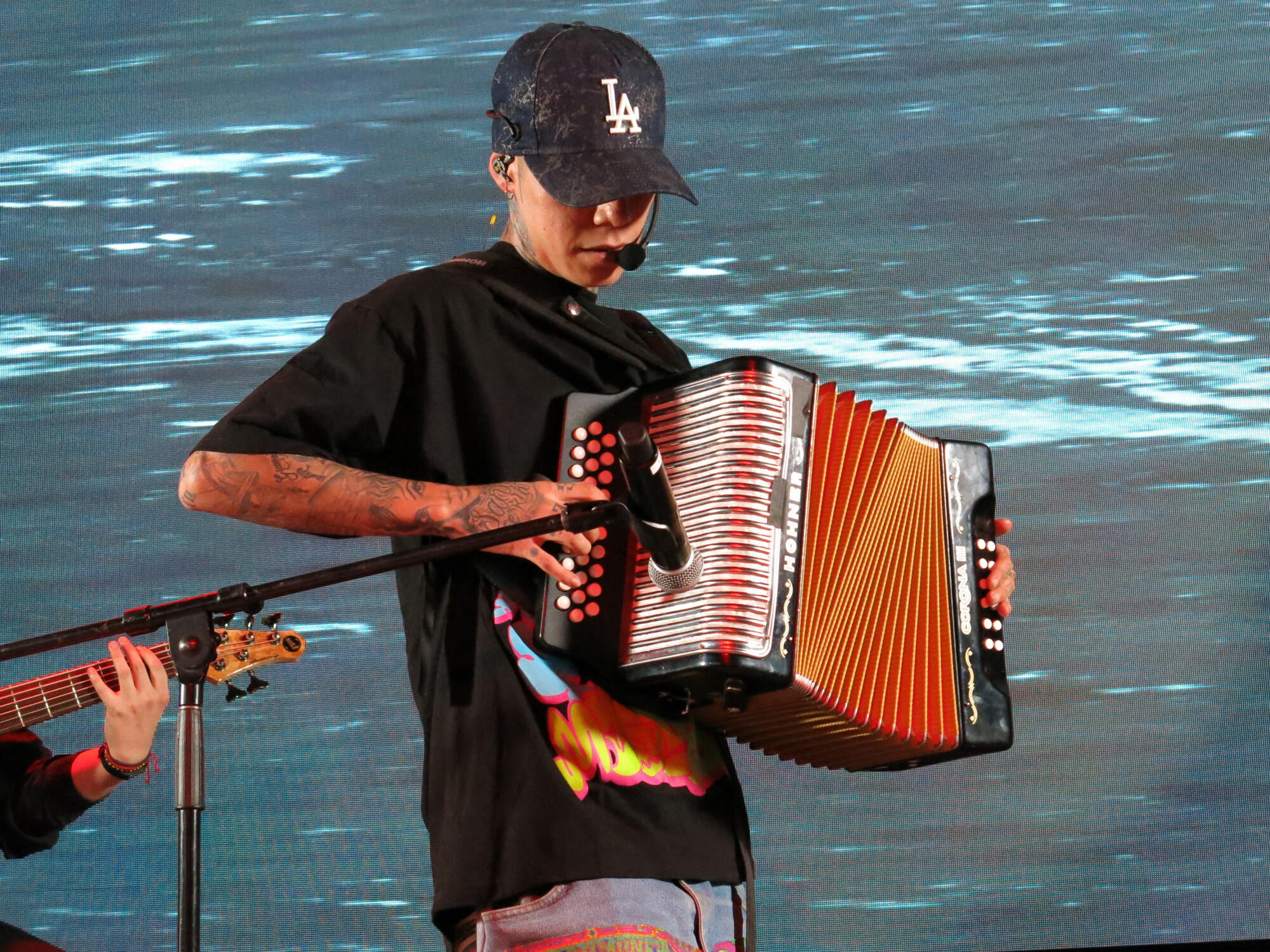
You can hear him before you see him. That raspy, unmistakable voice—weathered by the dust of Guanajuato—cutting through a heavy cumbia-trap beat. It’s the sound of Santa Fe Klan, or Ángel Jair Quezada Jasso if we’re being formal. But nobody is formal when it comes to Ángel. He’s the kid who turned a neighborhood struggle into a billion-stream reality, and honestly, the music industry still hasn't figured out how to categorize him. Is he a rapper? A cumbia legend in the making? An accordion virtuoso? He's all of it, and that’s exactly why he’s currently dominating the global stage.
If you walk through the Santa Fe neighborhood in Guanajuato today, things look a little different than they did fifteen years ago. Back then, a young Ángel was just trying to find a way to record songs without a real studio. Now, there’s a massive mural of his face and a physical store where fans trek like it’s a religious pilgrimage. He didn't just name himself after his "barrio"; he brought the entire barrio with him. That's not marketing fluff. It’s a rare kind of loyalty that usually gets bleached out of artists once they hit the mainstream.
The Raw Origin of the Santa Fe Klan Name
People always ask about the "Klan" part. It sounds heavy, right? But for Ángel, it was never about anything sinister. It was about the group of friends he started with. In the early days, Santa Fe Klan was a collective, a group of kids trying to survive and express themselves through hip-hop. As members drifted away or life took them in different directions, Ángel kept the name. He became the living embodiment of that original brotherhood.
He started recording at age 12. Think about that for a second. While most of us were figuring out middle school math, he was rigging up microphones and obsessed with the rhythm of the streets. By 15, he had his own studio. It wasn't fancy. It was grit and necessity. This wasn't about "making it big" in the Los Angeles sense; it was about being heard in the 473 area code.
His breakthrough didn't come from a polished PR campaign. It came from the sheer volume of his output. He released songs at a breakneck pace, blending the hard-hitting lyrics of urban life with the soulful, accordion-heavy sounds of cumbia sonidera. It was a collision of worlds. Old-school Mexican parents could vibe with the rhythm, while their kids related to the lyrics about life, love, and the police.
Why the Music Hits Different (It’s the Accordion, Honestly)
Most rappers stick to a formula. You get a beat, you drop some bars, you call it a day. Santa Fe Klan rejects the formula. One minute he’s dropping a hardcore rap track like "Silencio en el Callejón," and the next, he’s pulling out a Hohner accordion to play a heartbreaking cumbia.
The accordion is his secret weapon. It’s an instrument that carries the weight of Mexican history, and by bringing it into the world of trap and hip-hop, he bridged a generational gap that most artists can't touch. When he collaborated with the legendary Los Ángeles Azules, it wasn't a gimmick. It was a passing of the torch.
- The Sound: A mix of boom-bap, regional Mexican, and classic cumbia.
- The Vibe: Vulnerable but tough. He's not afraid to cry about a breakup or talk about the friends he's lost to violence.
- The Evolution: He’s moved from DIY street videos to high-budget productions, but the tattoos and the baggy clothes stay the same.
Breaking Into the Marvel Cinematic Universe and Beyond
If you missed him on the Black Panther: Wakanda Forever soundtrack, you weren't listening. His track "Soy" was a massive moment for Mexican representation. Hearing that Guanajuato rasp in a global blockbuster was a "we made it" moment for his entire community. He didn't change his style for Disney. He sounded exactly like the kid from the barrio, just with better mixing.
But with great fame comes the inevitable chaos. His personal life—specifically his relationship with Maya Nazor and the birth of their son, Luka—became tabloid fodder. In Mexico, the paparazzi treat him like a rock star because, well, he is one. The breakup was messy in the public eye, but Ángel did what he always does: he put it into the music. He doesn't hide behind a curated Instagram persona. If he’s hurting, you’re going to hear it in the next single.
The Business of Being Ángel Quezada
He’s more than a singer. He’s a brand. His store in Guanajuato isn’t just a place to buy t-shirts; it’s a local economy driver. He employs people from his neighborhood. He provides a hub for local artists. In an era where most celebrities move to Miami or Hidden Hills the second they get a check, Ángel’s continued presence in his hometown is a radical act.
He’s also been incredibly smart about collaborations. Working with Snoop Dogg and Lupillo Rivera on "Grandes Ligas" was a masterstroke. It connected the West Coast G-funk era with the Mexican corrido and rap scenes. It proved that Santa Fe Klan wasn't just a local phenomenon; he could hold his own with global icons.
There’s a rawness to his live shows that you don't see much anymore. He’s known for jumping into the crowd, for playing until the venue tries to shut him down, and for bringing out dozens of friends on stage. It’s chaotic. It’s loud. It’s exactly what his fans want. They don't want a choreographed pop show; they want to feel the energy of a street party.
Addressing the Critics
Not everyone is a fan, obviously. Some traditionalists think he’s "ruining" cumbia by adding rap. Some rap purists think he’s too "pop" or regional. But these critics usually miss the point. Santa Fe Klan isn't trying to fit into a box. He’s building a new box entirely. He represents a modern Mexico that is proud of its roots but also heavily influenced by global urban culture.
His lyrics often touch on dark themes—poverty, drugs, loss. Some argue this glorifies a certain lifestyle. But if you actually listen, he’s reporting. He’s a journalist of the streets. He’s telling the story of what he saw outside his window. To ignore those themes would be to lie about his life.
How to Actually Support the Movement
If you're new to the world of Santa Fe Klan, don't just stick to the hits on Spotify. To really get it, you have to dig into the live sessions and the acoustic performances. Seeing him play the accordion while smoking a cigarette and laughing with his friends tells you more about his "why" than any polished music video ever could.
- Check out the "Mundo" album. It’s arguably his most experimental work, showing a range that goes far beyond simple rap.
- Watch the "Santa Fe Klan - Desde el Barrio" documentary clips. They give you a look at the actual streets that shaped his sound.
- Follow the 473 Music label. This is his way of bringing up the next generation of Guanajuato talent.
The reality is that Ángel Quezada has already won. He’s taken a name that belonged to a small group of friends and made it a global trademark. He’s proved that you don't have to lose your accent or your neighborhood to sell out arenas in the United States and South America.
The next step for him? It looks like more cross-genre experimentation. There are rumors of more English-language collaborations, but don't expect him to start singing in English exclusively. His power lies in his authenticity. He knows that his fans love him because he sounds like home. Whether he’s playing for 50 people in a backyard or 50,000 at a festival, the energy is the same. He is the Santa Fe Klan.
Actionable Takeaways for Fans and Creators
If you're looking to follow in his footsteps or just understand the "secret sauce," here it is:
- Own your roots. Your specific local culture is your superpower, not something to be hidden.
- Consistency over perfection. Ángel released hundreds of songs before the world noticed.
- Diversify your skills. Don't just be a "rapper." Learn an instrument. Understand the production.
- Stay connected. Community isn't just a buzzword; it's a support system that keeps you grounded when the fame gets weird.
Keep an eye on his social media for impromptu street performances. He’s been known to announce a location and show up an hour later to play for free. That’s the kind of move that keeps him at the top of the game. No ego, just music and the people who love it.
Follow the 473 official store and social channels to keep up with his frequent new drops and local community projects in Guanajuato.