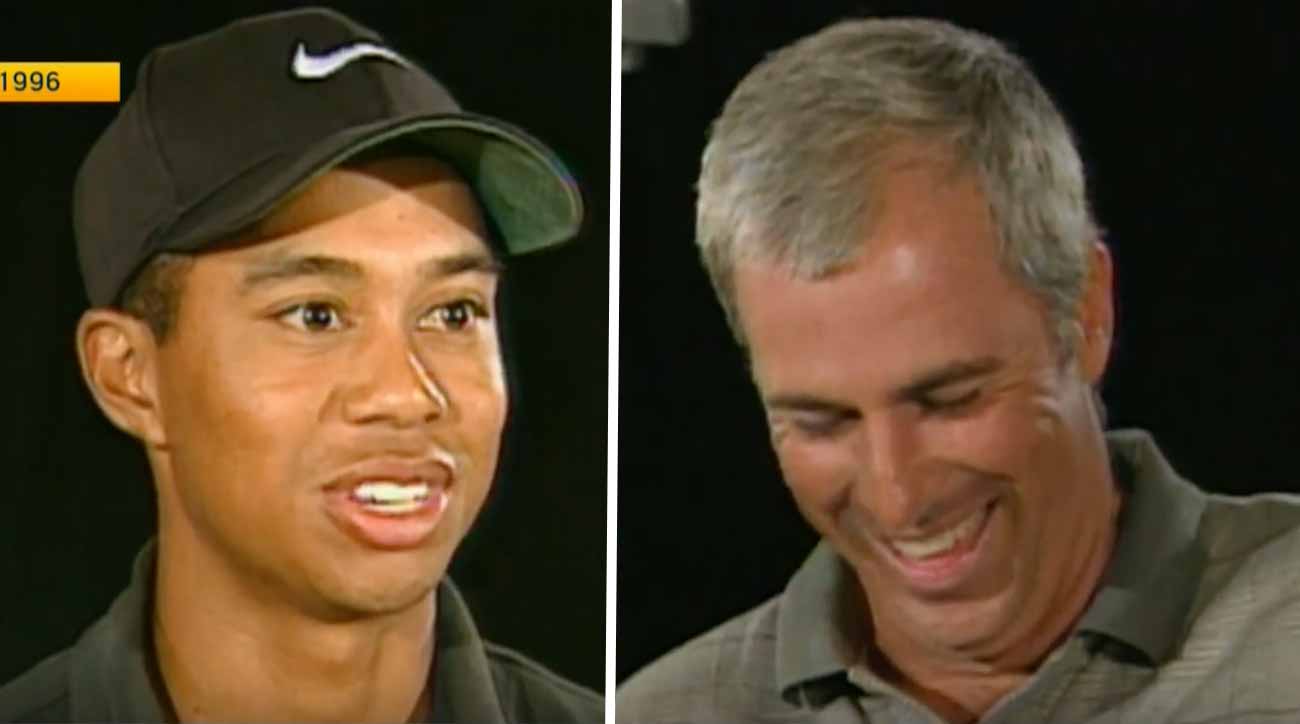
August 1996. Milwaukee. A skinny 20-year-old kid in a baggy polo shirt sits across from a two-time U.S. Open champion. Most people remember the clip. It’s one of those "freezing cold takes" that lives forever on YouTube.
The Curtis Strange Tiger Woods interview wasn't just a sit-down between a veteran and a rookie. It was a collision. Two different worlds of golf hitting each other head-on. Curtis Strange was the old guard—gritty, realistic, and frankly, a bit cynical. Tiger was something else entirely. He was the future, but nobody knew exactly how fast that future was coming.
The Interview That Defined an Era
Let’s set the scene. Tiger had just turned pro. He’d won three straight U.S. Amateurs, which is basically impossible. Nike had already handed him a $40 million contract before he’d even teed off at the Greater Milwaukee Open. The hype was suffocating.
Strange starts the interview asking what would make for a successful week. Tiger’s answer? He wanted to play four solid rounds and—oh yeah—a victory would be "awfully nice."
Strange didn't just disagree. He scoffed. He called the kid "cocky" and "brash." He looked at the camera, looked at Tiger, and dropped the line that has followed him for thirty years:
"You'll learn."
Why Curtis Strange Thought He Was Right
Honestly, in 1996, Curtis Strange’s take wasn't actually crazy. Back then, golf had a hierarchy. You paid your dues. You finished 40th, then 20th, then maybe you contended on a Sunday in your second or third year. To walk out and say you expected to win your first professional start? That was an insult to every journeyman who had been grinding for a decade without a trophy.
Strange was protecting the "sanctity" of the Tour. He genuinely thought the professional game would humble Tiger. He figured the rough was thicker, the greens were faster, and the pressure was heavier than anything a 20-year-old could handle.
But he was wrong. Spectacularly wrong.
Tiger didn’t win that week in Milwaukee (he finished T-60), but he won his fifth start at the Las Vegas Invitational. Then he won the Walt Disney World/Oldsmobile Classic. A few months later, he won the Masters by 12 strokes. Suddenly, "You'll learn" looked less like veteran advice and more like a guy trying to hold back a tidal wave with a toothpick.
The Body Language Tells the Story
If you watch the footage today, the words are only half the battle. The tension is in the air. Curtis is fidgeting. He’s leaning back, shaking his head, and looking at the ceiling like he can’t believe what he’s hearing. He’s acting like a disappointed uncle.
Tiger, meanwhile, is a statue.
He doesn’t blink. He doesn't get defensive. He just repeats his mantra: "I've always figured that why go to a tournament if you're not going there to try and win? There's really no point in even going."
That’s the exact moment the Curtis Strange Tiger Woods interview became legendary. It revealed the "Tiger Mentality" before we even had a name for it. To Tiger, second place didn't just suck; it was a waste of time.
A Clash of Personalities
- Curtis Strange: Represented the 1980s blue-collar golf. Success was earned through years of attrition.
- Tiger Woods: Represented the 2000s global icon. Success was a birthright earned through absolute dominance.
Strange later admitted that he was trying to "help" the kid in his own way. He thought he was giving him a reality check. But you can't give a reality check to someone who is busy creating a new reality.
What Most People Get Wrong About the Aftermath
People act like Curtis Strange and Tiger Woods became sworn enemies after that day. They didn't. Strange has spent years defending himself, often pointing out that the clip usually cuts off before he laughs and says "I'm just kidding you."
But let’s be real. He wasn't that much in on the joke. The laugh was a release of tension because he realized Tiger wasn't backing down.
By the time the 1997 Byron Nelson rolled around, they met again. Tiger already had four wins and a Green Jacket. Strange reportedly laughed and told Tiger he’d learned a few things himself. It was a white flag.
Why This Interview Matters in 2026
We still talk about this because it reminds us how uncomfortable greatness makes people. When someone shows up and refuses to play by the "unwritten rules," the establishment always tries to put them in their place.
The Curtis Strange Tiger Woods interview is the ultimate receipt. It’s a document of the exact moment the "Old Golf" tried to bully the "New Golf" and lost.
Strange wasn't a bad guy for what he said. He was just a victim of his own experience. He had seen a hundred "can't-miss" prospects come and go. He assumed Tiger was just another one. He didn't realize he was sitting across from a guy who was about to change the tax bracket of every single person on the PGA Tour.
Key Takeaways from the Exchange
- Confidence isn't always arrogance. Tiger knew his data. He knew his game. If you know you're the best, saying so isn't cocky—it's just a fact.
- The "Old Guard" is usually blinded by tradition. Don't let someone else's "realistic" expectations limit your own.
- Composure wins the room. Tiger won that interview not by shouting, but by remaining completely unmoved by Strange’s skepticism.
If you’re ever in a situation where a "veteran" tells you to slow down or "learn your place," remember Tiger. Sometimes the people telling you "how it is" are just terrified that you're about to show them how it could be.
The best way to handle your own "You'll learn" moment is to do exactly what Tiger did: go out and win until they have no choice but to laugh along with you.
To see the shift in golf history for yourself, you can find the original 1996 footage on the PGA Tour's official archives or various sports history channels. It’s worth a watch just to see the fire in Tiger's eyes before the world knew his name.
Actionable Insights:
- Review the transcript of the interview to understand the nuances of the "Tiger Mentality."
- Use this as a case study for maintaining composure under professional scrutiny.
- Study the 1996-1997 PGA Tour stats to see exactly how quickly Tiger made those "You'll learn" comments obsolete.