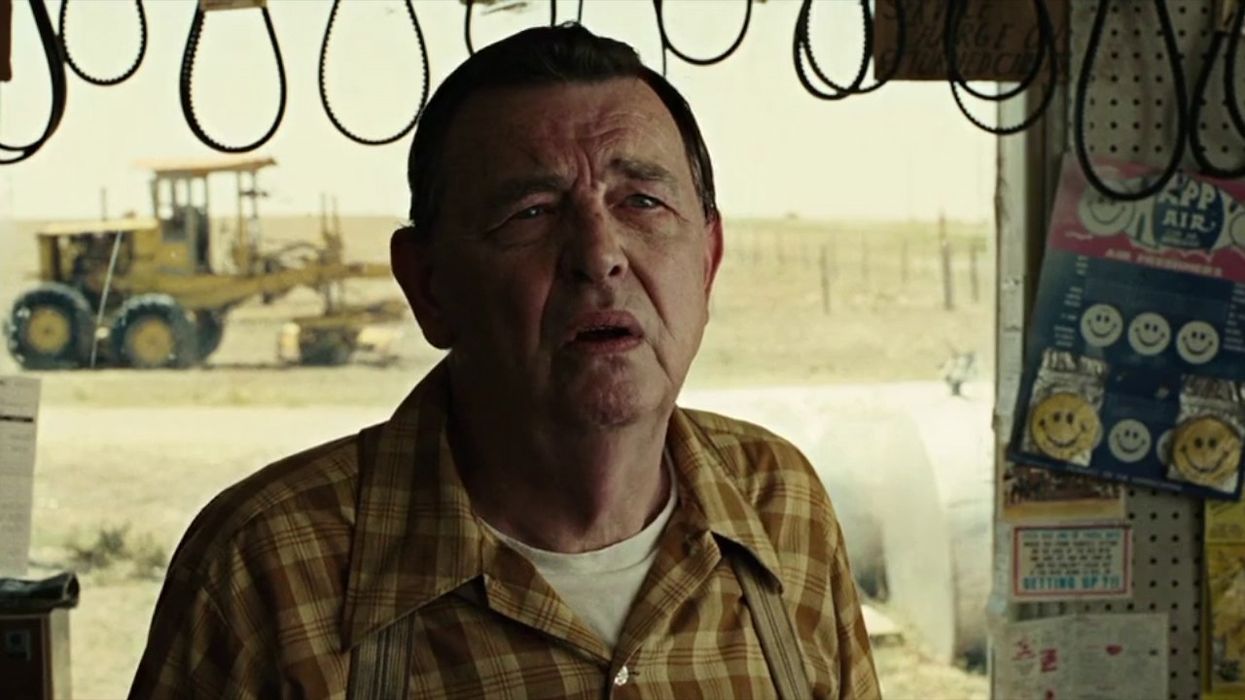
He isn't just a hitman. Anton Chigurh is a force of nature, or maybe just a really bad day personified in a bowl cut and a denim jacket. When he walks into that dusty gas station in the middle of nowhere, Texas, the air in the room just... shifts. You feel it. The proprietor feels it. And if you’re watching No Country for Old Men, you’re probably holding your breath without even realizing it.
The No Country for Old Men coin toss isn't just a bit of clever writing by the Coen Brothers or Cormac McCarthy; it’s a masterclass in tension that basically rewrote the rules for how we perceive movie villains. It’s awkward. It’s quiet. It’s deeply, deeply weird.
Most movie bad guys give you a manifesto. They tell you why they're doing what they're doing. Chigurh? He gives you a choice you didn't ask for, involving a piece of pocket change that's been traveling twenty-two years just to get to that counter. It’s a scene about luck, fate, and the terrifying realization that some people operate on a frequency you will never, ever understand.
The Anatomy of the Gas Station Confrontation
Let's talk about the setup. It’s so mundane. A gas station owner is just trying to close up. He makes a bit of idle small talk about the weather. It’s the kind of conversation we’ve all had a thousand times. But Chigurh, played with a haunting, dead-eyed stillness by Javier Bardem, refuses to participate in the social contract. He challenges every word. He turns "I guess I'll go ahead and lock up" into a cross-examination.
The tension builds because of the disconnect. The proprietor thinks he's in a conversation; Chigurh knows he's in a judgment. When the coin finally comes out, the stakes aren't even stated, but we know. We know the proprietor is playing for his life, even if he doesn't quite believe it yet.
Honestly, the sound design is what does it for me. The crinkle of the cashew bag. The wind whistling outside. The metallic tink of the coin. It’s loud because the silence around it is so heavy.
What the Coin Actually Represents
People argue about Chigurh’s philosophy all the time. Is he a nihilist? Is he a prophet of chaos? He tells the proprietor, "You need to call it. I can't call it for you. It wouldn't be fair."
That word—fair—is doing a lot of heavy lifting.
In Chigurh's twisted mind, he isn't the one killing people. The coin is. He’s just the instrument. By leaving it to a 50/50 flip, he absolves himself of the moral weight. It’s a way of saying that the universe is indifferent. If you win, you live. If you lose, well, that’s just how the physics of the world shook out for you today.
McCarthy’s writing (and the Coens' adaptation) suggests that Chigurh sees himself as an agent of fate. He tells Carla Jean later in the film that he "got here the same way the coin did." Everything is on a track. Every choice you’ve ever made led you to that specific gas station at that specific moment to face that specific coin. It’s a terrifying way to look at life because it removes all agency. You aren't a person; you're just a data point in a sequence of events.
Why the Gas Station Owner Lives
He wins. He calls "heads" and he's right. Chigurh tells him to put the coin in his pocket, but warns him not to mix it with his other change. "Don't put it in your pocket. It's your lucky quarter."
But then he corrects himself. "Anywhere not in your pocket. Where it'll get mixed in with the others and become just a coin. Which it is."
This is the kicker. Chigurh acknowledges that the coin is both a sacred object of destiny and a worthless piece of metal at the same time. The only thing giving it power is the moment of the toss. Once the toss is over, the magic is gone. The man is "saved," but he’s also fundamentally changed. He just met the devil and survived on a whim.
The Performance That Changed Everything
Javier Bardem won an Oscar for this role, and honestly, he could have won it just for the way he eats those cashews. There’s a specific kind of "uncanny valley" energy to his performance. He’s human, but he feels... off.
Psychologists have actually studied this. A group of Belgian psychiatrists once screened 400 movies to find the most "realistic" depiction of a sociopath. They landed on Anton Chigurh. Unlike the "sophisticated" killers like Hannibal Lecter or the "slasher" types like Michael Myers, Chigurh is frightening because he is utterly devoid of emotion, yet perfectly functional. He doesn't enjoy the kill. He doesn't hate the victim. He’s just... doing the math.
Comparing the Book to the Film
If you haven't read the Cormac McCarthy novel, you're missing out on some of the internal logic that makes the No Country for Old Men coin toss even bleaker. In the book, the prose is sparse. There are no quotation marks. It feels like a transcript from a crime scene.
The movie follows the book almost word-for-word in this scene, which is rare for Hollywood. It shows how much respect the Coens had for the source material. They realized they couldn't improve on the dialogue. The rhythm of the back-and-forth is already perfect.
One thing the movie adds, though, is the visual of the coin being placed on the counter. In the book, you imagine it. In the film, you see Bardem’s hand cover it. You see the grime on the counter. It grounds the philosophy in a very dirty, very real reality.
The Second Coin Toss (The One That Matters)
Most people remember the gas station. But the scene with Carla Jean at the end of the movie is the real "sequel" to the coin toss.
When Chigurh shows up at her house, he offers her the same deal. "Call it," he says.
But Carla Jean does something the gas station owner didn't. She refuses. She tells him, "The coin don't have no say. It’s just you."
This is the ultimate rebuttal to Chigurh’s worldview. She calls him out on his nonsense. She points out that he’s using the coin as an excuse to avoid being a murderer. He wants to be a ghost, a force of nature, an inevitable ending. She reminds him that he’s just a man with a gun making a choice.
Does it save her? No. Chigurh is seen checking his boots for blood as he leaves the house, implying he killed her anyway. But she won the philosophical argument. She stripped away his mask. For a brief second, he wasn't "Fate." He was just a killer.
Why We’re Still Talking About It in 2026
It’s been nearly twenty years since the movie came out, and the No Country for Old Men coin toss is still the benchmark for suspense. Why?
Maybe it’s because we live in an era where everything feels a bit chaotic. We like to think we have control over our lives. We work hard, we plan, we buy insurance. Then something totally random happens—a car wreck, a layoff, a global shift—and we realize we're just one "tails" away from a disaster.
Chigurh is the physical manifestation of that randomness. He’s the "what if" that keeps you up at night.
Actionable Insights: Lessons from the Coin Toss
While you (hopefully) won't find yourself in a life-or-death gamble with a hitman, the scene offers some pretty heavy things to chew on:
- The Power of Subtext: The scene works because they aren't talking about death; they're talking about gas prices and cashews. In your own communication, realize that what isn't said is often more powerful than what is.
- The Danger of Moral Absolutes: Chigurh’s "fairness" is actually a form of extreme cruelty. Be wary of systems that claim to be "objective" while causing harm.
- The Importance of Agency: Carla Jean’s refusal to play the game is a powerful reminder that even if you can't change the outcome, you can refuse to validate a flawed system.
- Atmosphere Over Action: You don't need explosions to create stakes. A slow-moving camera and a quiet voice can be way more impactful than a car chase.
If you’re a filmmaker, a writer, or just a fan of great storytelling, go back and watch that scene with the sound turned up. Pay attention to the pauses. Notice how Chigurh never blinks when he’s looking at the man. It’s not just a movie scene; it’s a lesson in how to make an audience feel genuinely, deeply uncomfortable.
Next time you find a quarter on the ground, maybe think twice before you flip it. You never know what’s riding on the result.