We’ve all been there. You’re standing in line at the grocery store or sitting in a soul-crushing budget meeting, and suddenly, you aren’t there anymore. You’re scaling the Himalayas. You’re saving a three-legged dog from a burning building. You’re finally telling your boss exactly where he can shove that TPS report. This is the core of The Secret Life of Walter Mitty, a story that has lived a dozen different lives since James Thurber first published it in The New Yorker back in 1939.
It’s a tiny story. Only about 2,000 words. But it tapped into a universal human glitch: the "maladaptive daydream."
Most people know the 2013 film directed by and starring Ben Stiller. Some film buffs remember the 1947 Danny Kaye musical version. But the way we talk about Walter Mitty today has shifted. He’s no longer just a henpecked husband hiding from his wife in a fantasy world. In the modern era, Mitty has become a mascot for the "quiet life" crisis—the feeling that our digital, cubicle-bound existence is robbing us of something primal and real. Honestly, it’s kind of wild how a story about a guy spacing out while buying overshoes became a manifesto for global travel and self-actualization.
The Massive Gap Between the Page and the Screen
If you go back and read Thurber’s original text, it’s actually pretty dark. There is no grand adventure. Walter doesn’t go to Greenland. He doesn’t jump into a helicopter piloted by a drunk guy. He just drives his wife to the hairdresser and imagines he’s a daring pilot or a world-class surgeon. The story ends with him standing against a wall, imagining he’s facing a firing squad. It’s a tragedy of stagnation.
The 2013 movie flipped the script.
Stiller’s version of The Secret Life of Walter Mitty is basically a "coming-of-age" story for a 40-year-old man. He works at Life magazine—a symbolic choice if there ever was one—as a negative assets manager. He’s the guy who handles the physical film in a world that’s gone digital. When a crucial negative for the final print issue goes missing, Walter has to stop daydreaming about adventure and actually go find it.
The shift from internal fantasy to external reality is where the movie gets its legs. It’s not just about dreaming; it’s about the terrifying moment you decide to stop dreaming and start doing.
Why the Sean O’Connell Character Matters
Let’s talk about Sean Penn’s character, Sean O’Connell. He’s the elusive photographer Walter is hunting down. He represents the "anti-Mitty." While Walter is stuck in a basement in New York, Sean is out in the wild, experiencing the world through a lens—or sometimes, not through a lens at all.
There’s that famous scene in the Himalayas where they’re waiting for a snow leopard, the "ghost cat." When it finally shows up, Sean doesn’t take the photo. He says, "If I like a moment, for me, personally, I don't like to have the distraction of the camera. I just want to stay in it."
That one line reframes the entire movie. It’s a direct critique of our current "pics or it didn't happen" culture. Walter spent the first half of his life trapped in his own head; modern audiences spend their lives trapped in their phones. Both are forms of dissociation. Sean O’Connell is the reminder that the point of life isn't to document it or to fantasize about it, but to inhabit it.
The Visual Language of the 2013 Film
The cinematography by Stuart Dryburgh is arguably the best part of the movie. It starts with a very "flat" look. Everything in the Life offices is grey, beige, and symmetrical. It feels cramped. It feels like a spreadsheet.
Then Walter hits Greenland.
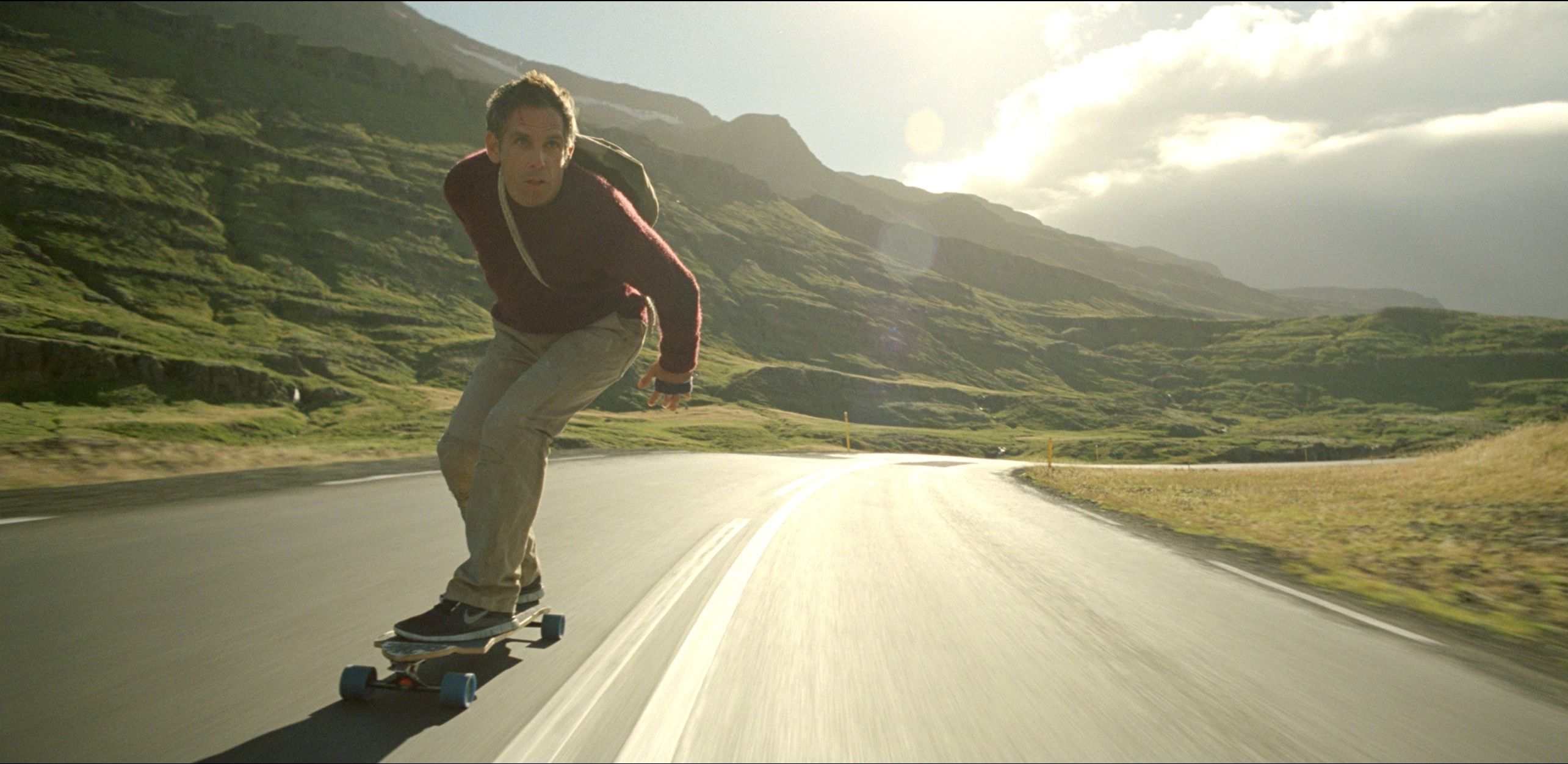
Suddenly, the frame opens up. The colors explode. The scale of the landscape makes Walter look like an ant, which is a classic visual trope for the "sublime"—that feeling of being small in a vast, beautiful world. You see the Icelandic coast, the winding roads, and that incredible longboarding sequence set to Jose Gonzalez’s "Step Out."
It’s worth noting that they actually filmed on location in Iceland (standing in for Greenland and the Himalayas). You can feel the cold. You can see the real grit on the ground. This wasn't a green-screen marvel, and that's probably why it has aged better than other "inspirational" films from that decade.
Breaking Down the "Mitty" Archetype
Is Walter Mitty a hero? Or is he just a guy who escaped a mid-life crisis through a series of highly improbable coincidences?
Psychologists actually use the term "Walter Mitty Syndrome" to describe people who spend an excessive amount of time in fantasy. It’s usually a defense mechanism. In the original story, Walter daydreams because his wife is overbearing and his life is mundane. In the Stiller film, he daydreams because he lost his father young and had to trade his "mohawk and skateboarding" dreams for a steady paycheck to support his mom and sister.
There’s a deep empathy in the 2013 version that isn't in the book. It acknowledges that most people aren't boring by choice. They’re boring because of responsibility.
The "Secret Life" isn't a flaw; it's a reservoir of the person they used to be. The movie's thesis is that you can tap back into that reservoir at any time. It's cheesy, sure. But it's a brand of cheese that feels necessary when you're staring at a fluorescent light for eight hours a day.
Critical Reception vs. Cult Legacy
When the movie came out, critics were... lukewarm. Rotten Tomatoes has it sitting at a 52%. Many reviewers felt it was a giant commercial for Life magazine or a glorified travel brochure. Some called it "product placement for the soul."
But the audience score tells a different story (around 71%).
Over the last ten years, The Secret Life of Walter Mitty has become a massive cult favorite among travelers, digital nomads, and people looking for a "comfort movie." It’s one of those films that people watch when they feel stuck. The soundtrack alone—featuring Arcade Fire, David Bowie, and Of Monsters and Men—has millions of streams from people trying to capture that "Walter Mitty feeling" on their morning commute.
The movie succeeded where the critics thought it failed because it understood the emotional reality of the modern worker. We don't want a gritty, realistic depiction of sadness; we want to believe that a trip to Iceland and a run-in with a shark is possible for us, too.
Real-World Locations You Can Actually Visit
If you want to live out your own version of the movie, you don't have to invent a missing negative. Most of the iconic spots are accessible.
- Stykkishólmur, Iceland: This stood in for Nuuk, Greenland. It’s a charming fishing village where Walter gets on the helicopter.
- Seyðisfjörður: This is where the longboarding scene was filmed. The road (Route 93) winds down a mountain into a beautiful fjord. It’s just as steep as it looks in the movie.
- Grundarfjörður: You’ll recognize the Kirkjufell mountain in the background of several shots.
Many people actually credit this movie with the massive boom in Icelandic tourism that happened in the mid-2010s. It turned the country into the ultimate destination for people trying to "find themselves."
Lessons From Walter’s Journey
So, what’s the takeaway? Should we all quit our jobs and head to the Himalayas? Probably not. Most of us have rent to pay and don't have a priceless negative to find.
But the movie offers a few "Mitty-isms" that are actually practical:
- Stop the "Zone Out": In the film, Walter’s daydreams are called "zoning out." It’s a literal disconnection from the present. The goal isn't to have better daydreams; it's to have a life you don't need to zone out from.
- The "Major Tom" Moment: Sometimes you need a push. In the movie, it’s a hallucination of Cheryl (Kristen Wiig) singing David Bowie. In real life, it’s usually a moment of extreme discomfort or a realization that time is running out.
- Practical Bravery: Walter doesn't become a superhero. He stays a quiet, slightly awkward guy. He just starts saying "yes" to things that scare him. Bravery isn't the absence of awkwardness; it's being awkward while doing something brave.
Taking Your Own Next Steps
If you feel like you’re stuck in a Mitty-esque loop of daydreaming without action, you don't need a plane ticket to Greenland to start shifting your perspective.
Start by identifying your "Zone Out" triggers. Is it your job? A specific relationship? The sheer noise of social media? Often, we daydream to compensate for a lack of agency in our real lives.
Next, look into the concept of Mindfulness-Based Stress Reduction (MBSR). It sounds clinical, but it’s essentially the antithesis of Walter Mitty Syndrome. It’s about training your brain to stay in the room, even when the room is boring.
Finally, if the film's message of "To see the world, things dangerous to come to, to see behind walls, draw closer, to find each other, and to feel" resonates with you, consider a "micro-adventure." You don't need to go to Iceland. Go to a part of your own city you’ve never seen. Eat something you can’t pronounce. Turn off your phone for four hours.
The secret life is only a problem if it stays a secret. Bringing those inner desires into the light—even in small, manageable ways—is how you stop being a passenger in your own head and start being the lead in your own story.