Music has this weird way of finding you when you're already down. You know that feeling? You’re sitting in a dark room, or maybe driving a little too fast at night, and a song comes on that feels less like a melody and more like a mirror. For millions of people over the last fifty years, that song is "Trouble."
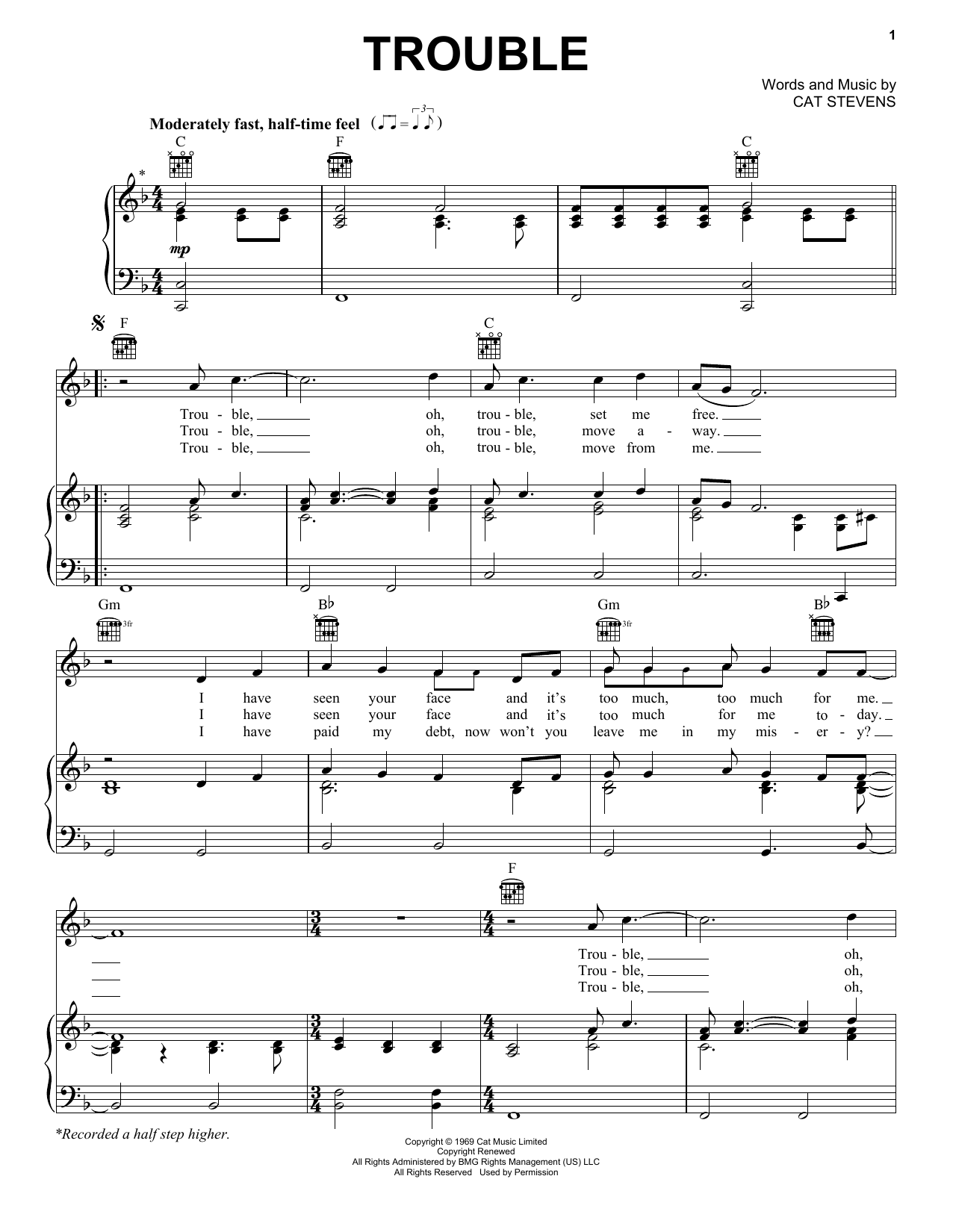
The trouble by cat stevens lyrics aren't just words on a page from the Mona Bone Jakon album; they are a desperate, stripped-back prayer. It’s raw. It’s honestly a bit uncomfortable if you’re not in the right headspace. But it’s also one of the most resilient pieces of songwriting from the early 1970s.
The Brutal Backstory You Probably Didn't Know
Most people think of Cat Stevens (now Yusuf Islam) and picture the peaceful, "Peace Train" guy with the gentle acoustic guitar. But "Trouble" was born out of a much darker period. In 1969, Stevens was hospitalized for a year with a collapsed lung and a severe bout of tuberculosis. He was 20 years old and literally facing his own mortality. He wasn't some folk legend yet; he was a kid who had been chewed up by the pop industry and spat out into a hospital bed.
When he wrote the lyrics to "Trouble," he wasn't trying to write a hit. He was begging for a break.
The song starts with that iconic line: "Trouble, oh trouble move from me." It’s a direct address. He’s personifying his pain, treating it like a physical presence in the room that he’s trying to usher out the door. The simplicity of the language is exactly why it works. There are no complex metaphors about the universe or flowery language. It’s just: Go away. I’m tired.
Breaking Down the Trouble by Cat Stevens Lyrics
Let's look at the structure—or lack thereof. The song doesn't follow your standard verse-chorus-verse-bridge-chorus radio formula. It’s circular. It’s repetitive because that’s how anxiety works. You loop.
"I've seen your face and it's too much for me today."
That line right there? That’s the heart of the song. It captures that specific brand of exhaustion where even looking at your problems feels like a physical weight. Stevens’ voice in the original recording is fragile. It cracks. It’s not the polished, deep baritone he’d develop later for Teaser and the Firecat. It sounds like someone who hasn't seen the sun in a few months.
Why the "Cold Grave" Line Scares People
There’s a part of the song that always makes listeners do a double-take: "I'm on my way to the cold grave."
Some critics back in the day thought this was a bit melodramatic. They were wrong. When you're 20 and your lungs are failing you, the grave isn't a metaphor. It’s a literal possibility. Stevens was grappling with the end of his life before it even really started. This isn't "emo" music; it's survival music. He mentions that his "eyes have seen very little of this world," which highlights the tragedy of his situation at the time. He felt like he was being robbed of his future.
Hal Ashby and the Harold and Maude Connection
You can’t talk about these lyrics without talking about the 1971 cult classic film Harold and Maude.
Honestly, the movie and the song are inseparable now. Director Hal Ashby was obsessed with Stevens’ music and used it to anchor the entire emotional arc of the film. There’s a scene where Harold—a young man obsessed with death—finally experiences real grief, and "Trouble" starts playing.
It fits perfectly because the song occupies that weird space between wanting to die and desperately wanting to live. The lyrics "I don't want no more of it" could be interpreted as a surrender, but the way Stevens sings them makes it sound like a demand for peace. He’s not giving up; he’s asking for a truce.
The Sound of the Lyrics
The arrangement is sparse. Just a piano, some light percussion, and that mournful guitar. This was a massive departure from his earlier "Matthew and Son" days where everything was overproduced and poppy.
By stripping away the bells and whistles, the trouble by cat stevens lyrics were forced to stand on their own. If you listen closely to the 1970 recording, you can hear the influence of his recovery. He had spent months reading about Buddhism and alternative spirituality while in the hospital. You can hear that "searching" quality in the lyrics. He’s looking for a way out that isn't just medical—it’s spiritual.
Common Misconceptions
People often get a few things wrong about this track.
First, some think it’s a song about a breakup. It’s really not. While you can certainly project your own romantic heartbreak onto it (and many do), the "trouble" Stevens is talking about is much more existential. It's about the burden of being alive when things are falling apart.
Second, there’s a persistent rumor that the song was written after his conversion to Islam. That’s factually incorrect. This song was written in 1969/1970, roughly seven years before he became Yusuf Islam. However, you can see the seeds of that spiritual journey in these lyrics. He was already looking for something higher than himself to help carry the load.
The Cultural Legacy: From Nirvana to Now
Why do we still care? Why do people still search for these lyrics fifty years later?
It’s because "Trouble" has been covered by everyone from John Frusciante to Elliott Smith. Kristin Chenoweth did a version. Eddie Vedder has played it. Each artist brings their own baggage to it, but the core remains the same. It’s a universal "SOS."
In a world that constantly tells us to "grind" and "stay positive," there is something deeply cathartic about a song that just admits things suck. It’s okay to tell your troubles to leave you alone for a while. It’s okay to be tired.
How to Truly Experience the Song
If you want to get the most out of these lyrics, don't just read them on a screen.
- Find the 1970 original version. The remastered versions are fine, but the original has a certain hiss and grit that fits the mood better.
- Listen in total darkness. Or at least with your eyes closed. The song is meant to be felt, not just heard.
- Read along with the lyrics once. Notice the phrasing. Notice how he drags out the word "trouble" as if he’s trying to physically push it away from his mouth.
- Watch Harold and Maude. Even if you’ve seen it, watch the ending again. The way the music syncs with Harold’s realization is one of the greatest moments in cinema history.
The trouble by cat stevens lyrics serve as a reminder that even the most legendary artists have moments where they feel completely powerless. Stevens didn't stay in that hospital bed. He got up, changed his life, and became one of the most influential songwriters of all time. But he had to go through that "cold grave" feeling first.
If you're feeling overwhelmed today, take a page out of his book. Acknowledge the trouble. Tell it to move. Then, keep walking.
To dive deeper into the technical side of this era, check out the liner notes for Mona Bone Jakon. It was produced by Paul Samwell-Smith, who was a founding member of The Yardbirds. His influence is what gave the track its specific, intimate "dry" sound that makes the lyrics feel like they're being whispered directly into your ear. There's no reverb to hide behind. It's just the truth.