Brunei is a tiny speck on the map of Borneo. Most people think of oil, gold-plated mosques, and maybe the Sultan. But if you head east, past the Limbang strip of Malaysia, you hit Temburong. It's an enclave. It’s isolated. And honestly, Ulu Temburong National Park is the only reason you need to visit this country.
Forget paved roads. They don’t exist here. To get into the heart of this place, you have to commit. You take a speedboat from Bandar Seri Begawan, weave through mangroves, then hop into a longtail boat called a temuai. You’re sitting on the floor of a wooden boat while a local Iban driver navigates rapids and shallow gravel beds. It’s loud. It’s wet. It is exactly what travel should feel like.
The "Green Jewel" isn't just a marketing slogan
People call this place the "Green Jewel of Brunei," and for once, the nickname isn't hyperbole. Because Brunei’s economy was built on offshore oil and gas, they never had to clear-cut their forests for palm oil like their neighbors in Sarawak or Kalimantan. The result? A pristine ecosystem that hasn't changed in millennia.
We’re talking about 50,000 hectares of primary rainforest. Most of it is strictly for scientists. You, as a visitor, only get access to a tiny sliver, about one square kilometer. But that sliver is enough to make you feel completely insignificant. The biodiversity is staggering. You’ve got Wagler’s pit vipers blending into the leaves, Bornean gibbons screaming in the distance, and rhinoceros hornbills that sound like prehistoric planes when they fly overhead.
It’s dense. It’s humid. The air feels heavy, like you’re breathing through a warm, damp cloth.
That Canopy Walkway is terrifying (and essential)
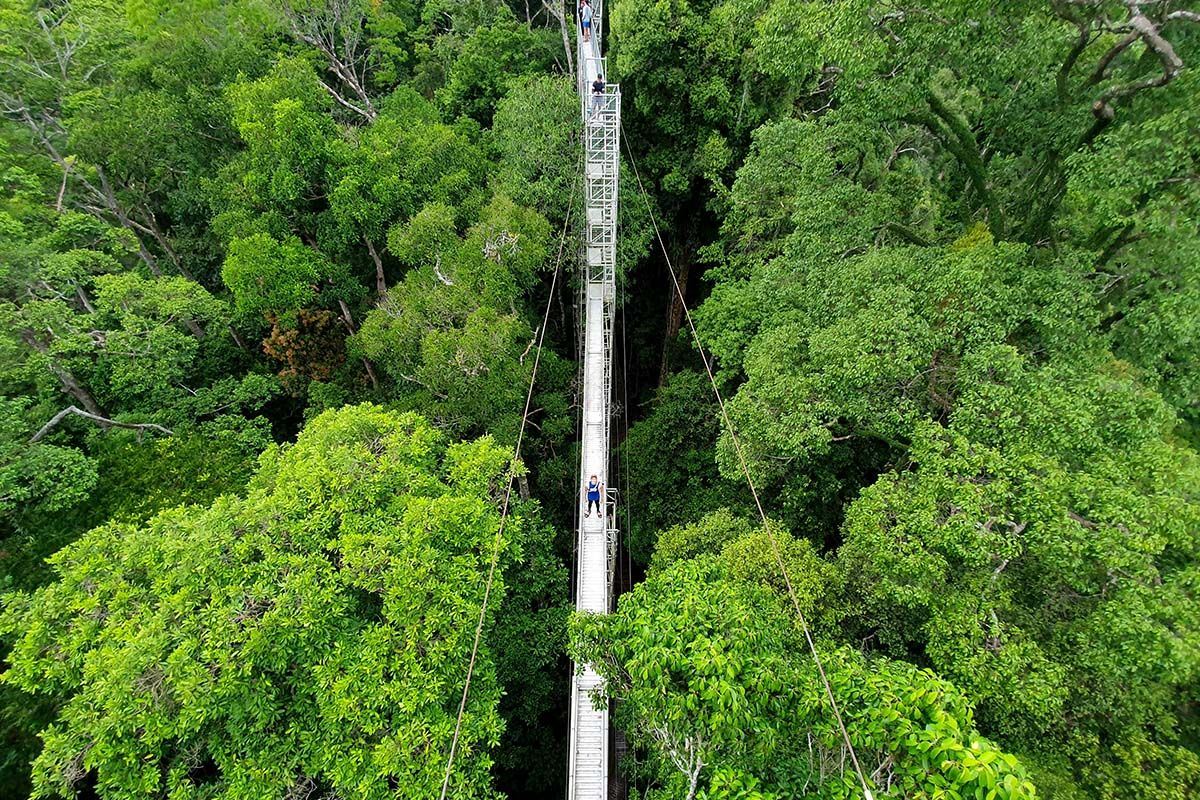
If you’ve Googled Ulu Temburong National Park, you’ve seen the photos of the metal towers poking through the trees. That’s the canopy walkway.
Let’s be real: it’s a workout. To even get to the base of the towers, you have to climb over 700 wooden steps. By the time you reach the top, your legs are screaming. Then you see the towers. They are aluminum structures built into the hillside, connected by narrow bridges. They sway. Just a little. Enough to make your stomach drop if you hate heights.
But then you look out.
You are 60 meters above the forest floor. You aren't looking at the trees; you are looking down on them. In the early morning, the mist sits in the valleys, and the emergent trees—the giants of the forest like the Dipterocarps—pierce through the clouds. It’s quiet. Well, not quiet, because the cicadas are buzzing at a frequency that vibrates in your chest, but it feels peaceful. You realize that this is what the world looked like before we started messing with it.
What most people get wrong about the wildlife
Don’t come here expecting a zoo. You won’t see an orangutan sitting on a bench waiting for a photo op. This is wild. Most of the "action" happens in the canopy or deep in the undergrowth where humans can't go.
- The Wallace’s Flying Frog: It’s actually here. It uses its webbed feet to glide from tree to tree.
- The Exploding Ant: Yes, Colobopsis saundersi exists in these woods. It literally ruptures its body wall to spray poison on enemies. Nature is metal.
- The Rajah Brooke’s Birdwing: These massive butterflies congregate by the riverbanks. They look like pieces of velvet floating in the air.
If you want to see things, you have to be still. You have to stop talking. Most tourists stomp around and wonder why they only saw a lizard. Sit by the river. Wait. That’s when the forest starts talking back to you.
Getting there is half the adventure
Logistics in Brunei used to be a nightmare, but the Sultan Haji Omar 'Ali Saifuddien Bridge changed things. It’s one of the longest bridges in Southeast Asia, spanning the Brunei Bay. It connects the main part of the country to the Temburong district.
Before the bridge, you had to cross through Malaysia, which meant four passport stamps just to get to another part of your own country. Now, it’s a smooth drive. But don't just drive to the park. The boat ride from the jetty at Batang Duri is the highlight.
The temuai drivers are artists. When the river is low, they have to jump out and push the boat over rocks. When the river is high, they have to read the eddies to avoid getting swamped. It’s an indigenous skill passed down through generations. These guys know the river like the back of their hands. They can spot a snake on a branch 50 yards away while navigating a Class II rapid. Respect that.
The Belalong Canopy Experience
If you’re staying overnight—which you absolutely should—you’ll likely end up at the Ulu Ulu Resort or one of the nearby eco-lodges like Freme or Sumbiling Eco Village. Staying in the park is different. When the day-trippers leave around 3:00 PM, the atmosphere shifts.
The evening symphony starts. It’s a literal wall of sound.
Honestly, the best thing to do is a night walk. Your guide will point out things you would never see: tarantulas peering out of holes, stick insects the size of your forearm, and "ghost mushrooms" that glow in the dark. It’s eerie and brilliant. It makes you realize that the forest never actually sleeps; it just changes shifts.
A quick word on the "Waterfall"
There’s a spot called the "Doctor Fish" waterfall. It’s a small fall at the end of a jungle trek. Is it the most impressive waterfall in the world? No. But the fish—Garra rufa—will swarm your feet and nibble off the dead skin. It’s a free spa treatment in the middle of a Bornean jungle. It tickles like crazy. Most people spend twenty minutes screaming and laughing while the fish go to work.
Practicalities: What you actually need to know
Don't show up in denim jeans. You will regret every life choice that led you to that moment. The humidity in Ulu Temburong National Park is roughly 90%. You will be soaked in sweat within five minutes.
- Wear quick-dry gear. If it says "moisture-wicking," buy it.
- Footwear matters. You need something with grip. "Kampung Adidas"—the cheap rubber football boots used by locals—are actually better than $200 hiking boots here. They drain water and grip wet rocks like glue.
- Leeches happen. They aren't dangerous, just annoying. Smearing tobacco water or using specialized leech socks helps, but honestly, just check your ankles every now and then.
- Sunscreen is a lie. You’re under a triple-canopy forest. You don't need it until you're on the boat. What you do need is high-DEET insect repellent.
Why this matters for the planet
We talk a lot about carbon sinks and climate change. Most of it feels abstract. But standing in Temburong, it feels real. This forest is part of the "Heart of Borneo" initiative, a cross-border agreement between Brunei, Indonesia, and Malaysia to protect one of the last great wildernesses on earth.
Brunei’s role is unique because they have the money to keep it pristine. They don't need the timber revenue. This makes Ulu Temburong a sort of "time capsule." It’s a baseline for what a healthy planet looks like. Scientists from the Kuala Belalong Field Studies Centre (KBFSC) have been documenting species here for decades, and they’re still finding new stuff.
It’s not just a park; it’s a library of genetic information that we haven't even finished cataloging yet.
The Actionable Plan for your visit
If you’re serious about seeing Ulu Temburong National Park the right way, don't just book a generic 6-hour tour from your hotel lobby.
Start by checking the weather. If it has been raining heavily, the river might be too high for the longboats. If it's too dry, you'll be pushing the boat more than riding in it. The "sweet spot" is usually between March and October, though it's the tropics—it rains whenever it wants.
Book a two-day, one-night stay. This allows you to do the canopy walk at sunrise. That is the "Golden Hour." The birds are most active, the temperature is bearable, and the light hitting the mist is a photographer's dream.
Pack light. A small waterproof dry bag is mandatory. Your phone, camera, and spare socks will thank you when the boat takes a splash through a rapid.
Lastly, engage with the guides. Many are from the local Iban community. They grew up in these forests. They don't just know the names of the trees; they know which ones can cure a headache or which ones have water inside their stems. That indigenous knowledge is worth more than any guidebook you'll find at the airport.
Go for the towers, stay for the silence. Just make sure you've stretched your calves before you start those stairs.