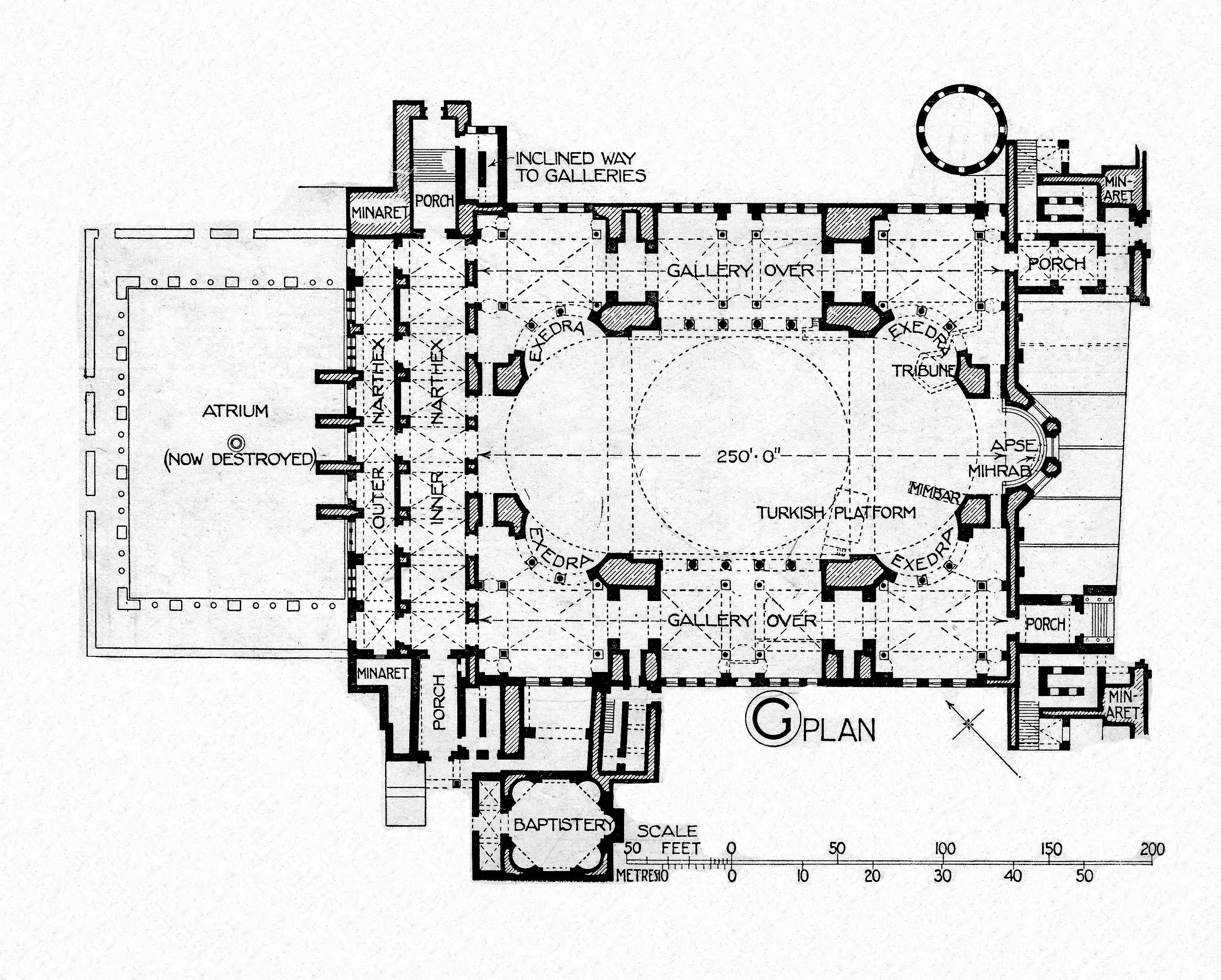
Walk into the Hagia Sophia today and your head immediately goes up. It’s a reflex. You’re looking at that massive, gravity-defying dome that seems to float on a ring of light. But if you want to actually understand how this building has survived earthquakes, riots, and the literal weight of history for nearly 1,500 years, you have to look down. The Hagia Sophia floor plan is where the real magic happens. It isn’t just a blueprint; it’s a high-stakes engineering gamble that shouldn't have worked, yet somehow, it did.
Most people think of it as a simple rectangle. It's not.
When Anthemius of Tralles and Isidore of Miletus—two guys who were actually mathematicians, not architects—sat down in 532 AD, they were trying to do something crazy. They wanted to shove a massive circular dome onto a square base. In the world of 6th-century geometry, that's like trying to fit a peg into a hole that doesn't exist yet. The result is a hybrid layout: a "domed basilica" that feels like a tug-of-war between a long, straight hallway and a central, open sunroom.
The Basics: Navigating the Layered Entry
Before you even get to the "wow" moment under the dome, the Hagia Sophia floor plan forces you through a series of checkpoints. You don't just walk in from the street. You transition.
First, there’s the Outer Narthex. It’s sparse. It’s functional. Then you hit the Inner Narthex. This is where things get serious. This space is roughly 60 meters wide. You’ll see nine gates here. The big one in the middle? That’s the Imperial Gate. Back in the day, if you weren't the Emperor or his immediate squad, you weren't walking through those doors. The floor plan here is designed to intimidate. It creates a sense of scale before you’ve even seen the main event.
Once you pass through, you’re in the Naos. That’s the central space. It’s roughly 70 by 75 meters. It feels bigger. Why? Because the architects used a trick of perspective. By using semi-domes at the east and west ends, they elongated the visual field. It makes the "square" feel like a massive, infinite oval.
Why the Pendentives Matter
You can't talk about the floor plan without talking about the four massive piers. These aren't just columns; they are giant legs of stone and mortar, hidden behind marble slabs. They hold up the pendentives—those triangular transitions that bridge the gap between the square pillars and the circular rim of the dome.
Honestly, the pendentives are the MVP of the Hagia Sophia. Without them, the dome would have pushed the walls outward until the whole thing folded like a cardboard box. Instead, the weight is channeled down into these four specific points on the floor plan. This freed up the walls to be "non-load bearing," which is why the architects could punch 40 windows into the base of the dome. It’s a literal light show.
The Ground Floor vs. The Gallery
The Hagia Sophia floor plan is split into two distinct levels that served very different social purposes. The ground floor was for the masses and the clergy. It’s wide, open, and paved with Proconnesian marble that looks like frozen waves. Seriously, look at the floor. The marble slabs were "book-matched," meaning they were sliced and laid out to create symmetrical, Rorschach-like patterns.
Then you have the Upper Gallery.
You don't take stairs to get there. You walk up a ramp. A long, winding, cobblestone ramp. Why? So the Empress could be carried up in a sedan chair without her guards getting winded on steps.
The gallery floor plan mimics the shape of the aisles below but offers a totally different vibe. This was the "VIP section." It’s where the mosaics of Empress Zoe and Constantine IX are located. From up here, you can see the "Omphalion" on the ground floor—the "Navel of the World." This is a section of the floor with circular marble inlays where Byzantine Emperors were crowned. If you’re standing in the gallery, you’re looking down at the very spot where power was solidified for centuries.
The Apse and the Mihrab
At the far eastern end, the floor plan curves into an apse. This is the most sacred part of the building. Historically, this is where the altar sat. After 1453, when the building became a mosque, the focus shifted slightly. Because the building faces east (Christian tradition) but prayer needs to face Mecca (Southeast from Istanbul), the Mihrab is actually tucked off-center.
It’s a fascinating visual "glitch" in the Hagia Sophia floor plan. The carpets are angled. The niche is skewed. It’s a constant reminder of the building’s layered identity. You have the original Byzantine shell holding a focused Islamic interior.
The Engineering Failures We Don't Talk About
Let’s be real: the first floor plan was a bit of a disaster. The original dome, finished in 537 AD, was too flat. It put too much outward pressure on the walls. In 558 AD, after an earthquake, the whole thing came crashing down.
Isidore the Younger (the nephew of one of the original designers) had to redesign the verticality of the floor plan. He raised the dome by about 6 meters. This made it more spherical and directed the weight more vertically onto those four big piers we talked about.
Even now, the building is "bulging." If you look at a top-down architectural survey, the north and south walls are actually leaning outward. To stop the whole thing from exploding, massive buttresses were added to the exterior over the centuries—especially by the Ottoman architect Mimar Sinan. These buttresses are technically part of the footprint now, acting like giant stone crutches.
Secret Passages and Subterranean Myths
There is a lot of "Indiana Jones" style talk about what’s under the floor. Legends say there are massive cisterns and tunnels that connect Hagia Sophia to the Topkapi Palace or even the Basilica Cistern.
While the "tunnels to the sea" are mostly myth, recent explorations by researchers like Çiğdem Özkan Aygün have confirmed there is a complex drainage system and small vaulted cellars beneath the floor. These were essential for keeping the massive structure dry. Without these hidden "negative spaces" in the floor plan, the humidity from the Bosphorus would have rotted the foundations centuries ago.
How to Read the Floor Plan Like a Pro
When you actually visit, don't just wander aimlessly. Use the layout to spot the history.
- The Weeping Column: Located in the northwest aisle. There's usually a line. People put their thumb in a hole in the bronze plate. The floor plan places this in a spot that historically had high moisture, leading to the "weeping" legend.
- The Viking Graffiti: Head to the south gallery. On the marble balustrade, look for faint scratches. It’s Runes. Someone named Halvdan carved his name there about 1,100 years ago. It’s a reminder that this floor plan has seen global "tourists" long before Instagram.
- The Door of Nicephorus: This is a bronze door at the exit of the vestibule, dating back to the 2nd century BC. It was brought here from a pagan temple. The floor plan literally incorporates recycled history.
Practical Insights for Your Visit
To truly appreciate the Hagia Sophia floor plan, you need to timing right. It’s a functioning mosque now, so the ground floor is often covered in carpets. This obscures the Omphalion and the marble "waves," but you can still feel the vastness.
- Look for the buttresses: Before you enter, walk around the outside. Notice how the "plan" includes those massive stone blocks pushing back against the dome.
- Check the Upper Gallery status: Access to the gallery has changed recently with new ticketing rules (it's often treated as a museum visit separate from the prayer area). Check the current status before you go, because you haven't seen the floor plan until you've seen it from 20 meters up.
- The Lustration Urns: In the Naos, you’ll see two massive alabaster jars. These were brought from Pergamon during the reign of Murad III. They are part of the Ottoman "layer" added to the Byzantine footprint.
The Hagia Sophia isn't just a building; it's a living organism. Its floor plan has shifted, settled, and been reinforced for over a millennium. It’s a miracle of geometry that survives on a wing and a prayer—and four very, very strong piers.
To get the most out of your study of this space, cross-reference the architectural drawings with the 19th-century Fossati brothers' restorations. Their documentation remains the gold standard for seeing what lies beneath the current plaster and carpets. Focus on the transition between the Narthex and the Naos to truly grasp how the Byzantines used architecture to manipulate the human ego—making you feel small before the divine.