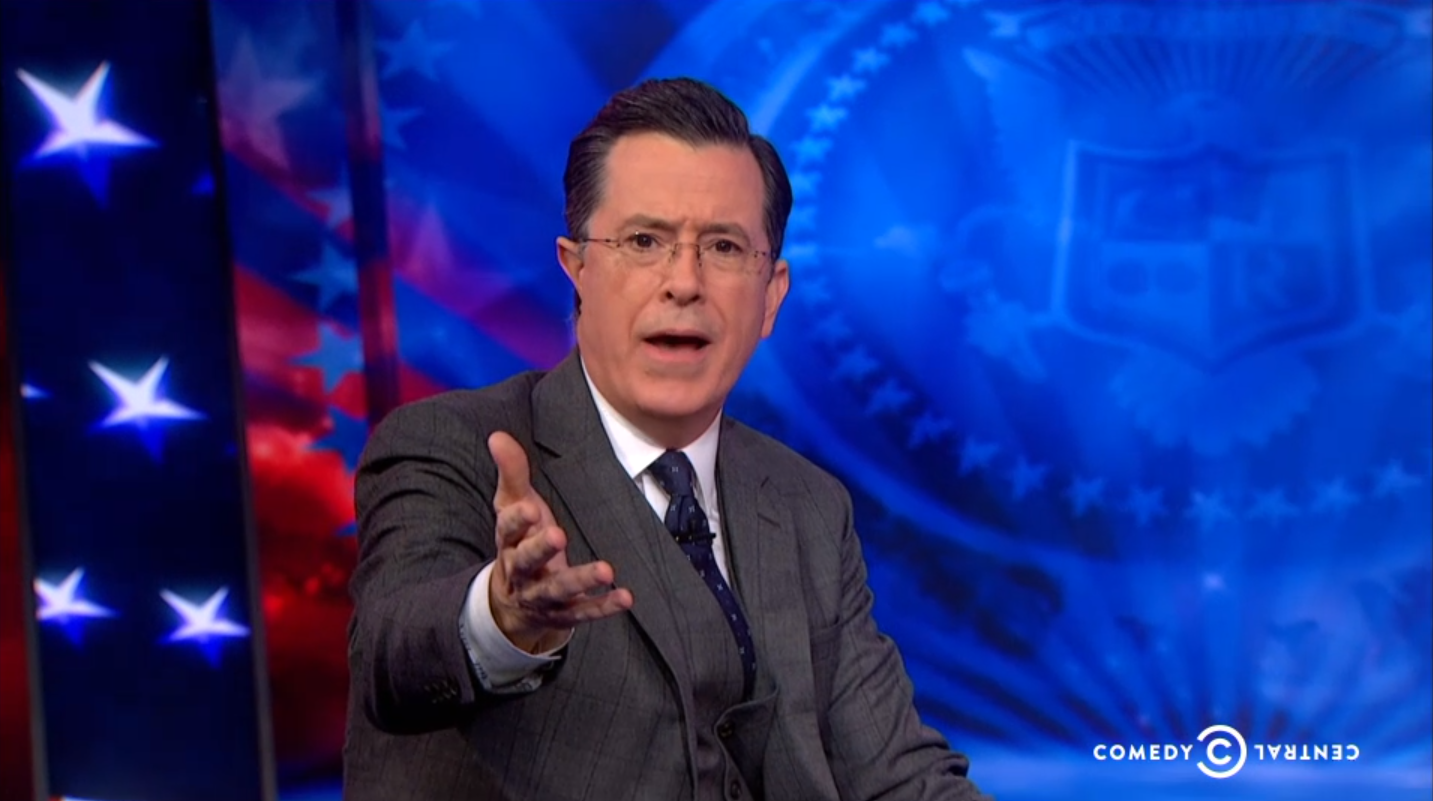
Television finales usually suck. They’re either too sappy, too weird, or they leave you staring at a black screen wondering if your cable just cut out. But back in December 2014, when the fictional, high-octane conservative blowhard "Stephen Colbert" had to say goodbye, he didn't just walk off into the sunset. He sang.
Specifically, he sang We'll Meet Again, the 1939 Vera Lynn wartime classic. It wasn't just him, though. It was basically everyone who had ever stepped foot in his studio over nine years.
Watching that clip now feels like looking at a time capsule from a different universe. You've got Henry Kissinger, Cyndi Lauper, Big Bird, and a bunch of U.S. troops in Afghanistan all belting out the same lyrics. It was chaotic. It was surreal. Honestly, it was the only way that character could have died.
The Night "Stephen Colbert" Became Immortal
The setup for the We'll Meet Again Stephen Colbert moment was peak absurdist comedy. In the final episode of The Colbert Report, titled "Same to You, Pal," the host didn't just retire. He accidentally became immortal.
After "killing" the Grim Reaper (whom he affectionately called "Grimmy") during a segment of "Cheating Death," Colbert realized he was never going to die. Since he was now a permanent fixture of the universe, saying a standard "goodbye" felt a bit dishonest.
So, he started singing.
It began quietly at his desk. Then Jon Stewart—his real-life mentor and the man who basically birthed the Colbert character on The Daily Show—walked out to join him. From there, the floodgates opened. It’s hard to overstate how many people were squeezed onto that stage. We’re talking:
- Musicians: Willie Nelson, Michael Stipe, Randy Newman (on the piano), and Mavis Staples.
- Politicians: Cory Booker, Mike Huckabee, Grover Norquist, and Eleanor Holmes Norton.
- Media Icons: Katie Couric, Arianna Huffington, and Charlie Rose.
- Pure Randomness: George Lucas, Patrick Stewart, and a guy in a bear suit.
Even Bill Clinton showed up via video, along with an astronaut on the International Space Station. The sheer logistics of getting that many egos in one room is a miracle of television production.
Why That Song Choice Actually Mattered
Most people know We'll Meet Again from the end of Stanley Kubrick's Dr. Strangelove. You know, the scene where the world ends in a series of nuclear mushroom clouds?
By picking that specific song, Colbert was leaning into the "truthiness" of his entire career. The song is a bop about hope, but it’s famously associated with the apocalypse. It fits the Colbert persona perfectly: a man who wraps terrifying political realities in a blanket of patriotic cheer.
But there’s a deeper, more personal layer here. Colbert has always been open about the tragedy in his life—specifically the plane crash that killed his father and two of his brothers when he was just ten years old. While the show ended with a jaunty singalong, the credits rolled to "Holland, 1945" by Neutral Milk Hotel, a song about the ghost of Anne Frank that Colbert has cited as a tribute to his lost family members.
The contrast between the public spectacle of the singalong and the private grief of the credit music is what makes him such a fascinating figure. He’s a guy who uses comedy to whistle past the graveyard.
Breaking the Character's Mask
For 1,447 episodes, Stephen Colbert played a version of himself that was arrogant, xenophobic, and loudly "pro-America." The singalong was one of the few times the mask slipped.
When you watch the footage, you see the "real" Stephen occasionally peek through. He’s arm-in-arm with Jon Stewart, looking genuinely overwhelmed by the crowd. At one point, he’s standing behind the piano, not even center stage, letting the guests take the lead.
For a character whose entire brand was narcissism, retreating into the background for the final number was a huge move. It signaled that the character was done, and the real man was ready to move to The Late Show on CBS.
The Cameo List That Won't End
If you try to count every person in that segment, you'll go cross-eyed. Some of the most notable (and weirdest) inclusions were:
- Jeff Daniels and Sam Waterston (staying in character from The Newsroom).
- Neil deGrasse Tyson, looking like he was having the time of his life.
- Vince Gilligan, the creator of Breaking Bad.
- James Franco, just... being there.
- Smaug. Yes, the dragon from The Hobbit (well, a digital version of him).
The Legacy of the "Report" Finale
Looking back from 2026, late-night TV feels a lot more fractured than it did in 2014. Back then, Colbert felt like the center of the political conversation. He wasn't just making jokes; he was teaching people how the system was broken by ironically embracing the brokenness.
The We'll Meet Again Stephen Colbert performance was a victory lap for a specific type of satire. It was the end of an era where a comedian could stay in character for nearly a decade and have the entire world play along.
When the song ended, the studio was empty. A single painting remained. Then, in a final weird twist, Colbert was picked up on the roof by Santa Claus, Abraham Lincoln, and Alex Trebek in a sleigh. Because why not? If you're immortal, you might as well ride with the heavy hitters.
What to Do if You're Feeling Nostalgic
If you want to revisit this piece of TV history, don't just look for the short clips. The full finale is where the context lives.
- Watch the "Cheating Death" segment first. It explains why he's singing in the first place.
- Pay attention to the "toss" from Jon Stewart. The final episode actually started with a classic hand-off from The Daily Show, which they hadn't done in years.
- Look for the "Easter eggs" in the crowd. Every time you watch the singalong, you'll spot someone new—like the "Formidable Opponent" version of Stephen or his actual family members tucked into the back rows.
The performance serves as a reminder that even when things feel like they’re falling apart (or a beloved show is ending), there’s a weird power in a group of people—no matter how different they are—standing together and singing a song about seeing each other again.
Practical Next Steps
To truly appreciate the scope of this moment, you should track down the high-definition version of the finale on Paramount+ or the official Comedy Central archives. Most YouTube uploads are grainy and miss the nuance of the cameos. If you're a fan of political history, try to identify the "strange bedfellows" in the crowd; seeing ultra-conservatives and staunch liberals sharing a microphone is a rare sight that likely won't happen again in today's polarized climate. Finally, listen to the lyrics of the original Vera Lynn version; understanding its history as a "morale booster" during the Blitz gives Colbert's choice a much heavier emotional weight than it appears on the surface.