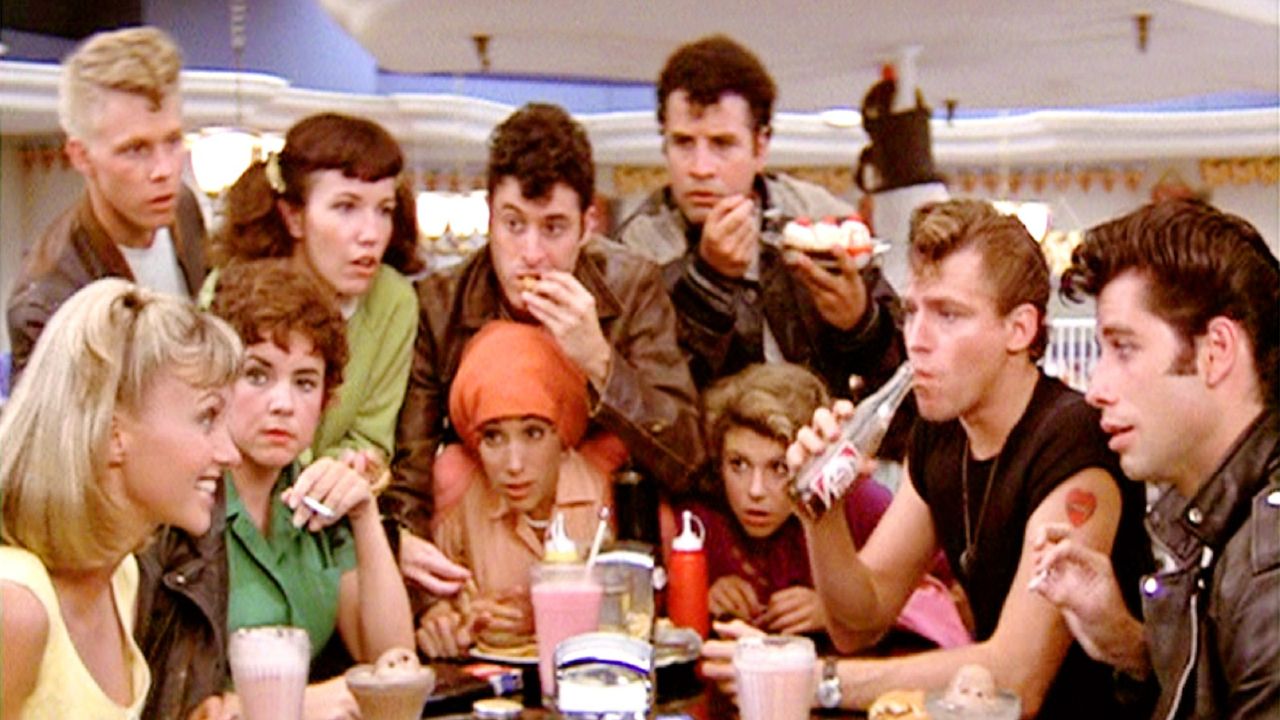
It was the summer of 1982. Expectation was a heavy, suffocating thing. Everyone was still humming "You’re the One That I Want," and Paramount Pictures was desperate—absolutely starving—to recapture the lightning in a bottle that was the original 1978 phenomenon. So, when did Grease 2 come out exactly? It officially hit theaters in the United States on June 11, 1982.
The world was different then. No TikTok trends. No instant streaming. You had to physically go to the mall, buy a ticket, and sit in a sticky seat to see if Maxwell Caulfield could actually live up to John Travolta’s leather jacket.
He couldn't. At least, not according to the critics at the time.
The Long Road to June 1982
Most people assume sequels happen fast. Not this one. There was a massive four-year gap between Sandy and Danny flying off in a car and Stephanie Zinone taking over the Pink Ladies. Why the wait? Honestly, it was a mess behind the scenes. Allan Carr, the flamboyant producer who basically willed the first movie into existence, had a vision for a "Grease" franchise that looked more like a television series or a multi-movie epic.
But Travolta and Olivia Newton-John weren't coming back. That was the first big hurdle. You can't just replace the biggest stars in the world and expect people to not notice. Paramount spent a huge chunk of 1980 and 1981 trying to figure out if they should do a direct sequel or a spin-off. They eventually settled on a "next generation" approach, casting Michelle Pfeiffer—who was basically an unknown at the time—and British actor Maxwell Caulfield.
Filming didn't even start until seven months before the release date. Think about that. They were rushing. They were frantic. The script was being rewritten on the fly, and the director, Patricia Birch (who had choreographed the first film), was thrown into the deep end.
By the time Grease 2 came out in June, the production felt like a high-speed chase where the wheels were wobbling.
Why the Release Date Mattered (and Almost Killed the Movie)
Timing is everything in Hollywood. Paramount picked June 11, 1982. On paper, it looks like a prime summer blockbuster slot. In reality, it was a suicide mission.
Look at what else was in theaters that same weekend. Steven Spielberg’s E.T. the Extra-Terrestrial opened on the exact same day. E.T. didn't just win; it annihilated everything in its path. While families were weeping over a wrinkly alien, nobody wanted to hear a song about "Cool Riders" or reproduction.
Then you had Poltergeist and Star Trek II: The Wrath of Khan already dominating the box office from the weeks prior. Grease 2 was essentially a musical bowl of cereal being served at a steakhouse. It was the wrong movie for the wrong summer. It pulled in about $6 million on its opening weekend, which sounds okay until you realize the first Grease was a cultural juggernaut that ended up making over $360 million globally.
The Critical Cold Shoulder
The reviews were brutal. Roger Ebert famously gave it two stars, essentially saying it felt like a recycled version of the first one but with less charisma. He wasn't entirely wrong, but he also wasn't entirely right.
What the critics missed—and what fans eventually discovered on VHS years later—was that the movie was weirdly subversive. It flipped the gender roles. In the first movie, the girl changes for the guy. In Grease 2, the guy (Michael) has to turn into a "cool rider" to impress Stephanie.
A Quick Look at the Numbers
- Budget: Roughly $13 million (double the original's budget).
- Box Office: Roughly $15 million domestic.
- Rotten Tomatoes Score: It sat in the "rotten" basement for decades, though it’s seen a slight uptick recently thanks to camp-loving millennials.
The Michelle Pfeiffer Factor
If there is one reason the movie survived its disastrous 1982 launch, it’s Michelle Pfeiffer. Seriously.
She was 23. She was magnetic. Even in a movie about a singing biology class, she commanded the screen. Most critics at the time agreed that she was "too good" for the material. When Grease 2 came out, it was meant to be a star vehicle for Maxwell Caulfield, but Pfeiffer stole the entire show.
She later admitted in interviews that she hated the experience at the time. She felt inexperienced and overwhelmed. But watching it now, you can see the raw talent that eventually led her to Scarface just a year later. Without her, this movie would have been a forgotten footnote in a studio's tax write-off ledger.
The Cult Following: Beyond 1982
Something strange happened in the 90s. Cable television and home video gave the movie a second life. Gen X kids who were too young for the theater started watching it on repeat.
Why? Because the songs are actually... kind of great? "Cool Rider" is a genuine bop. "Score Tonight" is a ridiculous, high-energy bowling alley anthem. "Reproduction" is a hilarious, double-entendre-filled mess that shouldn't work but somehow does.
People started realizing that while it wasn't the original, it had its own campy, neon-soaked charm. It didn't take itself seriously. It was colorful, loud, and deeply eighties, despite being set in 1961.
When Did Grease 2 Come Out Around the World?
The U.S. wasn't the only market, though it was the most important one. The international rollout was staggered, which was common back then before the era of "day-and-date" global releases.
- United Kingdom: Late 1982.
- Australia: September 1982.
- Japan: December 1982.
In many of these markets, it actually performed slightly better relative to expectations because it wasn't competing directly with the E.T. frenzy of the American June. But the damage was done. The dream of a Grease 3—which was rumored to be set in the late 60s with a counter-culture vibe—was effectively dead by the time the 1982 holiday season rolled around.
Technical Details and Production Facts
The movie was shot at Excelsior High School in Norwalk, California. The school had actually closed just before filming began, which gave the crew total control over the campus. This is why the school looks so much "fuller" and more lived-in than the sets in the first movie.
They also brought back a few familiar faces to bridge the gap.
- Didi Conn as Frenchy (though she inexplicably disappears halfway through the movie).
- Eddie Deezen as Eugene.
- Sid Caesar as Coach Calhoun.
- Eve Arden as Principal McGee.
These cameos were supposed to give the audience a sense of continuity. Instead, they mostly served as a reminder of how much everyone missed Danny and Sandy. It felt like going to a party where you only know the host’s parents.
Common Misconceptions About the Release
A lot of people think the movie was a "bomb" in the sense that it lost hundreds of millions. It didn't. It technically made its budget back, but in the world of Hollywood accounting, "breaking even" is a failure when your predecessor was the highest-grossing musical of all time.
Another myth is that John Travolta refused to be in it. In reality, he was never seriously approached with a script that he liked, and by 1982, he was trying to move into more "serious" roles (which led to Blow Out and Urban Cowboy). The timing just never lined up.
What to Do if You Want to Revisit It
If you’re looking to dive back into the world of Rydell High, don't just watch it as a sequel. Watch it as a standalone piece of 80s camp.
Steps for the best viewing experience:
- Skip the comparisons: Don't try to find the "new Danny Zuko." Michael Carrington is a different beast entirely.
- Listen to the soundtrack first: The music holds up better than the plot. Put on "Cool Rider" while you're driving; it changes the vibe immediately.
- Look for the 4K Restoration: Recent digital updates have fixed a lot of the grainy, rushed look of the original 1982 theatrical print. The colors pop way more now.
The legacy of when Grease 2 came out isn't one of cinematic excellence, but of resilience. It survived one of the most competitive summers in film history and carved out a niche that still exists forty years later. It’s the underdog story that nobody expected, featuring a future superstar and some of the most ridiculous lyrics ever put to film.
To truly understand the 1982 film landscape, look beyond the box office numbers. This was a movie caught between the nostalgia of the 50s and the burgeoning MTV style of the 80s. It was a bridge to nowhere that ended up becoming a destination for a very specific, very loyal group of fans.
Next time you see it on a streaming menu, remember it didn't just fail against E.T.; it fought for its life in a summer that changed movies forever. Grab some popcorn, ignore the critics from forty years ago, and just enjoy the ride. The "Cool Rider" deserves at least that much.
To get the most out of your re-watch, track down the "sing-along" versions often hosted by independent theaters. Seeing this movie with a crowd that knows every word to "Reproduction" is a completely different experience than watching it alone on a laptop. It turns a "bad" movie into a communal celebration of 1980s excess.