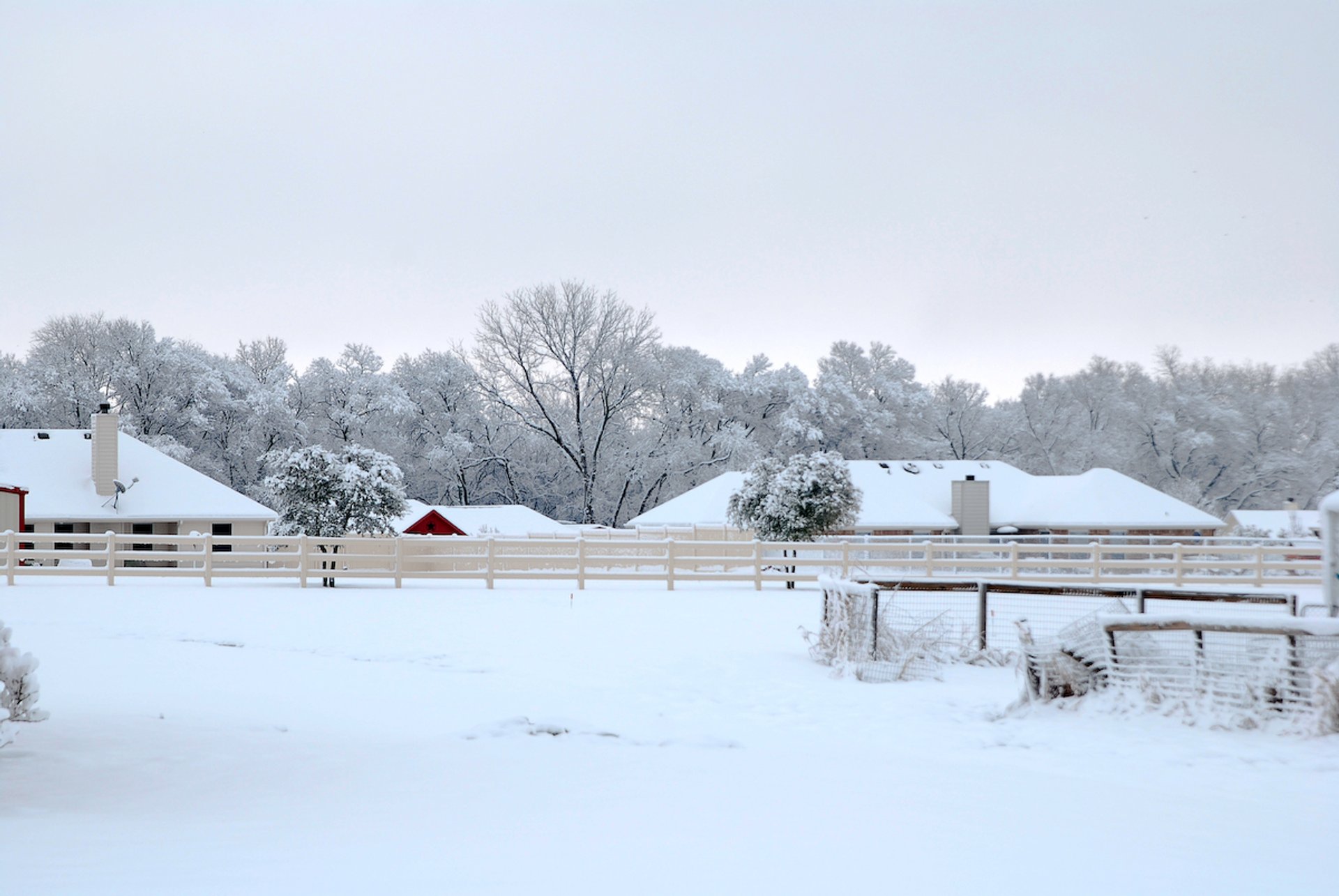
Texas winter is a liar. You’ll be sitting on your patio in mid-February, soaking up 75-degree sunshine and thinking about buying tomato starts, only for a blue norther to scream down the plains forty-eight hours later. Suddenly, you’re wrapping pipes and praying your power grid holds. It’s a wild ride. Honestly, trying to pin down exactly when is winter over in Texas is like trying to nail jello to a wall—it depends entirely on which part of this massive state you’re calling home and how much you’re willing to gamble on the "false spring."
Texas spans roughly 800 miles from north to south. That’s a huge geographic footprint. While someone in Brownsville is basically living in a tropical paradise by late February, folks up in Amarillo might still be dealing with blowing snow and sub-zero wind chills well into April.
The big "false spring" trap
Most Texans recognize the phenomenon of the false spring. It happens every year. We get a week of glorious weather, the redbuds start to peek out, and everyone rushes to the local nursery. Then, the hammer drops.
Historically, the final freeze dates vary wildly. In the Dallas-Fort Worth Metroplex, the "average" last freeze lands around March 12th. But "average" is a dangerous word in meteorology. In 2021, we saw record-breaking cold in mid-February that changed how everyone thinks about Texas winters. That Year of the Big Freeze taught us that the atmosphere doesn't care about your calendar. Even if the official winter season ends with the vernal equinox in late March, the biological and atmospheric winter often hangs on much longer in North Texas.
Down in Houston, things feel different. The humidity starts creeping back in by early March. Usually, by the time the Houston Livestock Show and Rodeo is in full swing, you’re looking at highs in the 70s. For the Gulf Coast, winter is effectively over by the first week of March. After that, you're mostly just waiting for the inevitable transition into the "Swamp Heat" of June.
Looking at the Hard Data
If you want to be scientific about it, you have to look at the USDA Plant Hardiness Zones and the National Oceanic and Atmospheric Administration (NOAA) climate normals. These give us the best statistical guess for when the danger of frost has passed.
- South Texas (McAllen, Laredo, Brownsville): Winter is basically a suggestion here. The last frost usually happens in late January or early February. By Valentine’s Day, it’s spring.
- Central Texas (Austin, San Antonio): This is the transition zone. The median date for the last freeze is late February, specifically around February 22nd to the 27th. However, late-season freezes in mid-March aren't unheard of.
- North Texas (DFW, Wichita Falls): Don't trust the weather until at least mid-March. March 12th to March 20th is the danger zone. If you plant your garden before St. Patrick’s Day, you are taking a massive risk.
- The Panhandle (Amarillo, Lubbock): These folks have it the hardest. Winter isn't "over" here until mid-to-late April. It’s not uncommon to see a dusting of snow while the rest of the state is wearing flip-flops.
Why the jet stream keeps us guessing
Texas is basically a battlefield. You’ve got warm, moist air coming up from the Gulf of Mexico constantly clashing with cold, dry air pushing down from the Rockies and the Canadian plains. When those two meet, you get the volatile spring weather Texas is famous for—thunderstorms, drylines, and the occasional late-season ice storm.
The El Niño-Southern Oscillation (ENSO) cycle plays a huge role in determining when winter actually packs its bags. During an El Niño year, Texas tends to stay cooler and wetter longer. This can push the end of winter back, keeping those gray, drizzly days around well into April. Conversely, La Niña years usually bring warmer, drier winters, making it feel like spring arrived in January. But even in a dry year, one stray arctic blast can ruin your landscaping.
The 2021 Winter Storm effect
We have to talk about February 2021. It changed the psyche of the state. Before that, many people assumed that once you hit February 15th, the worst was over. Then Uri hit. It proved that Texas can experience catastrophic winter conditions even when the "statistical" end of winter is just weeks away. Now, when people ask when is winter over in Texas, they aren't just asking about the temperature—they're asking when they can stop worrying about the infrastructure.
Meteorologists like Matt Lanza from Space City Weather often emphasize that "Spring" in Texas is less a season and more a chaotic transition period. You don't just wake up and it's over. It's a series of cold fronts that get progressively weaker until, one day, the wind shifts to the south and stays there.
Practical signs that spring has actually arrived
Farmers and old-timers in the Hill Country swear by the mesquite trees. Legend has it that a mesquite tree won't bud until the danger of frost is 100% gone. They are supposedly the smartest trees in the state. While scientists might argue that it's just a reaction to soil temperature, plenty of gardeners won't put a tomato in the ground until they see those green lacey leaves on the mesquite.
Another big indicator? The bluebonnets. The Lady Bird Johnson Wildflower Center tracks these closely. When the bluebonnets start carpeting the highways near Brenham and Austin, you know the soil is warming up. This usually happens in mid-to-late March. If the bluebonnets are peaking, you're generally safe.
What you should do while you wait
Since the timing is so fickle, preparation is better than prediction.
First, keep your frost blankets handy. Don't pack them away in the attic just because you had one 80-degree day in February. Keep them in the garage until at least April 1st if you’re north of I-10.
Second, watch the soil temperature, not just the air temperature. Most summer vegetables need a soil temp of at least 60 degrees to thrive. You can buy a cheap soil thermometer at any hardware store. It’s a much more reliable metric than the date on a calendar.
Third, use the "shoulder season" to your advantage. Texas is great for cool-weather crops like kale, carrots, and snap peas. These can handle a light frost, so you can plant them in January or February and not worry if winter decides to stick around for an extra two weeks.
Dealing with the "Easter Freeze"
There’s an old saying about the "Easter Freeze." It seems like every few years, we get one last gasp of winter right around the holiday. Whether it’s late March or early April, that final cold snap can be a real plant-killer. If you’ve already moved your hibiscus outside, keep an eye on the local forecast—specifically the dew point. If the dew point is low and the sky is clear, your plants are at much higher risk of frost damage than on a cloudy, humid night.
The final verdict
So, when is winter over in Texas?
If you live in the Rio Grande Valley, it's over by early February.
If you're in Austin or San Antonio, give it until the first week of March.
For Dallas and Fort Worth, don't breathe easy until the third week of March.
And if you're in Amarillo? Hold onto your parka until May.
The most important thing to remember is that Texas weather is defined by its extremes. We don't really do "mild" transitions. We go from heater to air conditioner in the span of 24 hours.
To stay ahead of the curve, stop looking for a single date. Instead, watch the long-range ensemble models (like the GFS or ECMWF) for signs of high-pressure ridges building over the western U.S., which often signals the end of the cold air pipelines from the north. Once the "Bermuda High" starts influencing our weather from the east, you can officially declare winter dead and buried.
Until then, keep the faucet covers close and the Dr. Pepper cold. You’re going to need both before the year is out.
Actionable Next Steps:
Check your specific zip code on the NOAA's "Probabilistic Statistics for First/Last Freeze" charts. These don't give you a date; they give you a percentage chance. Waiting until there is only a 10% statistical chance of a freeze is the smartest move for your lawn and your wallet. Also, sign up for local NWS (National Weather Service) alerts on your phone. In Texas, a "Freeze Warning" can be issued with very little lead time, and being ready to move your potted plants inside is the only way to ensure they survive the transition.