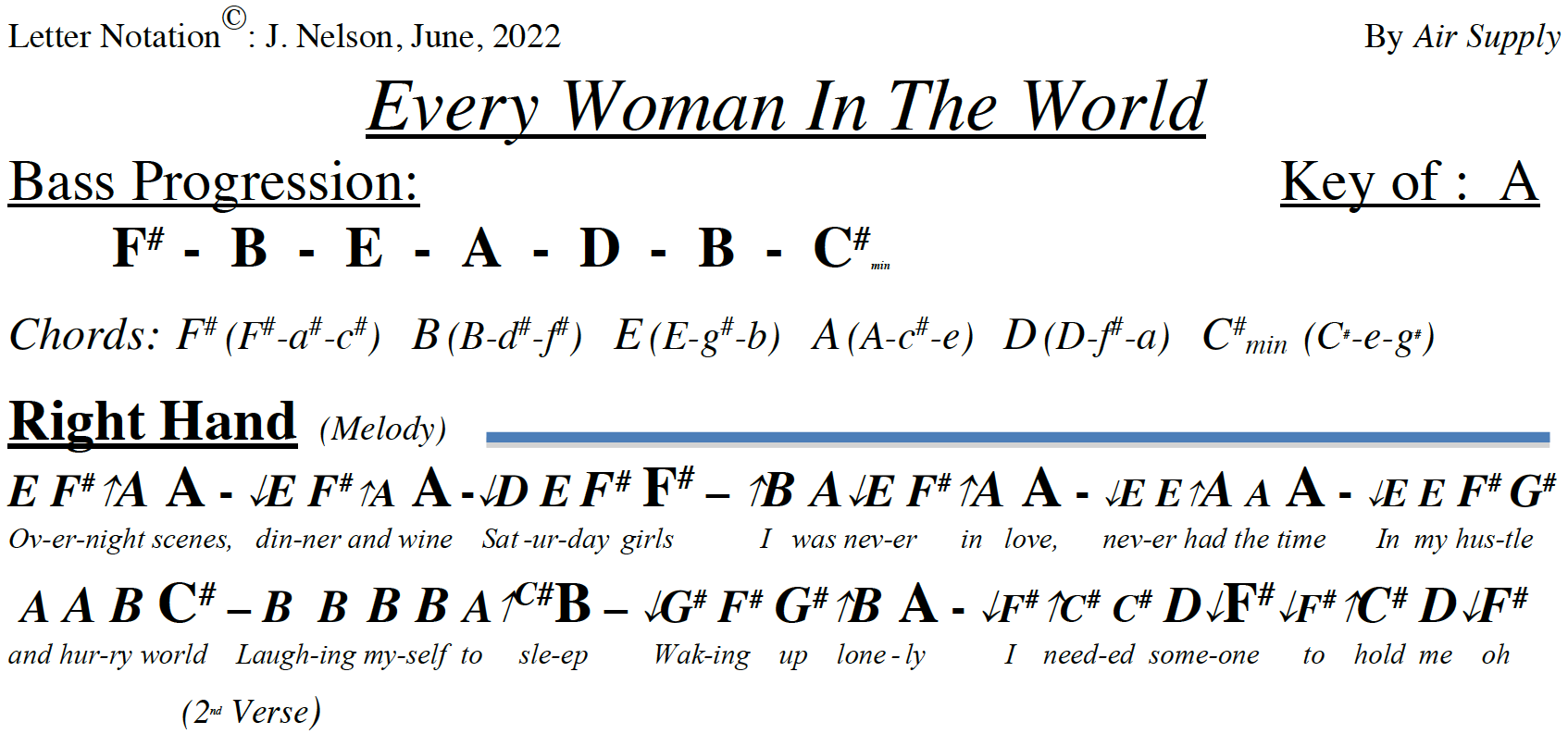
Soft rock gets a bad rap. People call it "dentist office music" or "yacht rock lite," but then a song like "Every Woman in the World" comes on the radio while you’re stuck in traffic, and suddenly you’re hitting notes you haven't tried since high school choir. Air Supply has this weird, almost supernatural ability to make absolute vulnerability sound like a stadium anthem. When you actually sit down and look at the Air Supply Every Woman in the World lyrics, you realize it isn't just a love song. It's a total surrender.
It was 1980. The world was changing, but Graham Russell and Russell Hitchcock were busy perfecting the art of the power ballad. This track was the lead single from their fifth album, Lost in Love. Think about that for a second. They had already been a band for years before they truly exploded into the global consciousness with this specific blend of soaring tenors and unapologetic sentimentality.
The Story Behind the Sentiment
Dominic King and Frank Musker wrote this one. It’s funny because while Graham Russell wrote most of Air Supply's hits, he knew a winner when he heard it. The song functions as a laundry list of appreciation. It basically says, "I was a mess, and then you showed up."
The lyrics start with a confession. "Overnight scenes / Dinner and wine / Saturday girls / I was never in love, never had the time."
It’s honest. It’s a guy admitting he was just going through the motions. The "Saturday girls" line is particularly telling of that era—a nod to the fleeting nature of disco-era dating before someone finds "the one." Then the chorus hits, and it's like a tidal wave. Russell Hitchcock’s voice climbs into a register that most men need a safety harness for.
When he sings that she is "every woman in the world" to him, he’s not just being hyperbolic. He's saying she fills every role: friend, lover, anchor, and inspiration. It’s a heavy burden to place on a partner, honestly, but in the context of a three-minute pop song, it feels like the ultimate compliment.
Breaking Down the Air Supply Every Woman in the World Lyrics
Let's get into the weeds of the second verse. "Girl, you're every woman in the world to me / You're my fantasy, you're my reality."
That’s a fascinatng juxtaposition. Usually, fantasy and reality are at odds. If something is a fantasy, it isn't real. If it's reality, it’s often boring or gritty. The song argues that the subject of the lyrics has bridged that gap. She is the dream made manifest. It’s the kind of writing that made Air Supply the kings of the Adult Contemporary charts.
They weren't trying to be cool.
They weren't trying to be edgy or punk.
They were trying to be felt.
Interestingly, the bridge offers a shift in tone: "Everything I do, I do it for you." It’s simple. Maybe too simple for some critics, but the public devoured it. The song peaked at number five on the Billboard Hot 100. In 1980, you couldn't escape it. It was playing in grocery stores, at weddings, and through the tinny speakers of Ford Pintos across America.
Why the Vocals Matter More Than the Poetry
If you read the lyrics on a plain white sheet of paper, they might seem a bit sentimental. Maybe even "cheesy" if you’re a cynic. But lyrics don't live on paper; they live in the performance.
Russell Hitchcock has a voice that sounds like it’s being squeezed out of a tube of pure emotion. When he sings the line "You're the one that I've been looking for," he isn't just stating a fact. He's pleading. He's celebrating. There’s a specific vibrato he uses on the word "for" that carries more weight than the literal meaning of the words.
Graham Russell’s acoustic guitar work provides the heartbeat. It’s steady. It’s grounded. This contrast between the grounded music and the soaring vocals is what makes the Air Supply Every Woman in the World lyrics work. It’s the sonic equivalent of a kite—the vocals are the kite flying high in the clouds, but the lyrics and the guitar are the string keeping it from drifting away into nothingness.
The Cultural Longevity of Soft Rock Romantics
People still search for these lyrics today. Why? Is it just nostalgia?
Maybe. But there’s also a lack of this kind of "all-in" romanticism in modern music. Today, lyrics are often guarded. They’re ironic or self-deprecating. There’s a lot of "it’s complicated" in modern songwriting. Air Supply wasn't interested in "complicated." They were interested in "I love you and you are my everything."
There is a profound bravery in being that un-ironic.
The song has appeared in movies and TV shows, often used to signify a moment of pure, unadulterated realization of love. Or, sometimes, it's used for comedic effect because of how over-the-top the sentiment feels by today’s standards. But even when it's used as a joke, the melody stays in your head for three days. You can’t shake it.
Common Misconceptions About the Lyrics
Sometimes people misinterpret the title. They think it’s a song about a guy who wants "every woman in the world."
Nope.
It’s the exact opposite. It’s about a guy who has stopped looking at everyone else because he found the entire spectrum of womanhood in one person. It’s a song about monogamy and the depth that comes with it.
"I'm lost in love, I don't know much / Was it something that I said or something that I touched?" Wait, that’s a different song. But you see the point—their themes were consistent. They carved out a niche of being the guys who were perpetually "lost in love," and "Every Woman in the World" was the roadmap out of that wilderness.
Real-World Impact and Legacy
If you look at the charts from that era, Air Supply was competing with the likes of Queen, Kenny Rogers, and Blondie. It was a chaotic time for music. To cut through that noise with a soft ballad required something special.
Critics at the time were often harsh. Rolling Stone wasn't exactly giving them five-star reviews. But the fans didn't care. The fans saw themselves in these lyrics. They saw their own relationships. They used these songs to propose. They used them to apologize.
The legacy of the Air Supply Every Woman in the World lyrics is found in the millions of people who still turn the volume up when that opening piano riff starts. It’s a piece of 1980s history that refuses to stay in the past.
Actionable Steps for Music Lovers and Lyric Collectors
- Listen for the harmonies: Next time you play the track, ignore the lead vocal for a second and focus on the background harmonies during the chorus. The layering is actually quite complex and explains why the song feels so "full."
- Check the live versions: Air Supply still tours. Their live versions of this song often feature extended guitar solos or vocal ad-libs that aren't on the studio record. It changes the vibe of the lyrics significantly.
- Compare with the songwriters' other work: Look up Frank Musker and Dominic King. They wrote for Sheena Easton and others. You can see a through-line in how they structure a pop hook.
- Create a "Power Ballad" playlist: Place this song between REO Speedwagon’s "Keep On Loving You" and Journey’s "Open Arms." You’ll notice how "Every Woman in the World" acts as a bridge between the 70s folk-rock style and the 80s arena ballad style.
The song is a masterclass in direct emotional communication. It doesn't hide behind metaphors or abstract imagery. It says what it means. In a world of subtext and "read between the lines," there is something deeply refreshing about a song that just tells you exactly how the singer feels. Whether you love it or think it's a bit much, you can't deny the craft that went into making these lyrics a permanent part of the pop culture lexicon.