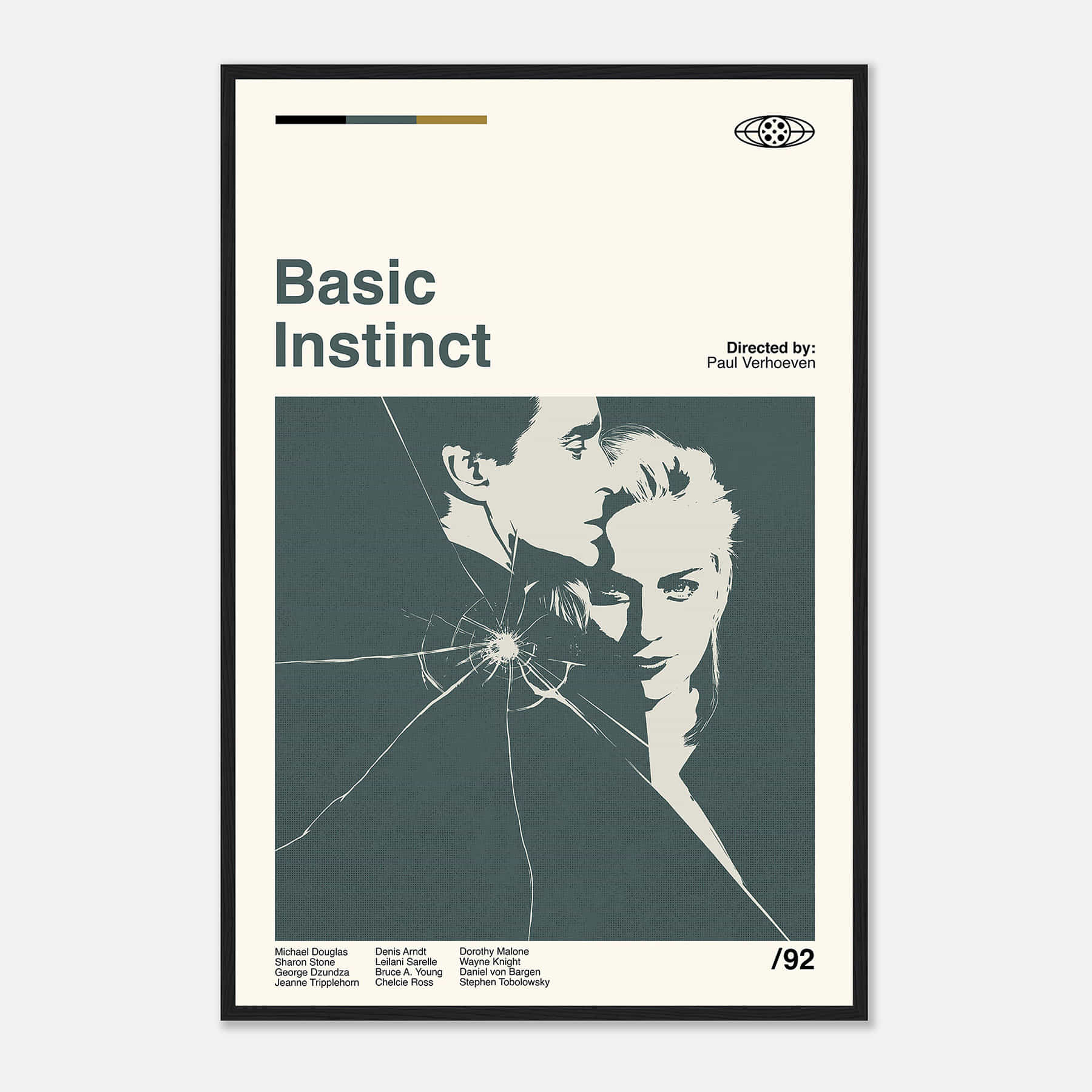
It was 1992. People actually went to the movies—like, physically sat in a dark room with hundreds of strangers—and collectively lost their minds over a flickering image of Sharon Stone. Paul Verhoeven’s Basic Instinct didn't just push the envelope; it shredded it. When we talk about sex in Basic Instinct, we aren't just talking about a couple of sweaty scenes in a neo-noir thriller. We’re talking about a seismic shift in how Hollywood handled desire, consent, and the "femme fatale" archetype. It was messy. It was loud. Honestly, it was kind of a miracle it got released without an X rating.
The film follows Nick Curran, a detective who’s basically a walking disaster, played by Michael Douglas at his most "unhinged 90s man." He’s investigating the murder of a rock star who was killed with an ice pick during sex. Enter Catherine Tramell. She’s rich, she’s a brilliant novelist, and she’s almost certainly a sociopath. The chemistry between them isn't "romantic" in any traditional sense. It’s predatory. It’s a power struggle where the bedroom is the primary battlefield.
The Interrogation Scene: More Than Just a Flash
You can't discuss sex in Basic Instinct without the leg-cross. You know the one. It’s become a piece of pop culture shorthand, but the context matters more than the visual. It wasn't just about nudity; it was about dominance. Catherine Tramell used her body as a weapon of distraction to dismantle a room full of powerful men who thought they were in control.
Sharon Stone has been very vocal over the years about how that scene came to be. In her memoir, The Beauty of Living Twice, she mentions that she was told her underwear was reflecting the light and needed to be removed, with the assurance that nothing would be visible on film. When she saw the final cut in a room full of agents and lawyers, she reportedly slapped Verhoeven. That’s the reality behind the "glamour." It was a moment of intense vulnerability transformed into a global spectacle. This tension—between the actress's experience and the character’s perceived power—is exactly why the scene feels so charged and, frankly, a bit uncomfortable to watch today.
Breaking Down the Club Scene and the "Main" Encounter
The nightclub sequence is a masterclass in sensory overload. The pulsing techno, the strobe lights, the sweat—it all builds toward the infamous scene in Catherine’s bedroom. Most movies at the time used "soft focus" or "cheesy saxophone" to signal sex. Verhoeven went the other way. He wanted it to look visceral. He wanted the audience to feel the danger.
- The choreography was intentionally frantic. It wasn't meant to look "pretty."
- The use of shadows and harsh lighting emphasized the "noir" elements of the story.
- Michael Douglas’s performance reflected a man losing his moral compass in real-time.
Then there’s the sheer physicality. Verhoeven, coming from a Dutch filmmaking background, had a much more relaxed (or perhaps "European") attitude toward nudity than American censors. He fought the MPAA tooth and nail. To get an R rating, they had to trim seconds here and there, but the impact remained. It felt explicit because of the intent, not just the skin. It was about the loss of self.
Why the Eroticism Felt Different
Basically, the film used sex as a plot device rather than a break from the plot. In most 80s thrillers, you’d have the "love scene" and then get back to the detective work. In Basic Instinct, the sex was the detective work. Or rather, it was the trap.
Joe Eszterhas, the screenwriter, was paid a then-record $3 million for the script. He knew exactly what he was doing. He wrote Catherine Tramell as a character who understood that in the post-80s world, sex was the ultimate currency. She didn't just want Nick; she wanted to see if she could make him kill for her, or die for her. Every touch was a calculation. If you watch closely, Nick is almost always the one in the reactive position. He thinks he's the hunter, but he’s the prey.
The Controversy and the Backlash
It wasn't all just "movie magic" and box office receipts. When the movie was filming in San Francisco, it faced massive protests. LGBTQ+ activist groups were furious about the portrayal of a bisexual woman as a cold-blooded killer. They felt it reinforced dangerous stereotypes. They actually showed up to sets with whistles and mirrors to disrupt the filming.
This adds a layer of complexity to how we view the sex in Basic Instinct today. Is it a feminist masterpiece where a woman owns her sexuality to destroy the patriarchy? Or is it a regressive trope that links "non-traditional" sexuality with "evil"? Honestly, it’s probably a bit of both. That’s what makes it art. It’s a polarizing, jagged piece of cinema that refuses to play nice.
The Technical Side: How They Shot It
Jan de Bont, the cinematographer who later directed Speed, used a lot of anamorphic lenses. This gave the film a wide, expansive feel that made the intimate scenes feel even more voyeuristic. You aren't just watching them; you’re in the room, but you’re also weirdly distanced by the coldness of the architecture. Catherine’s house is all glass, stone, and ocean views. It’s beautiful, but it’s freezing.
The sound design played a huge role too. Jerry Goldsmith’s score is haunting. It doesn't use the typical "sexy" tropes. Instead, it uses swirling woodwinds and strings that feel like a fever dream. When the sex scenes happen, the music often stays tense rather than romantic. It’s a constant reminder that an ice pick might be under the pillow.
The Legacy of the "Erotic Thriller"
Basic Instinct essentially birthed a decade of imitators. Suddenly, every studio wanted their own version. We got Sliver, Jade, Body of Evidence. But none of them quite captured the lightning in a bottle that Stone and Douglas did. Why? Because most of those movies focused on the "sex" part without the "instinct" part. They lacked the psychological warfare.
The film also changed Sharon Stone's life overnight. She went from being a working actress to a global icon. But it came at a cost. She’s spoken about how she was pigeonholed afterward, often expected to be that character in real life. It highlights the weird, often parasocial relationship audiences have with actors who perform in highly sexualized roles.
What We Can Learn From It Now
Looking back, the sex in Basic Instinct serves as a time capsule of a specific moment in Hollywood history. We’re currently in a bit of a "puritanical" era in mainstream cinema. Big Marvel movies and franchise sequels often strip away sexuality entirely to appeal to the widest possible global audience. Watching Basic Instinct now feels like a shock to the system. It’s a reminder that movies can be dangerous, adult, and deeply messy.
It also forces us to look at consent through a 1990s lens versus a 2026 lens. Some of the scenes are genuinely aggressive. Nick Curran is not a "good guy." He’s a deeply flawed, often violent man. The film doesn't ask you to like him; it asks you to watch him fall apart.
Actionable Insights for the Cinephile
If you’re revisiting the film or watching it for the first time, don't just look at the surface-level provocations.
- Watch the power dynamics: Notice who is leading the scene. It’s almost always Catherine. Even when she seems vulnerable, she’s setting a pace.
- Pay attention to the color palette: Notice how the warmth of the skin tones contrasts with the cold, blue-grey of the San Francisco settings.
- Observe the "Gaze": The movie is often accused of the "male gaze," but Verhoeven’s camera is almost equally obsessed with Michael Douglas’s vulnerability.
- Listen to the silence: Some of the most "erotic" moments in the film have the least amount of dialogue. It’s all in the eyes and the movement.
To really understand the impact, you have to look at the film as a piece of subversion. It took the tropes of the 1940s film noir and updated them for a generation that had lived through the sexual revolution and was now facing the anxieties of the 90s. It’s a film about the fear of being known and the thrill of being destroyed.
The next step for any fan of the genre is to watch Verhoeven’s earlier Dutch work, like The Fourth Man. You’ll see the DNA of Basic Instinct everywhere—the same obsession with religion, death, and desire. Then, compare it to his later work like Elle. You’ll see how his portrayal of female agency and sexuality evolved into something even more complex and controversial.
The "ice pick" isn't just a weapon in the movie; it’s a metaphor for the film itself—something sharp, cold, and capable of leaving a permanent mark.
Next Steps for Deep Diving into Neo-Noir:
Read Sharon Stone’s The Beauty of Living Twice to get the unfiltered perspective of what happened on that set. It reframes the entire movie. Then, track down the "Director's Cut" to see the few seconds of footage that the MPAA originally deemed too intense for American theaters. Seeing the unedited vision helps clarify that this wasn't just about being scandalous—it was about a director refusing to blink.