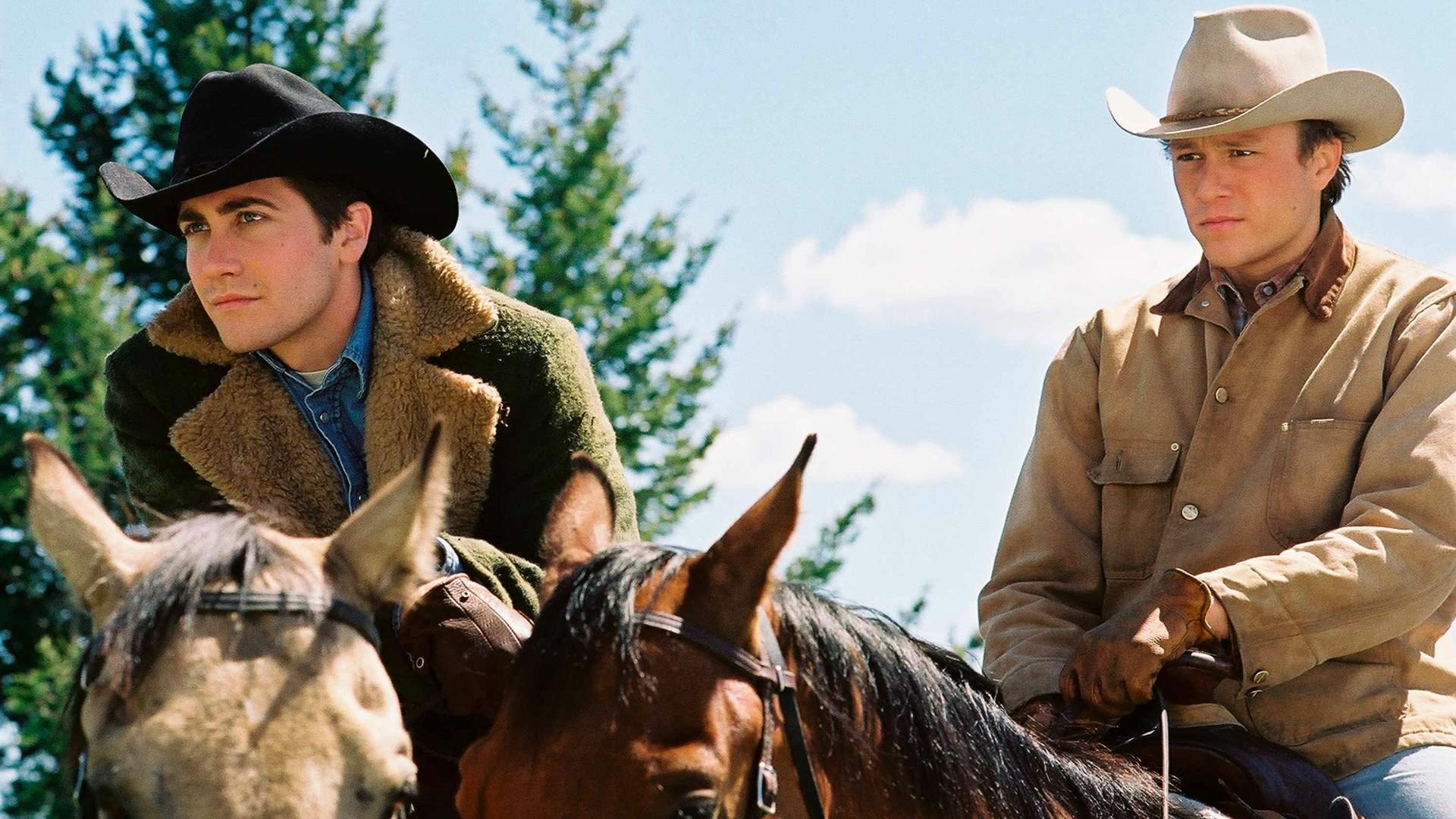
It has been roughly two decades since Ang Lee’s masterpiece hit theaters, and yet, the visual language of the film remains stuck in our collective psyche. You’ve seen them. The images of two men against a jagged skyline, the denim-on-denim textures, and that specific, dusty light of the Canadian Rockies (which were famously standing in for Wyoming). But Brokeback Mountain photos aren't just stills from a movie; they’ve become a sort of cultural shorthand for longing and the American West.
The film didn't just win Oscars. It changed how we look at landscapes.
Honestly, if you scroll through film photography forums or cinematography blogs today, people are still trying to deconstruct how Rodrigo Prieto, the Director of Photography, made a 2005 film look like it was shot in the 1960s without it feeling like a cheap gimmick. It’s all about the grain. It’s about the way the light hits Heath Ledger’s hat.
The shots that defined a decade
The most famous Brokeback Mountain photos usually involve that iconic shot of Jack and Ennis on the mountain, sheep scattered like white rice across the green slopes. It looks peaceful. But if you look closer at the production stills, there’s a grit there.
Prieto and Lee were heavily influenced by the photography of Richard Avedon, specifically his "In the American West" series. If you compare Avedon’s portraits to the close-ups of Jake Gyllenhaal and Heath Ledger, the DNA is undeniable. There is a harshness to the skin. You see the pores, the sun damage, and the dirt under the fingernails. It’s a direct rejection of the "pretty" Hollywood cowboy trope.
Most people think the movie was shot in Wyoming because that’s where Annie Proulx’s short story is set. Nope. It was actually filmed in the Canadian Rockies—places like Fortress Mountain and Kananaskis Country in Alberta. The photos from the set captured a wilderness that felt ancient and indifferent to the human drama unfolding within it.
Why these images still trend on social media
You might notice that every few months, a batch of Brokeback Mountain photos goes viral on Twitter or TikTok. Why? Because the film captures "liminal space" before that was even a buzzword.
The mountain is the only place where these characters are "real." Down in the plains, in the towns of Riverton and Childress, the photos are claustrophobic. The ceilings are low. The rooms are dark. The contrast between the expansive mountain stills and the cramped domestic photos tells the whole story without a single word of dialogue.
Some of the most heartbreaking images aren't even of the actors. Think about the photo of the two shirts tucked inside one another. That single image, captured by the unit still photographer (often the unsung heroes of film promotion), carries more emotional weight than most entire scripts. It represents the "ghost" of a relationship.
Behind the lens with Rodrigo Prieto
Rodrigo Prieto didn’t want the film to look like a postcard. He used different film stocks to differentiate the eras.
As the story moves from 1963 into the 70s and 80s, the color palette shifts subtly. The early Brokeback Mountain photos have a cooler, more desaturated feel. By the time we get to the later years, there’s a slight warmth, a sort of sepia-toned nostalgia that makes the tragedy feel even heavier.
Interestingly, the weather was a nightmare. They had to deal with snow in the middle of summer and sweltering heat when they needed cold. The production photos show the crew huddling under parkas between takes of the famous "summer" scenes. It’s a reminder that movie magic is often just a bunch of people being very uncomfortable for the sake of art.
The legacy of the poster art
We have to talk about the poster. You know the one—the "leaning" shot.
Ennis and Jack are leaning against a fence, looking in opposite directions. It’s a classic composition. It’s been parodied a thousand times, but the original still holds up because of the body language. It conveys a sense of being "back to back" against the world while still being inextricably linked.
This specific image was used for the DVD covers and the theatrical release, and it’s arguably the most recognizable piece of LGBTQ+ cinema history. It’s weird to think about now, but in 2005, putting two male leads in that configuration on a mainstream movie poster was considered a massive risk. Marketing executives were terrified it would alienate audiences. Instead, it became an icon.
Technical details for the film nerds
For those who care about the "how," the movie was shot on 35mm film.
- Camera: Arriflex 535B and Arricam ST.
- Lenses: Zeiss Master Primes and Cooke S4s.
- Film Stock: Kodak Vision2 200T 5217 and 500T 5218.
The choice of Tungsten-balanced film (the "T" in 200T) used in daylight with an 85 filter is what gives those mountain scenes that specific, rich blue and green depth. It prevents the highlights from looking "blown out" or digital. When you look at high-resolution Brokeback Mountain photos today, you can see the organic texture of the silver halide crystals. It’s something that digital sensors still struggle to replicate perfectly.
The "Hidden" photos: What wasn't in the movie
There are dozens of production stills that never made it into the official trailers or press kits. Some show the actors laughing between takes—a stark contrast to the grueling emotional labor they were doing on screen.
Heath Ledger, in particular, was known for being quite shy on set. The candid photos of him shows a man deeply immersed in his craft. There’s a specific photo of him leaning against a truck, looking at his boots, that feels more like Ennis Del Mar than any posed shot ever could.
How to use these visuals for inspiration
If you’re a photographer or a filmmaker, there’s a lot to learn from the Brokeback Mountain photos.
First, look at the "Rule of Thirds." Ang Lee almost never centers the characters when they are on the mountain. They are always off-center, tiny compared to the peaks behind them. This emphasizes their insignificance in the face of nature and society.
Second, study the lighting. Prieto used a lot of natural light, but he "shaped" it using large silk screens to keep the shadows soft. This is why the actors' faces look so expressive even under the harsh midday sun.
Actionable steps for fans and creators
If you’re looking to dive deeper into the visual history of this film, or if you’re a creator looking to capture this specific aesthetic, here is what you should do next.
- Study the Richard Avedon "American West" collection. This is the primary visual source material for the movie. Understanding Avedon’s use of stark white backgrounds and raw human texture will change how you view the film's close-ups.
- Visit the filming locations. Many of the iconic spots in Kananaskis Country and around Fort Macleod are accessible to the public. Taking your own photos in these spots can give you a real appreciation for the scale of the landscape Lee was working with.
- Look for the "Focus Features" archival prints. Occasionally, high-quality lithographs of production stills are released for anniversaries. These are vastly superior to the low-res files you find on standard image searches.
- Analyze the costume design by Marit Allen. The photos highlight the "weathering" of the clothes. If you’re a stylist or photographer, pay attention to how the denim fades over the twenty-year timeline of the film. It’s a masterclass in visual storytelling through wardrobe.
The power of Brokeback Mountain photos lies in their silence. They capture a story of things left unsaid, using the rugged beauty of the wilderness to mirror the internal landscape of two men who were never quite allowed to be themselves. Whether you’re a film buff or just someone who appreciates great photography, these images remain some of the most potent examples of how a camera can capture the human heart.
The best way to appreciate the cinematography is to watch the film on a high-quality 4K restoration. The grain, the color grading, and the sheer scale of the Alberta scenery are best experienced in motion, where you can see how the light changes as the day ends on the mountain. Check out the Criterion Channel or specialized film archives for the highest-quality versions of these visual assets.