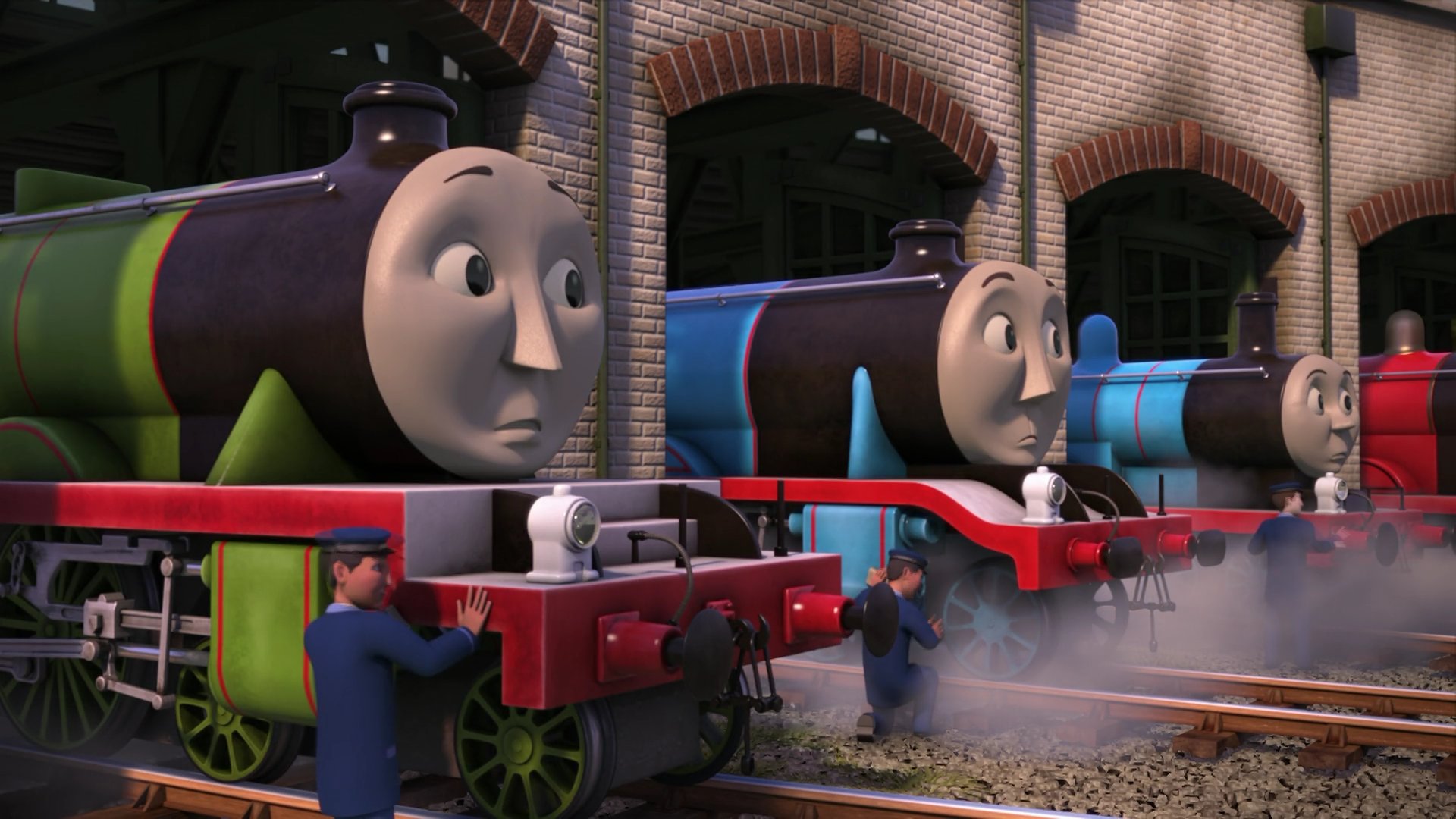
It happened in 2009. For over two decades, Thomas the Tank Engine was a physical thing—a heavy brass model sliding along a track with a tiny puff of real smoke. Then, Hero of the Rails arrived, and suddenly, CGI Thomas and Friends became the new reality. Some people hated it immediately. Others felt it was a breath of fresh air for a show that was literally creaking at the seams. Honestly, looking back at it now, the move to computer animation wasn't just a tech upgrade; it was a total personality transplant for the North Western Railway.
The transition was jarring. You’ve got to remember that before 2009, the "faces" of the engines were static resin molds. To make them "blink," a crew member had to physically swap the eyes between frames. It was charming, sure, but it was incredibly limiting for storytelling. When Nitrogen Studios took over the animation, the engines finally found their voices. No more single narrator doing a "Salty" impression. Now, the engines had individual voice actors, moving lips, and—critically—the ability to use their wheels like hands to express emotion.
The Nitrogen Era: A High Point for Realism
When people talk about the "good" CGI years, they're usually talking about the work done by Nitrogen Studios between 2009 and 2012. They treated the island of Sodor like a real place. The lighting was moody. The steam looked heavy. They even kept the "scale" of the original models in mind, making sure the engines didn't move too fast or feel like toys.
Basically, the show became a cinematic experience.
In Blue Mountain Mystery, arguably the peak of this era, the animation allowed for camera angles that were physically impossible with the old live-action models. We're talking sweeping aerial shots and POV angles from the tracks. It gave the show a sense of scale that the 1984 original simply couldn't touch. But there was a catch. The writing during this period—often dubbed the "Miller Era" after head writer Sharon Miller—was notoriously repetitive. Every episode followed a strict three-strike formula. Thomas makes a mistake. Thomas makes the same mistake again. Thomas finally listens. It was predictable, but the visuals were so stunning that a lot of older fans gave it a pass.
Why the Move to CGI Was Actually Necessary
Let's get real for a second. The model sets were a nightmare to maintain. By the mid-2000s (specifically the HiT Entertainment era), the production costs were astronomical. The models were breaking, the silicone faces were degrading, and the physical space required to house the massive sets was becoming a financial liability.
CGI solved the "crowded track" problem.
In the model era, you rarely saw more than three engines in a shot because the wiring and the magnets under the table would get tangled. With CGI Thomas and Friends, the directors could suddenly populate Knapford Station with dozens of engines, moving independently. It felt like a working railway for the first time. It also allowed for the introduction of characters like Victor and Kevin at the Sodor Steamworks—characters who moved in ways a physical model never could. Kevin’s hook actually swung. Victor’s wheels could slip on the rails. It added a layer of mechanical realism that actually respected the railway roots of Rev. W. Awdry’s original books.
The Shift to Arc Productions and Beyond
Around Season 17, the animation moved from Nitrogen Studios to Arc Productions, and the show underwent a massive creative shift. This is where Andrew Brenner stepped in as head writer. This era is generally considered the "Golden Age" of CGI. Why? Because Brenner was a superfan. He brought back long-lost characters like Duck, Bill, Ben, and even the "Arlesdale" miniature engines that hadn't been seen in decades.
He understood that Sodor wasn't just a background; it was a character.
The animation became more fluid, and the stories started acknowledging the actual history of the railway. We saw the engines dealing with realistic problems—like narrow-gauge clearances or the dangers of coastal erosion—rather than just "the three strikes" logic. It was a weirdly sophisticated time for a show aimed at toddlers. You had complex characters like Hiro, the "Master of the Railway," who brought a sense of international history to the show, bridging the gap between Japanese locomotive design and British rails.
The Big World! Big Adventures! Controversy
Then things got weird. In 2018, Mattel (who bought the brand) decided the show needed a "reboot" within the CGI world. This became Big World! Big Adventures! (BWBA). They kicked Edward and Henry out of Tidmouth Sheds. They added Nia and Rebecca. Thomas started traveling the world, visiting China, Brazil, and Australia.
Fans were livid.
The physics changed, too. The engines started "bouncing" on their springs. They didn't feel like heavy pieces of iron anymore; they felt like rubber characters. This was the moment CGI Thomas and Friends lost a lot of its "heritage" audience. The show leaned heavily into "edutainment," teaching kids about different cultures, which was noble enough, but the grit of Sodor was gone. The animation became brighter, faster, and much less grounded in reality. It was a move designed to compete with high-energy shows like Paw Patrol, but in doing so, it abandoned the slow, methodical pace that made the show unique.
How CGI Compared to the Original Models
If you compare a shot from 1984’s "Thomas and Bertie" to a shot from 2014’s "The Adventure Begins," the difference is staggering.
- Humanity: The CGI humans (Sir Topham Hatt, the drivers) actually walked and talked. In the model era, they were literally plastic figurines that "disappeared" between frames if they needed to move.
- Atmosphere: While CGI offered better weather effects (rain, snow, fog), many argue it lacked the "soul" of the hand-crafted sets. There's something about the way light hits a physical model that a computer algorithm still struggles to perfectly replicate.
- Expression: This is the big win for CGI. The engines could look sad, terrified, or mischievous with just a subtle movement of their eyebrows.
The Legacy of the CGI Era
Love it or hate it, the CGI run (Seasons 13 through 24) is the longest continuous version of the show. It defined Thomas for an entire generation of kids who would find the original 1980s models "boring" or "slow." It expanded the lore of Sodor in ways the books never did, giving us a deep dive into the history of the Sodor Search and Rescue Center and the various hidden parts of the island like Ulfstead Castle.
But everything ends. Eventually, the CGI era was replaced by the 2D-animated All Engines Go! in 2021. This move was even more controversial, as it completely abandoned any pretense of being a "railway" show. Thomas now jumps off the tracks and uses his wheels like hands. For many, the end of the CGI era marked the end of Thomas as a "serious" depiction of a railway.
What You Should Do Now
If you're a parent or a collector looking to revisit this era, don't just watch whatever is on YouTube. To truly appreciate the work that went into CGI Thomas and Friends, you need to look at the specials. Movies like Sodor’s Legend of the Lost Treasure feature incredible voice work (Eddie Redmayne and John Hurt!) and animation that actually pushes the boundaries of what a "kids' show" can look like.
- Watch the Brenner Era: Stick to Seasons 17 through 20 for the best balance of storytelling and animation quality.
- Check out the "The Adventure Begins" special: It’s a CGI retelling of the very first stories from 1945, and it’s a beautiful bridge between the old and the new.
- Avoid the BWBA era if you want realism: If you prefer the engines to act like actual trains, skip everything from Season 22 onwards.
The CGI era was a bridge. It took a 1940s book series and pushed it into the 21st century. While it had its stumbles—mostly when it tried too hard to be "hip"—it remains a massive achievement in digital storytelling for children. It proved that you could give a face a voice without losing the heart of the character. Just don't expect the engines to stay on the rails if you watch the newer stuff. Those days are officially over.