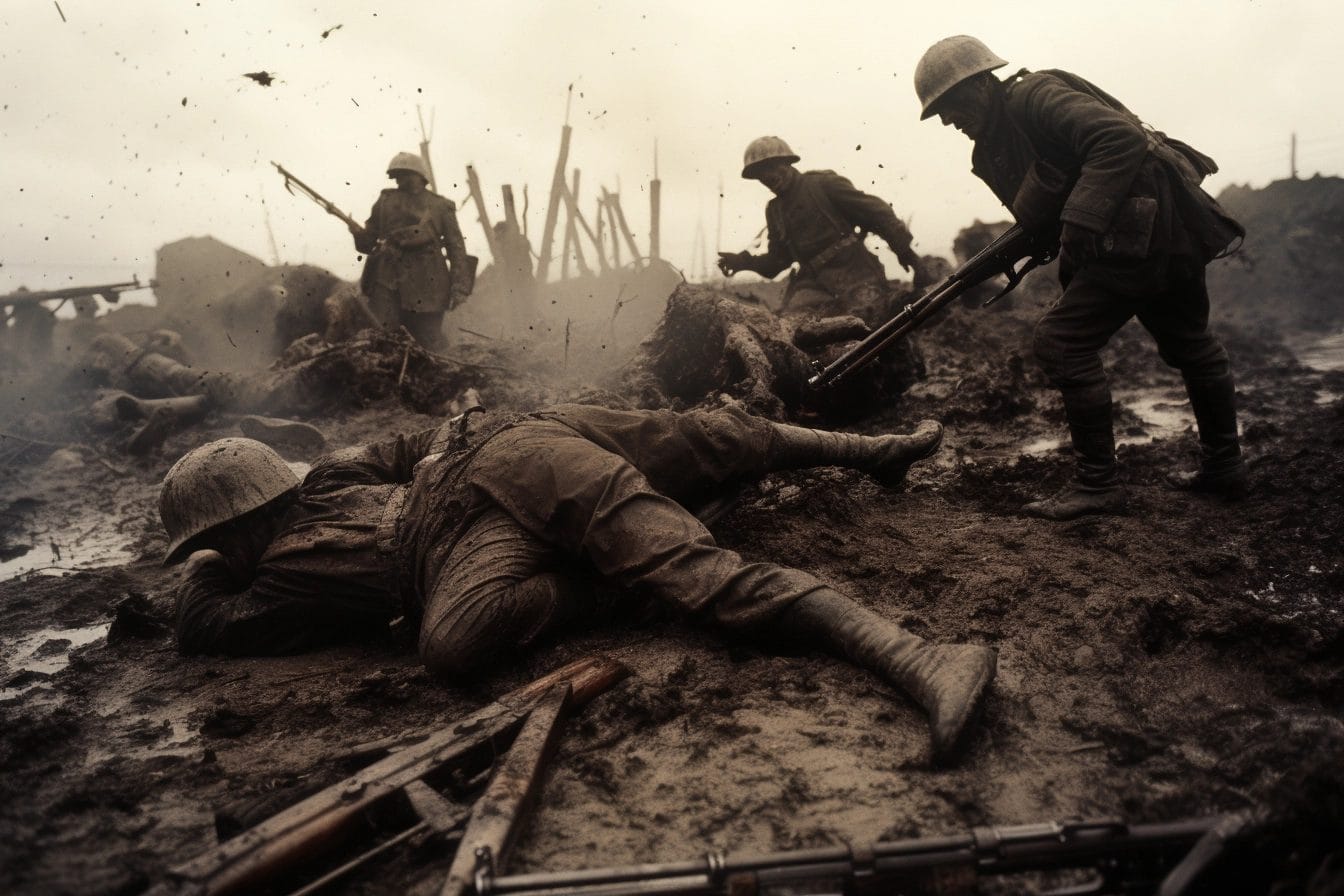
You've probably seen the phrase on a dusty war memorial or carved into a stone archway in some quiet European village. Dulce et decorum est pro patria mori. It sounds noble. It sounds like something a hero says right before the credits roll. But if you actually sit down and read Dulce Et Decorum Est by Wilfred Owen, you realize pretty quickly that Owen wasn't interested in being a hero. He wanted to scream.
He wrote this while recovering from shell shock at Craiglockhart War Hospital in 1917. Think about that for a second. He wasn't some academic sitting in a cozy library in Oxford imagining what war felt like. He was a soldier who had seen his friends' lungs literally dissolve because of chlorine gas. He was twitching, stammering, and having nightmares that would eventually become the most famous anti-war poem in the English language.
It's raw. It's ugly. Honestly, it’s kind of terrifying.
The Old Lie vs. The Gritty Reality
Most people think of World War I through the lens of black-and-white photos and silent film reels. Everything looks slow and sort of distant. Owen changes that. He starts the poem not with a charge or a shout, but with soldiers who look like "old beggars under sacks." They aren't marching; they’re "trudging." They’re "coughing like hags."
It’s a total subversion of the "soldier" archetype.
When we talk about Dulce Et Decorum Est by Wilfred Owen, we have to talk about the sensory overload. He focuses on the feet. "Many had lost their boots / But limped on, blood-shod." Can you imagine that? Walking miles through freezing mud without shoes, your feet so raw they look like you’re wearing boots made of blood. It’s a visceral image that sticks in your throat. Owen isn't trying to be poetic here; he’s trying to be a witness.
The turning point of the poem is the gas attack. It’s sudden. "Gas! GAS! Quick, boys!"
Everything shifts from a slow, painful crawl to a frantic, clumsy scramble for masks. In 1917, those masks weren't the high-tech respirators we see today. They were clunky, goggles-fogging canvas hoods that smelled like chemicals. And one guy doesn't get his on in time.
What Actually Happens During a Chlorine Gas Attack?
To understand why Owen was so angry, you have to understand the science of what he was watching. Chlorine gas reacts with the water in the lungs to produce hydrochloric acid. It literally burns the respiratory system from the inside out.
Owen describes the victim "floundering like a man in fire or lime." He watches through the "misty panes" of his own gas mask as his comrade "guttering, choking, drowning" in a sea of green vapor.
The word "drowning" is key.
You aren't drowning in water; you’re drowning in your own fluids because your lungs are being destroyed by acid. Owen didn't just see this once. He saw it constantly in his mind. He describes these "helpless sights" in his dreams. This is a classic symptom of what we now call PTSD, but back then, they just called it "neurasthenia" or being "faint-hearted."
Who Was Wilfred Owen Writing For?
This is where it gets spicy. Owen didn't write this for the general public or for history books. He wrote it for a specific person: Jessie Pope.
She was a journalist and poet who wrote jingoistic, "pro-war" verses that encouraged young men to enlist. She wrote things like The Call, which basically treated the war like a big game of cricket. Owen originally dedicated the poem "To a certain Poetess," and later drafts specifically named her.
He was essentially saying, "You’re sitting in London telling kids it’s glorious to die, while I’m watching them cough up 'froth-corrupted lungs' into a wagon."
When he calls the phrase Dulce et decorum est pro patria mori "The Old Lie," he’s taking a direct shot at the Roman poet Horace. Horace wrote that in the first century BC. For two thousand years, Western civilization had treated that line as the ultimate truth. Owen called BS. He argued that there is nothing "sweet" (dulce) or "fitting" (decorum) about dying in a ditch because a politician made a mistake.
Why the Structure of the Poem Matters
If you analyze the meter, it’s mostly iambic pentameter, which is the "fancy" Shakespearean way of writing. But Owen breaks it. Constantly.
He uses "caesuras"—those little breaks or pauses in the middle of a line—to make the rhythm feel jagged. It’s like a heartbeat that keeps skipping. It mirrors the physical exhaustion of the soldiers. They can’t keep a steady pace, so the poem can’t either.
Then there’s the imagery.
- "Obscene as cancer"
- "Bitter as the cud of vile, incurable sores"
- "White eyes writhing in his face"
He uses words that feel "thick" in your mouth. "Guttering," "clumsy," "fumbling." You can’t read this poem quickly. It forces you to slow down and experience the agony. It’s heavy. It’s meant to be heavy.
The Misconception of "Anti-War"
Some people think Owen was a pacifist who hated the military. That’s not quite right. Owen actually returned to the front lines after his treatment. He felt he had to be with his men. He was a decorated officer who won the Military Cross for bravery.
He didn't hate the soldiers; he hated the justification for the slaughter.
He was killed in action on November 4, 1918—exactly one week before the Armistice was signed. His parents received the telegram informing them of his death on the very day the church bells were ringing to celebrate the end of the war. You couldn't write a more tragic ending if you tried.
The Lasting Impact on Modern Literature
Before Owen and his contemporary Siegfried Sassoon, war poetry was mostly about flags, horses, and noble sacrifices. Think of Tennyson’s The Charge of the Light Brigade. It’s exciting! It’s rhythmic! "Forward, the Light Brigade! / Was there a man dismayed?"
Owen killed that version of war poetry.
He paved the way for the "gritty" realism we see in modern war movies like Saving Private Ryan or 1917. He took the camera off the generals on the hill and shoved it right into the mud of the trenches. Every time you see a movie that shows the "horror" of war instead of the "glory," you’re seeing Wilfred Owen’s influence.
How to Analyze This Today
If you’re studying this for a class or just interested in history, don't just look at the words. Look at the anger.
- Notice the perspective shift: The poem moves from "we" (the soldiers) to "he" (the dying man) to "you" (the reader/Jessie Pope). He’s pulling you into the trench and then blaming you for being there.
- Look for the color green: The "green sea," the "green light." Chlorine gas has a yellowish-green tint. By using that color, Owen makes the atmosphere feel sickly and unnatural.
- The irony of the title: The title is a fragment. It’s incomplete until the very last line. It sets you up for a tribute and delivers a gut-punch instead.
Actionable Takeaways for Readers
Reading Dulce Et Decorum Est by Wilfred Owen isn't just a literary exercise. It’s a lesson in how to spot propaganda and how to value the human cost of political decisions.
To truly grasp the weight of Owen's work, consider these steps:
- Compare Owen to Brooke: Read Rupert Brooke's The Soldier ("If I should die, think only this of me...") alongside Owen. It shows the massive divide between the romanticized view of war at the start of 1914 and the disillusioned reality of 1917.
- Watch the imagery in film: Re-watch the gas attack scenes in All Quiet on the Western Front (the 2022 version is particularly visceral). It gives a visual context to the "misty panes" and "thick green light" Owen describes.
- Research the "War Office" propaganda: Look at the posters from 1914-1915. You’ll see exactly what Owen meant by "The Old Lie." The posters make it look like a summer camp; Owen makes it look like hell.
- Examine the draft manuscripts: The British Library has digital copies of Owen’s handwritten drafts. Seeing his cross-outs and revisions—especially how he sharpened the insults toward Jessie Pope—shows how much he labored over the emotional impact of every single word.
Owen didn't want his poem to be "beautiful." He wanted it to be true. A century later, it remains the definitive warning against the hollow glorification of violence.