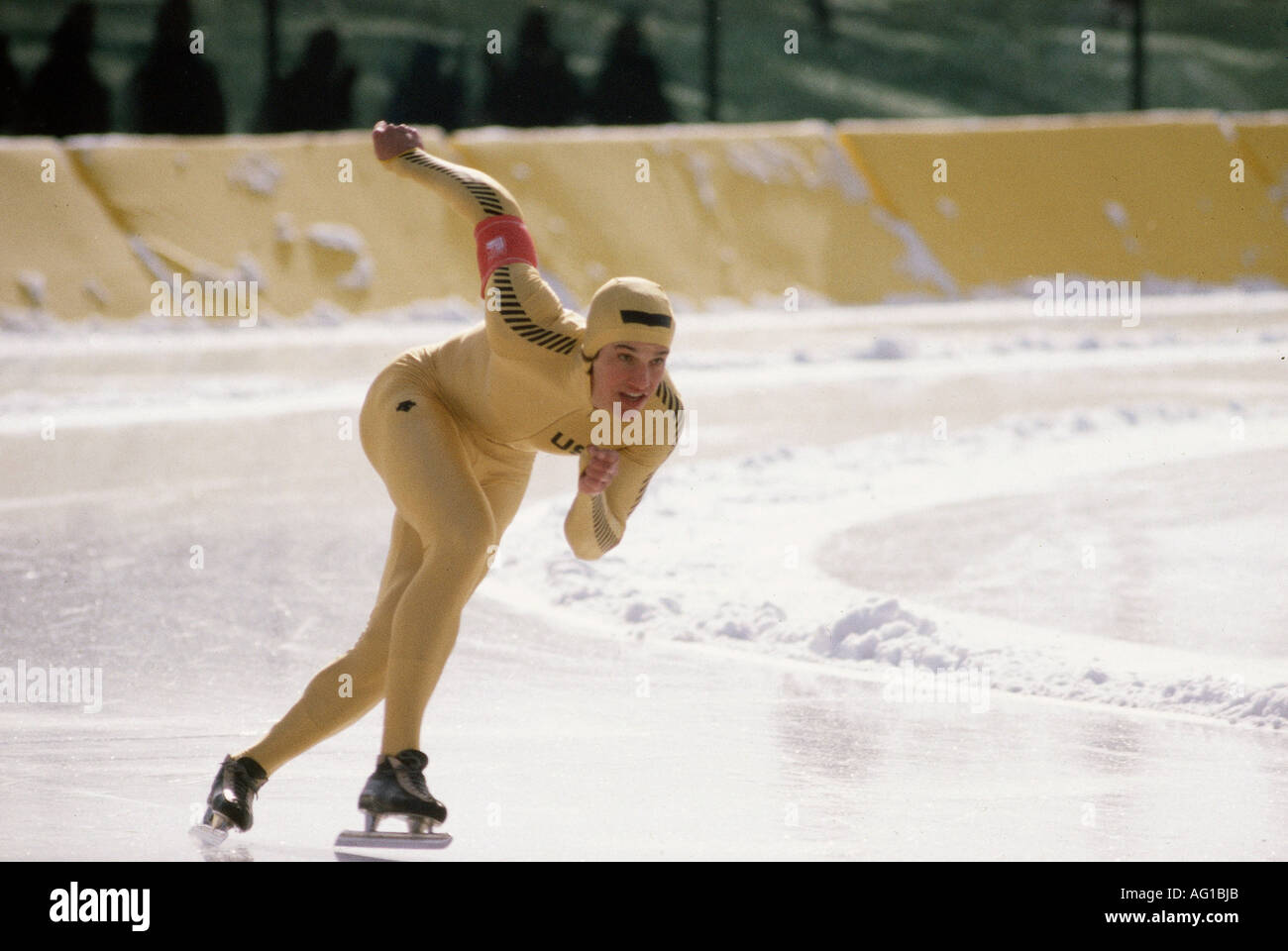
If you were around in February 1980, you probably remember the "Miracle on Ice." It’s the story everyone tells about Lake Placid. But while the U.S. hockey team was busy shocking the Soviets, a 21-year-old kid from Madison, Wisconsin, with thighs the size of tree trunks was quietly—well, maybe not quietly—pulling off the most impossible feat in the history of the Winter Olympics.
Eric Heiden speed skater extraordinaire didn't just win a gold medal. He won five.
Every single individual event on the program. From the 500-meter sprint, which is basically a 35-second explosion, to the 10,000-meter marathon on ice that lasts nearly 15 minutes. It’s like a track athlete winning the 100-meter dash and the 10,000-meter run in the same week. It doesn't happen. It shouldn't be physically possible. Yet, Heiden did it, and honestly, the way he did it was even weirder than the stats suggest.
The Morning He Overslept (and Still Broke a World Record)
You’d think a guy on the verge of his fifth gold medal would be dialed in, right? Nope.
On the morning of the 10,000-meter race—the most grueling event of them all—Heiden actually overlept. He’d been watching the U.S. hockey team beat the Soviets the night before and couldn't sleep from the excitement. He woke up late, skipped a real breakfast, and ended up just scarfing down a couple of slices of whole-grain bread while rushing to the rink.
Most athletes would panic. Heiden? He just went out and broke the world record by over six seconds.
He finished that race in 14:28.13. It was his fifth gold of the Games. To put that in perspective, Heiden won more gold medals by himself than every other country at those Olympics except for the Soviet Union and East Germany. He was literally a one-man powerhouse.
What Made Him Different?
If you look at photos of Heiden from 1980, the first thing you notice are his legs. His thighs measured 29 inches. For context, that’s larger than the waistline of many marathon runners.
He didn't get those legs from fancy tech or modern sports science. This was the late 70s. Heiden and his coach, Dianne Holum, relied on what they called "dry land" training.
- Duck walking: He would literally walk in a deep squat for what seemed like miles.
- Cycling: He spent hours on a bike long before it was his second career.
- Weightlifting: He focused on massive repetitions of squats.
His coach, Holum, was a legend herself, and she pushed him into a regimen that combined pure explosive power with insane cardiovascular endurance. This is why he could win the 500m (power) and the 10,000m (endurance). Most skaters specialize. They are either sprinters or stayers. Heiden was the glitch in the system.
The Near-Fall in the 1500m
People forget that he almost lost it all in the 1,500 meters. Halfway through the race, he hit a soft patch of ice or caught a rut and stumbled. He actually had to put his hand down on the ice to keep from face-planting at 30 miles per hour.
Any other skater would have been rattled. The rhythm would be gone. But Heiden just gathered himself, stayed low, and still won the race by 0.37 seconds. It’s that kind of freakish composure that defines him.
From the Oval to the Tour de France
Most people think Heiden just vanished after 1980. He didn't. He was just bored of winning everything on ice.
He basically retired from skating at the top of his game because he didn't want to be a professional celebrity. He wanted to be a cyclist. He was a founding member of the iconic 7-Eleven Cycling Team. Think about that transition for a second. He went from being the best in the world at a sport that lasts minutes to competing in the Tour de France—the most grueling endurance event on the planet.
In 1985, he won the first-ever U.S. Professional Road Cycling Championship. He competed in the 1986 Tour de France, though he had to drop out after a nasty crash. He is one of the very few humans to ever reach the elite level of both a Winter Olympic sport and a major professional summer sport.
Dr. Heiden: The Third Act
If being a 5-time gold medalist and a pro cyclist wasn't enough, Heiden decided to go to medical school. He graduated from Stanford in 1991.
He didn't just get the degree to have it; he became a high-level orthopedic surgeon. He specialized in sports medicine, which makes total sense. If you’re a pro athlete with a blown-out knee, who would you trust more than the guy who knows exactly what it takes to train through pain?
Today, Dr. Eric Heiden practices in Park City, Utah. He’s been the team physician for the U.S. Speed Skating team at multiple Olympics. He’s the guy behind the scenes now, making sure the next generation doesn't fall apart. It’s a full-circle moment that feels way more authentic than seeing him on a cereal box or doing "Dancing with the Stars."
Why the Records Still Matter
You might look at his times and think, "Hey, people go faster now." And they do. But they have clap skates. They have indoor, climate-controlled rinks. They have aerodynamic suits that look like they were designed by NASA.
Heiden did all of this outdoors. In Lake Placid. In the wind. On "slow" ice.
Actionable Takeaways from Heiden's Career
If you’re looking to apply the "Heiden Mindset" to your own life or training, here’s the blueprint:
- Cross-Train for Versatility: Heiden didn't just skate. He biked, he ran, he lifted. This prevented burnout and built a body that could handle any physical demand.
- Focus on the Basics: Forget the fancy gadgets. Heiden’s success came from thousands of hours of squats and duck walks. Master the fundamental movements of your craft.
- Stay Even-Killed: Whether he was oversleeping or almost falling on the ice, he didn't panic. He focused on the next stride.
- Know When to Pivot: He stopped skating when he had nothing left to prove. He wasn't afraid to start over as a "rookie" in cycling or medicine.
He remains the only person to ever sweep all five speed skating distances in a single Olympics. In an era of hyper-specialization, it’s a record that will almost certainly never be broken. He wasn't just a fast skater; he was a complete athlete who decided to see how far his body could go, and then decided to spend the rest of his life fixing everyone else’s.
To see the "Heiden Stroke" in action today, you can actually look up archival footage of the 10,000m world record run from 1980. Pay attention to his hips and how low he stays even when his lungs are screaming. That’s the gold standard. If you're interested in modern sports medicine, checking out the research coming out of his clinic in Park City gives a great look at how he's translated that Olympic power into clinical excellence.