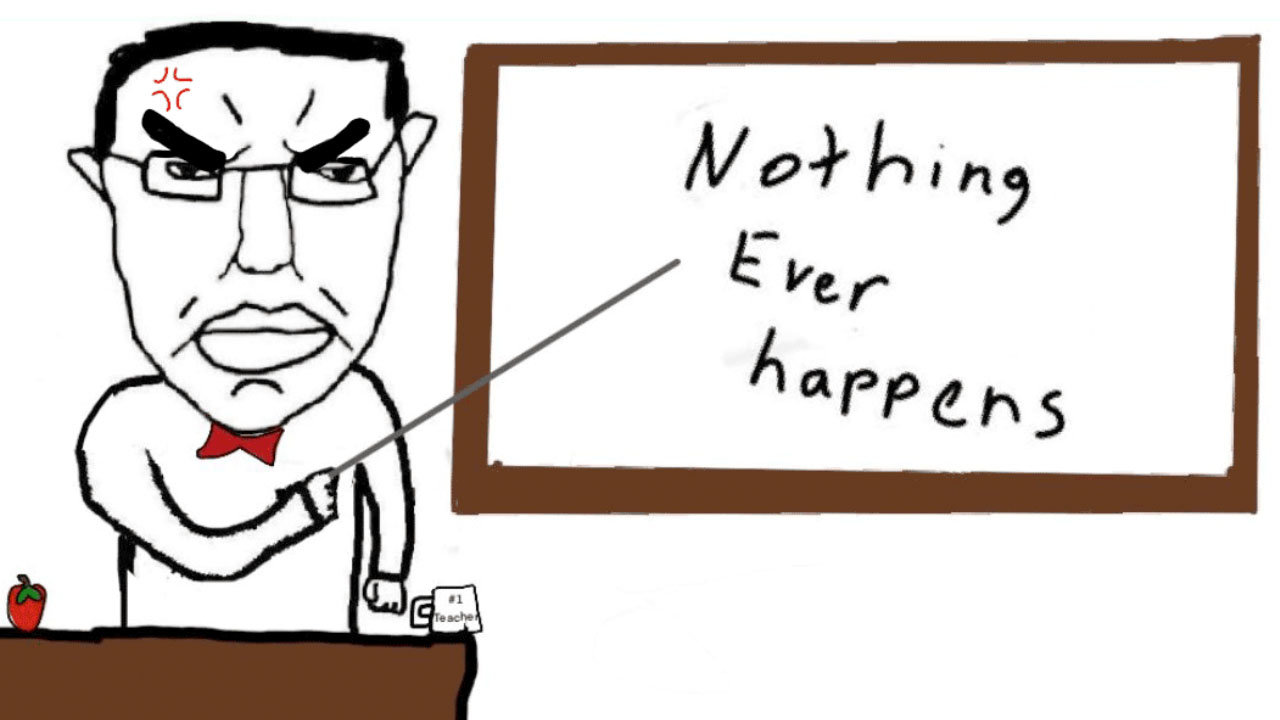
You've seen it. That specific, slightly unhinged energy on your timeline where someone posts a photo of a catastrophic event followed by the phrase I'm all in nothing ever happens. It’s the definitive mood of the mid-2020s. We live in a world that feels like it’s constantly on the brink of a series of "unprecedented" finales, yet, somehow, Monday morning always rolls around. People are exhausted. This isn't just a meme; it's a coping mechanism for a generation that has been told the world is ending every Tuesday for the last decade.
The phrase is a paradox. It’s the ultimate expression of "Accelerationism" meeting "Doomerism" in a dark alley. When you say I'm all in nothing ever happens, you are essentially betting on the status quo while simultaneously acknowledging how fragile everything looks. It is the verbal equivalent of a shrug while watching a wildfire from a safe distance.
Where Did This Sentiment Actually Come From?
The "nothing ever happens" trope didn't just appear out of thin air in 2024 or 2025. It has roots in deep-web imageboard culture, specifically 4chan’s /pol/ and /biz/ boards, where users would wait for massive geopolitical shifts that never quite materialized. They called themselves "Happening Junkies." Every time a naval ship moved or a stock dipped, the threads would fill with "IT'S HAPPENING."
Then, nothing happened.
The counter-reaction was the "Nothing Ever Happens" guy. Usually depicted by a specific edit of the "Yes Honey" Wojak or a smug looking character, this persona mocks those who expect the world to change overnight. It’s a cynical take. It suggests that the systems of power, the "Deep State," the "Algorithm," or just the sheer inertia of human history is too heavy to be moved by single events.
The Shift to "I'm All In"
Adding the I'm all in part changes the flavor entirely. It’s no longer just cynical observation; it’s a gamble. It’s the language of the "Degenerate Gambler" era of the internet—the WallStreetBets crowd and the crypto-Twitter (X) circles.
When a major news story breaks—maybe a massive cyberattack or a bizarre political scandal—the "all in" crowd bets their mental health, their portfolios, or just their social capital on the idea that by next week, we’ll all be talking about a new season of a reality show instead. They aren't just predicting stability. They are rooting for it because the alternative is too chaotic to process.
The Psychology of the "Nothing" Filter
Why do we find this funny? Psychologists might point to "normalization bias." This is the mental state people enter when they face a disaster. They underestimate the possibility of the disaster actually happening or its effects. We’ve been through a global pandemic, multiple "once in a century" economic crashes, and a complete overhaul of how we communicate.
We’re desensitized.
Honestly, if an alien landed in Central Park tomorrow, half of the internet would probably post I'm all in nothing ever happens just to see if they could manifest a world where they still have to pay their rent on the first of the month. It’s a way to reclaim power. If "nothing happens," then you don't have to be afraid. You can stay in control.
The Role of Irony in Modern Content
Everything is layered in irony now. You can’t just say "I hope things stay peaceful." That’s boring. You have to say I'm all in nothing ever happens while a literal tornado sirens blares in the background.
- It signals you are "online" enough to know the meme.
- It protects you from looking stupid if the "big event" actually is a dud.
- It creates a community of shared nihilism.
Social media thrives on the "Event." The Algorithm demands a constant stream of "The Most Important Thing Ever." By leaning into the I'm all in nothing ever happens mindset, users are effectively opting out of the outrage cycle. It’s a refusal to give the 24-hour news cycle the reaction it wants.
Real World Examples of the "Nothing" Phenomenon
Think back to the "Great Reset" theories or the various "Y2K-style" fears regarding AI takeovers. In 2023, when the UAP (UFO) hearings were happening in Congress, the internet was primed for a paradigm-shifting revelation. People were screaming that the world was about to change.
What happened?
A few weeks later, everyone was back to arguing about whether a sandwich is a taco. The "Nothing Ever Happens" crowd won. They were "all in" on the idea that the status quo is the most powerful force in the universe.
Even in the world of finance, we see this. Every time a "Black Swan" event is predicted, there is a contingent of traders who bet against the chaos. They buy the dip. They rely on the fact that the world, for all its flaws, has a remarkable ability to just... keep grinding along.
The Danger of the Meme
There is a dark side to being I'm all in nothing ever happens. If you truly believe nothing matters and nothing changes, you stop trying to change things. It’s a form of political and social paralysis.
If we assume every "happening" is a false alarm, we might miss the one that actually requires our attention. It’s the Boy Who Cried Wolf, but the boy is a Twitter account with 200,000 followers and the wolf is a genuine systemic collapse.
Breaking Down the Aesthetic
The visual language of this meme is usually lo-fi. It’s not polished. It’s a grainy screenshot of a news headline or a blurry photo of a crowded street. It feels "real" because it lacks the sheen of corporate marketing.
This is why it hits Google Discover so hard. It feels like a genuine human sentiment in a sea of AI-generated "10 Ways to Prepare for the Future" articles. It’s raw. It’s a little bit rude. It’s exactly how people actually talk when they’re hanging out with friends.
- The Vibe: Detached, smug, slightly anxious but hiding it.
- The Audience: People aged 18-35 who have lived through "three historical events a week."
- The Goal: To survive the news cycle without losing your mind.
How to Use This Energy (The Actionable Part)
If you find yourself spiraling because the news feels like a disaster movie, adopting a bit of the I'm all in nothing ever happens philosophy might actually be good for your health.
Stop checking the "Trending" tab every fifteen minutes. Most things that are "happening" right now will be forgotten by Friday.
Focus on the local. Focus on the tangible.
The meme teaches us that while the "macro" world feels like it’s exploding, the "micro" world—your coffee, your walk, your work—tends to stay the same. There is a weird comfort in that.
Next Steps for the Digitally Overwhelmed
Instead of doomscrolling, try this:
- Audit your feed. If an account is constantly posting "IT'S HAPPENING" with siren emojis, mute them. They are selling you adrenaline, not information.
- Bet on the mundane. Spend time on hobbies that have nothing to do with the internet. Gardening, woodworking, or just reading a physical book.
- Acknowledge the fatigue. It’s okay to be tired of history. You don't have to have an opinion on every geopolitical tremor.
- Watch the patterns. Notice how many "crises" from six months ago have completely evaporated. This helps build your own "Nothing Ever Happens" internal filter.
The world is loud, but it is also remarkably stubborn. It refuses to end just because a headline says it should. So, next time the internet loses its collective mind, take a breath. Remember the phrase. I'm all in nothing ever happens. Usually, you'll be right. And if you're wrong? Well, you won't be the only one surprised.
Invest your energy in what you can actually control. The rest is just noise.