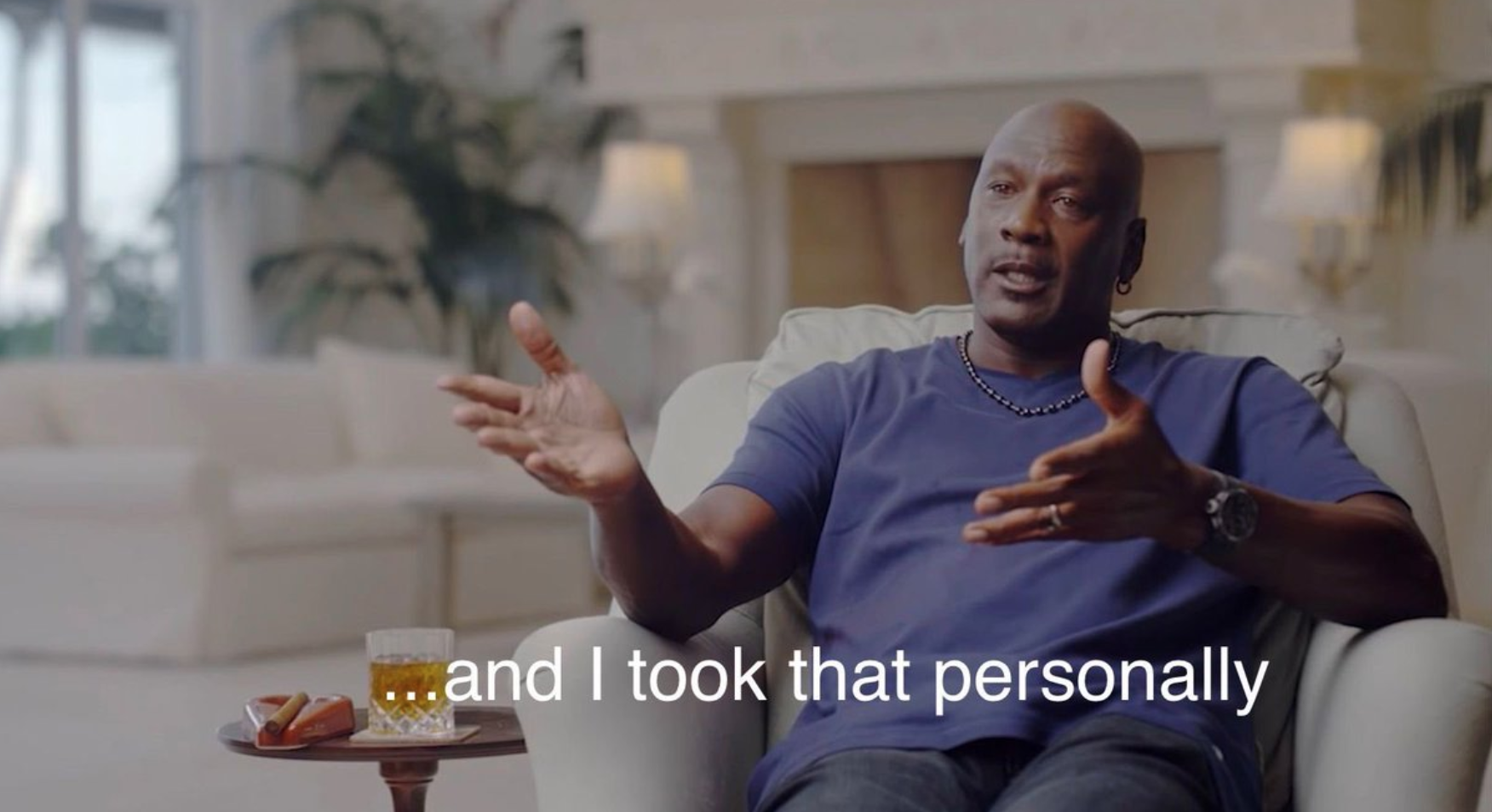
He sat there, glass of tequila in hand, cigar smoke probably lingering just off-camera, and uttered five words that launched a billion tweets. Michael Jordan and "I took that personally" became an instant cultural shorthand during the spring of 2020. We were all stuck inside. We needed a hero, or maybe a villain. What we got was a masterclass in the psychological pathology of greatness.
It's funny, actually.
Most people use the meme to describe a minor slight. You didn't get invited to a birthday party? I took that personally. Someone cut you off in traffic? I took that personally. But for MJ, this wasn't just a funny catchphrase for a documentary trailer. It was a terrifying, almost clinical mechanism for success. He didn't just get mad. He manufactured grievances out of thin air to ensure he could destroy his opponents.
The birth of a meme during The Last Dance
If you watched The Last Dance, you know the vibe. Director Jason Hehir captured Jordan in his post-retirement element, reflecting on a career built on scorched earth. The phrase itself actually appears in several contexts throughout the docuseries, but it crystallized when Jordan discussed players who dared to look at him wrong or, heaven forbid, play well against him.
Take B.J. Armstrong.
In 1998, Armstrong was playing for the Charlotte Hornets. He hit a big shot against the Bulls in the playoffs and celebrated a bit. Just a tiny bit of emotion. Jordan’s reaction in the documentary? He basically admitted that seeing his former teammate celebrate was enough to trigger a vengeful rampage. He didn't just want to win the next game; he wanted to end B.J.'s career right then and there.
It wasn't always about reality
Honestly, the most fascinating part about the whole Michael Jordan and "I took that personally" phenomenon is that Jordan often lied to himself to get motivated. He needed an enemy. If an enemy didn't exist, he created one in his mind.
Remember LaBradford Smith?
This is the gold standard of Jordan’s "taking it personally" obsession. In 1993, Smith, a relatively obscure player for the Washington Bullets, had a career night against Jordan, scoring 37 points. Jordan claimed that as they walked off the court, Smith put his arm around him and said, "Nice game, Mike."
Jordan was incensed.
He told everyone he was going to score 37 points in the first half of the next game. He nearly did, finishing with 47 and absolutely obliterating Smith. Years later, Jordan admitted that Smith never actually said "Nice game, Mike." He made it up. He fabricated a slight just to fuel a performance. That is a level of competitive intensity that borders on the surreal. Most of us need a coffee to get going; Jordan needed a fictional insult from a rookie.
Why this resonated so hard in 2020
We have to look at the timing. When The Last Dance aired, the world was in a weird place. Sports were gone. We were isolated. Seeing a man who possessed such a singular, uncompromising focus on winning—even if it meant being a bit of a jerk—was refreshing. It was a sharp contrast to the "buddy-buddy" era of the modern NBA where players swap jerseys and vacation together in the offseason.
Jordan didn't want to vacation with you. He wanted to take your lunch money.
The meme took off because it’s relatable on a surface level but ridiculous when you actually apply it to Jordan’s life. When we say it, we’re being dramatic. When he said it, he was being literal. The sheer volume of stories involving this mindset is staggering. George Karl, the legendary coach, famously didn't say hi to Jordan at a restaurant before the 1996 Finals.
Guess what? Michael Jordan and "I took that personally" became the theme of that series. Karl was just trying to eat his dinner and maintain focus, but to MJ, it was a declaration of war.
The psychological cost of greatness
Is it healthy? Probably not.
If you live your life taking every minor interaction personally, you'll end up exhausted. But Jordan wasn't trying to be healthy; he was trying to be the Greatest of All Time. There’s a nuance here that often gets lost in the social media jokes. The "taking it personally" mindset is actually a form of cognitive reframing.
In psychology, reframing is the process of changing the way you look at a situation to change your emotional response to it. Jordan was a master of this. He reframed a neutral event (a coach not saying hello) into a high-stakes conflict. This allowed him to access a level of adrenaline and focus that most players can’t reach in a random Tuesday night game in November.
Real-world examples of the MJ effect:
- The Clyde Drexler Comparison: Before the 1992 Finals, pundits compared Drexler to Jordan. Jordan took it as a personal insult that anyone could be mentioned in the same breath. He went out and hit six three-pointers in the first half of Game 1 (the famous shrug).
- The Dan Majerle Defense: Bulls GM Jerry Krause liked Dan Majerle’s defensive game. Because Jordan hated Krause, he decided to destroy Majerle in the 1993 Finals just to prove Krause was wrong.
- The Isiah Thomas Snub: The 1992 Dream Team selection remains a point of contention. Jordan’s long-standing grudge with the "Bad Boy" Pistons meant he took their very existence personally for over a decade.
The meme vs. the man
Social media has a way of flattening complex people into caricatures. Today, the "I took that personally" meme is used by everyone from brands selling shoes to teenagers complaining about their homework. It’s become a "vibe."
But the reality is much darker and more impressive.
It represents a man who was so addicted to winning that he could not allow himself to have a "normal" interaction with a competitor. Every handshake was a scouting report. Every smile was a potential weakness. When we look at the legacy of Michael Jordan and "I took that personally," we’re looking at the engine of the 90s Bulls dynasty.
It wasn't just talent. It wasn't just the triangle offense. It was a pathological need to settle scores—even scores that didn't exist.
How to use the MJ mindset (without losing your mind)
You don't have to be a billionaire NBA owner to learn something from this. While you shouldn't go around making up lies about your coworkers to get a promotion, there is value in "internalizing" your goals.
- Find your "Why": Jordan’s "why" was often "to prove them wrong." If you’re struggling with a project, find a critic—even a small one—and use their doubt as fuel.
- Control the Narrative: You get to decide what a situation means. If someone gives you constructive criticism, you can take it as a defeat, or you can "take it personally" in a way that drives you to master that specific skill.
- Channel the Energy: Notice that Jordan didn't just get mad and tweet about it. He went to the gym. He stayed late. He practiced his jump shot until his fingers bled. If you’re going to take something personally, the emotion is useless unless it’s converted into work.
The meme will eventually fade, as all memes do. But the story of a man who used his own ego as a nuclear reactor will remain one of the most fascinating chapters in sports history. Michael Jordan didn't just play basketball; he played a psychological game against the world. And most of the time, he won before the ball was even tipped.
If you want to apply this to your own life, start by identifying one area where you've been "settling." Find the person or the voice in your head that says you've reached your limit. Take that personally. Then, do the work to prove that voice wrong. Success isn't just about being the best; it's about refusing to let anyone else define what your best looks like.