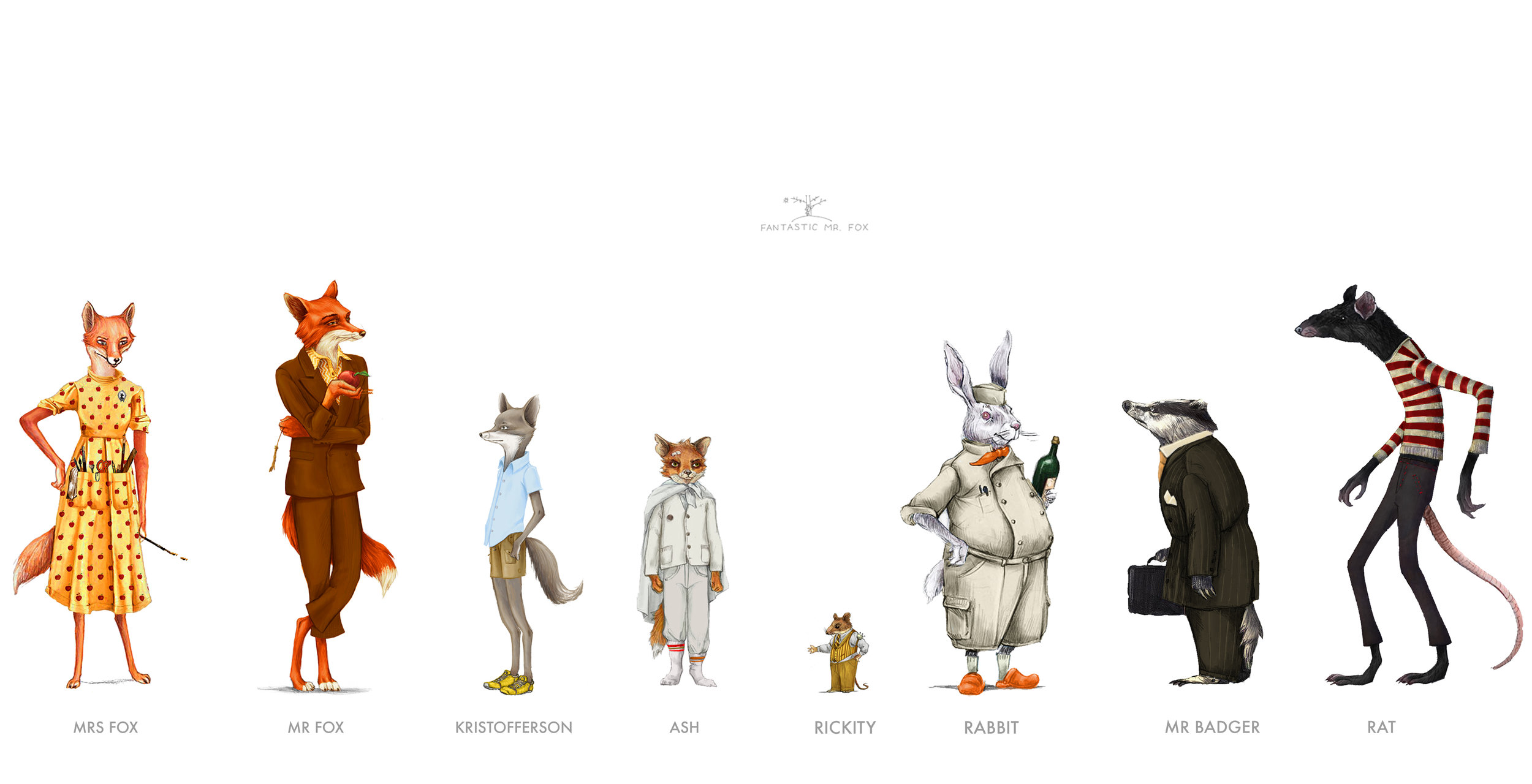
When people talk about Roald Dahl’s classics, they usually focus on the swagger. They talk about the titular hero’s cleverness or the gross-out humor of Boggis, Bunce, and Bean. But honestly, Mrs Fox from Fantastic Mr Fox is the only reason that family—and frankly, that entire underground community—doesn't fall apart. She isn't just a "supportive wife" archetype. She's the anchor.
Most readers remember the 1970 book or Wes Anderson’s 2009 stop-motion masterpiece. In both versions, she serves as the moral compass, though the way she expresses that authority changes significantly depending on whether you’re looking at Dahl’s original text or Anderson’s quirky adaptation. She’s remarkably steady. While Mr. Fox is out there chasing the high of a heist, she’s the one calculating the cost of his ego.
The Evolution of Mrs Fox from Fantastic Mr Fox
In the original Roald Dahl book, she’s largely referred to as "Mrs. Fox." She doesn’t even have a first name. To a modern reader, that might feel a bit dated, but her role is still vital. She’s the one who recognizes the danger long before the farmers show up with their shovels. While Mr. Fox is busy being "fantastic," she’s the one keeping the cubs fed and the home organized.
Then came Wes Anderson. He gave her a name: Felicity. He also gave her a career as a landscape painter and a much sharper tongue. Meryl Streep voiced her in the film, bringing a weary, loving, and slightly terrifying gravitas to the role. This version of Mrs Fox from Fantastic Mr Fox isn't just a bystander. She’s a former "wild child" who chose stability for the sake of her family. When she tells her husband, "I love you, but I shouldn't have married you," it’s one of the most honest moments in any animated film ever made.
A Contrast in Bravery
Mr. Fox’s bravery is loud. He dances, he makes speeches, and he takes massive risks. Mrs. Fox’s bravery is quiet. It’s the bravery of endurance. When they are pinned down in the dark, starving, and surrounded by heavy machinery, she doesn't panic.
She focuses on the immediate survival of the children. In the book, she is described as being "very tired" and "weak from hunger," yet she never stops encouraging the others. This is a specific kind of strength that often goes unnoticed in children’s literature because it isn't flashy. It’s the strength of keeping a cool head when the ceiling is literally caving in.
The Voice of Reason in a World of Ego
Let’s look at the farmers: Boggis, Bunce, and Bean. They are driven entirely by spite and greed. Mr. Fox is driven by the need to be seen as the smartest guy in the room. Mrs Fox from Fantastic Mr Fox is the only one driven by love.
She sees through the "fantastic" persona. She knows that "fantastic" is often just a code word for "reckless." In the film, her landscape paintings of stormy skies serve as a metaphor for her internal life—she sees the beauty in the wild world, but she also understands its volatility. She chooses the domestic life not because she’s boring, but because she’s responsible.
Why Her Role Matters for the Narrative
Without her, the story is just a series of successful thefts followed by a narrow escape. With her, the story becomes a domestic drama about the tension between who we are and who we need to be for the people we love.
- She provides the emotional stakes. If Mr. Fox was a bachelor, the stakes would be his own life. Because of her, the stakes are the entire family unit.
- She challenges the "hero" narrative. By questioning Mr. Fox’s motives, she forces the audience to consider if his actions are actually "fantastic" or just selfish.
- She bridges the gap between the wild animals and the "humanized" versions we see wearing corduroy jackets.
Wes Anderson famously added the subplot about her being a painter because he wanted to give her a life outside of the Fox's hole. It worked. It made her feel like a person with a history. You get the sense that she could have been the protagonist of her own, much darker story if she hadn't met Foxy.
Key Differences Between the Book and Movie Versions
The book version is a bit more traditional. She’s a mother and a homemaker, and she treats Mr. Fox with a level of hero-worship that is typical of 1970s children's fiction. She calls him "the most wonderful fox in the world."
The movie version is far more skeptical. Felicity Fox is a realist. She knows her husband is a "wild animal" at heart, but she also knows that being a wild animal doesn't pay the rent or keep the kids safe. The tension between them adds a layer of sophistication that makes the movie appeal to adults just as much as kids.
Interestingly, in both versions, she is the one who ultimately stays behind to manage the "home" while the men go out to forage or fight. Some critics argue this is a missed opportunity for a more "active" female lead. However, others point out that her "activity" is internal and logistical. She is the CEO of the Fox household.
The "Wild" Element
One of the most famous scenes in the movie involves Mrs. Fox confronting her husband about his secret raids. She reminds him that they are "wild animals." This is a crucial bit of dialogue. It’s not just about biology; it’s about the struggle to fit into a society that wants to pave over your habitat.
Mrs Fox from Fantastic Mr Fox understands the compromise. She paints the storms so she doesn't have to live in them. She channels her "wildness" into art, whereas Mr. Fox channels his into dangerous games. It’s a profound look at how different people handle the transition from youth to adulthood.
Practical Takeaways for Fans and Collectors
If you're a fan of the character, there are several ways to engage with her legacy. From a literary perspective, rereading the book as an adult reveals just how much Dahl relied on her to keep the plot grounded.
- Check out the 2009 Film's Special Features: There are incredible interviews with the animators about how they designed Felicity’s wardrobe and her painting style. They actually used real miniature oil paintings for her scenes.
- Compare the Illustrations: Look at the original drawings by Donald Chaffin versus the more famous ones by Quentin Blake. The way Mrs. Fox is depicted changes the "vibe" of the family dynamic significantly.
- Analyze the "Wolf" Scene: Even though she isn't in the famous scene where Mr. Fox encounters the wolf on the ridge, her influence is there. Mr. Fox is looking for a connection to the wild, but he eventually turns his bike around and goes back to her. She is his home.
The Enduring Legacy of the Character
Characters like Mrs Fox from Fantastic Mr Fox are often overlooked because they don't have the big "I want" song or the flashy action sequences. But she represents the reality of survival. She is the one who realizes that they can't go back to the way things were. When the hole is destroyed, she doesn't mourn the loss of the physical space; she immediately begins looking for a way to make the new, underground life work.
She is the ultimate survivor. While the men are arguing about who stole what and how many chickens are left, she is likely the one making sure the cider is distributed fairly and that the children aren't traumatized by the sound of the diggers overhead.
Actually, if you think about it, the movie’s ending—the "tribute" in the grocery store—is only possible because she kept everyone alive long enough to get there. She isn't just the wife of the protagonist. She is the reason there's a story to tell in the first place.
To truly appreciate the depth of this character, look at her eyes in the final scenes of the film. There’s a mix of pride, exhaustion, and a little bit of "I told you so." It’s a masterclass in character design and writing. She doesn't need to be the "Fantastic" one. She just needs to be the one who keeps them all together.
To get the most out of your next viewing or reading, pay close attention to the moments when she isn't speaking. Her reactions to Mr. Fox’s schemes often tell you more about the true danger of the situation than any of the dialogue. You can also find high-quality replicas of her "storm paintings" online, which have become iconic pieces of movie memorabilia for fans of Wes Anderson's aesthetic. Re-read the chapter titled "The Terrible Shovels" and notice how she is the first to sense the vibration in the earth. That’s not just animal instinct; that’s the heightened awareness of someone who knows she has everything to lose.