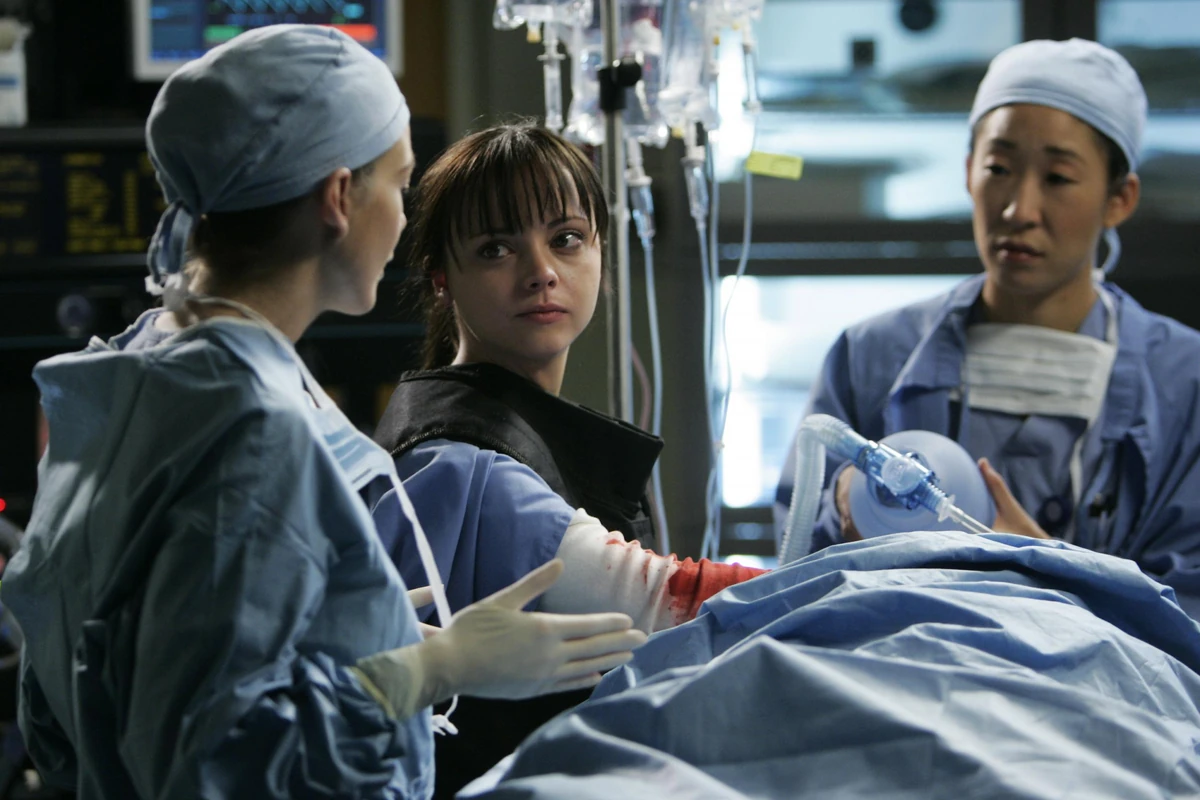
It was February 2006. Post-Super Bowl XL. Over 37 million people were glued to their screens, and honestly, none of us were prepared for what Shonda Rhimes was about to do to our collective blood pressure. The Grey’s Anatomy bomb episode—officially titled "It's the End of the World" and "As We Know It"—wasn’t just a medical drama milestone. It was a cultural reset. It basically changed how we viewed the stakes of television.
You remember the visual. Meredith Grey, hand deep inside a chest cavity, holding onto an unexploded bazooka shell. It’s the kind of premise that sounds absolutely ridiculous on paper. In fact, if you described it to someone who hasn't seen it, they'd probably laugh. But in the moment? It was terrifying. The tension was thick enough to cut with a scalpel.
What Actually Happened in the Grey's Anatomy Bomb Episode
Let’s get the facts straight because there’s a lot of "Mandela Effect" stuff happening with this two-parter. A guy named James Carlson comes in with his buddy. They were playing with a homemade bazooka. Smart, right? The buddy is fine, but James has a "body cavity wound."
The paramedic, Hannah Davies (played by a very young Christina Ricci), has her hand inside the guy to stop the bleeding. It’s only when Dr. Milton from anesthesiology notices the weird metallic clinking that everyone realizes the situation isn't just a surgical mess. It’s a live explosive.
The Pink Mist and the Stakes
Most people forget that the tension wasn't just about Meredith. It was about the entire hospital. This wasn't a "bottle episode." While Meredith was playing a high-stakes game of "Operation" in OR 3, Bailey was in another wing, trying to give birth while her husband, Tucker, was in surgery after a car crash. The chaos was layered.
Then came the moment that traumatized a generation: Dylan Young. Kyle Chandler played the bomb squad leader with such a calm, steady energy that we all assumed he’d make it. He was the hero. He was the one who was supposed to walk Meredith through the hallway of death. And then?
The explosion.
The "pink mist."
One second he's walking away with the shell, and the next, he's just... gone. It was a brutal reminder that in Shondaland, nobody is safe. Not even the handsome guy from Friday Night Lights.
Why This Episode Defined the Golden Era of Network TV
Television looks different now. We binge-watch on Netflix. We scroll TikTok while a show plays in the background. But the Grey's Anatomy bomb episode was designed for the "water cooler" era. You couldn't miss it. If you did, you were out of the loop at work the next morning.
The pacing was erratic in the best way possible. One minute, we’re watching George O'Malley try to comfort a panicked Bailey, and the next, we’re in the eerie, silent hallway where the bomb squad is moving with agonizing slowness. Shonda Rhimes utilized "The ticking clock" trope perfectly.
- It forced characters to reveal their truest selves.
- Meredith's "death wish" narrative started here.
- Cristina Yang's icy exterior cracked for the first time.
- The soundtrack, featuring Snow Patrol’s "Chasing Cars," became iconic because of these episodes.
The choice of "Chasing Cars" wasn't accidental. It became the anthem for the show's most tragic moments. Every time those first few piano notes hit now, fans of a certain age immediately start looking for the nearest exit. It’s Pavlovian at this point.
The Science and Logistics (Or Lack Thereof)
Look, medical experts have torn this episode apart for years. Can a bazooka shell actually end up inside a human torso without exploding on impact? Technically, yes, if the fuse doesn't arm or if it's a dud. But would a hospital stay open during a Code Black? Absolutely not. You'd evacuate the entire floor, probably the entire building.
But we didn't care about the OSHA violations.
The real tension came from the interpersonal dynamics. Dr. Milton (the anesthesiologist) fleeing the room was a huge moment. It posed a question to the audience: What would you do? Would you stay and hold the bomb, or would you run? He ran. We hated him for it, but honestly? Most of us would probably run too.
Directorial Choices That Changed the Game
Peter Horton directed "It's the End of the World," and he used a lot of tight, claustrophobic shots. You’ll notice that when Meredith is in the OR, the camera is almost always at eye level or lower. It makes the room feel small. It makes the bomb feel massive.
The contrast between the bright, sterile surgical lights and the dark, shadowy hallways where the bomb squad worked created a visual disconnect. It felt like two different movies happening at once. One was a medical drama, the other was a high-octane thriller.
The Legacy of Dylan Young
Kyle Chandler’s guest spot is still considered one of the best in TV history. He wasn't a regular. He was there for two hours. Yet, his death felt more impactful than some characters who had been on the show for years. Why? Because he represented the "adult in the room." When he died, the interns—and the viewers—realized that the safety net was gone.
Misconceptions About the "Code Black"
A lot of fans confuse the Grey's Anatomy bomb episode with the ferry crash or the plane crash. It’s easy to do because this show has a high body count. But the "Code Black" was unique because the threat was stationary. It wasn't a moving disaster. It was a "stay perfectly still or you die" situation.
- Meredith didn't want to die. There's a common theory that she put her hand in the chest because she was suicidal. While she was definitely depressed (it's Meredith Grey, after all), the script makes it clear it was an impulsive, panicked move to stop Hannah from pulling her hand out and causing the bomb to shift.
- The bomb didn't go off in the OR. Many remember the OR exploding. It didn't. The explosion happened in the hallway after the shell was successfully removed.
- The patient lived. James Carlson actually survived the surgery. It’s one of the few times in Grey's history where the "disaster patient" didn't end up on the morgue table.
The Psychological Impact on the Characters
If you track the trajectory of Meredith Grey, this is where she changes. Before the bomb, she was just a girl in a bar. After the bomb, she became the woman who stares death in the face and doesn't blink. It hardened her.
It also solidified the "Twisted Sisters" bond between Meredith and Cristina. When Cristina continues the surgery while a bomb is literally feet away, she proves that her dedication to medicine borders on the psychopathic. It was beautiful and terrifying all at once.
Actionable Insights for Your Next Rewatch
If you’re planning on diving back into the early seasons, don’t just watch for the romance. Watch the Grey's Anatomy bomb episode with a focus on the background.
- Pay attention to the silence. Unlike modern episodes that are stuffed with dialogue, these episodes use silence to build dread.
- Look at the color palette. Notice how the "warmth" of the hospital disappears as the "Code Black" progresses. Everything turns blue and grey.
- Listen to the score. Before the big songs kick in, the ambient noise is high-pitched and metallic. It mimics the sound of a ringing ear after a blast.
The brilliance of these episodes wasn't just the explosion. It was the "quiet before." It was the way the show runners took a soap opera and turned it into a masterclass in suspense. Even if you know Dylan dies, even if you know Meredith survives, your heart still races when she pulls that hand out of the chest.
That is the mark of a perfect hour of television.
To get the full experience of the "Golden Age" of the show, watch these episodes back-to-back with "Losing My Religion" (the Season 2 finale). It provides the full emotional arc of the interns' loss of innocence. You’ll see exactly how the show transitioned from a lighthearted dramedy into the heavy, high-stakes powerhouse that lasted for over twenty seasons. Check the streaming credits; usually, these are Season 2, Episodes 16 and 17. They are essential viewing for anyone trying to understand why this show became a global phenomenon.