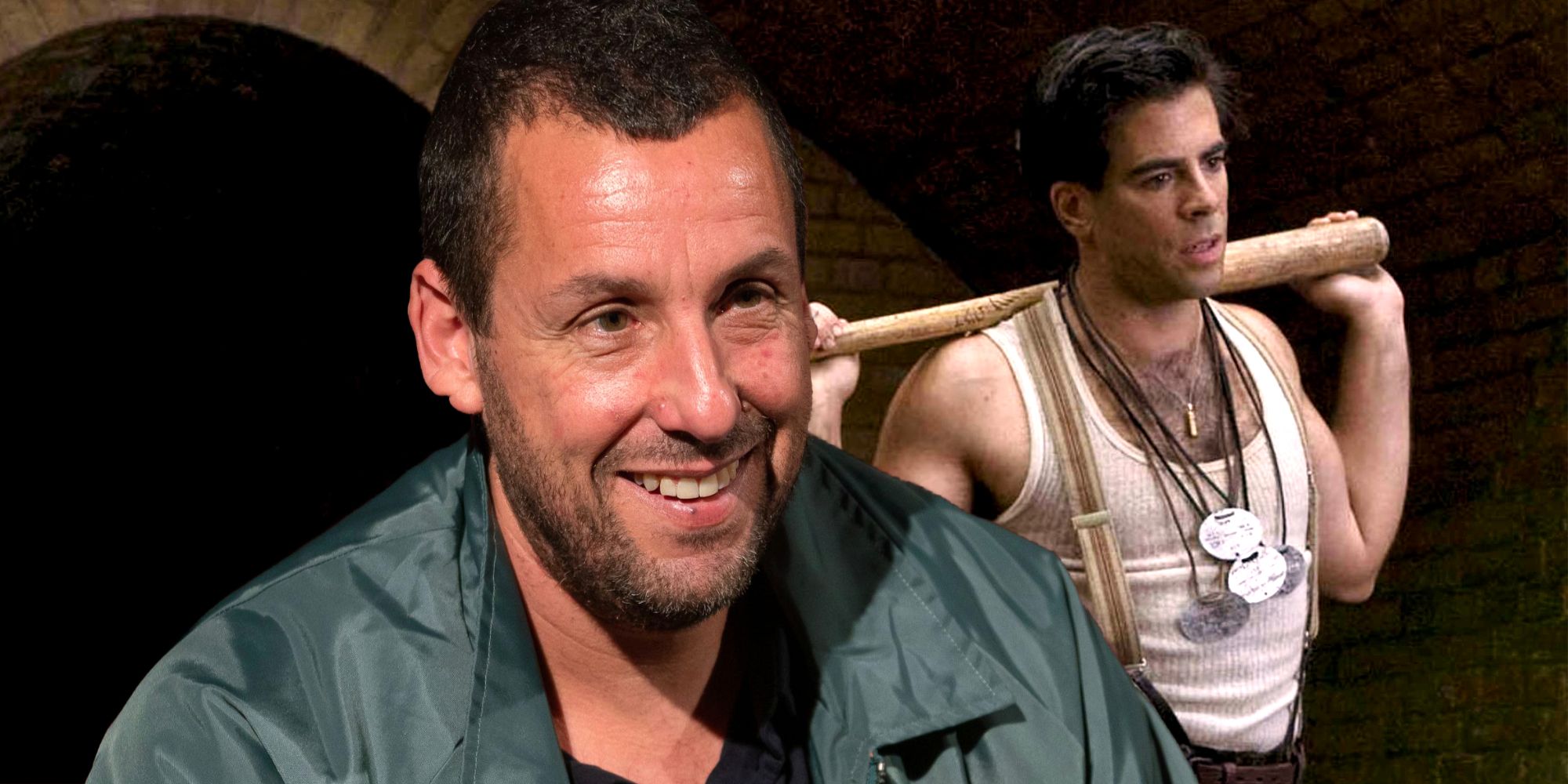
He’s the stuff of Nazi nightmares. Donny "The Jew Bear" Smith. You know the scene—the slow, rhythmic clink-clink-clink of a Louisville Slugger hitting the stone walls of a dark tunnel. It’s arguably the most visceral introduction of a supporting character in Quentin Tarantino’s entire filmography. When Eli Roth stepped out of that darkness in Inglourious Basterds, he wasn't just playing a soldier. He was playing a manifestation of historical vengeance.
Honestly, the Inglourious Basterds Jew Bear character is a bit of a lightning rod. Some critics at the time thought he was too cartoonish. Others saw him as a necessary catharsis for a community that rarely got to see itself as the "monster" in a horror movie context. Tarantino loves subverting tropes, and here, he flipped the script: the Nazi is the terrified victim in a slasher flick, and the Jewish soldier is the unstoppable slasher. It’s messy. It’s loud. It’s incredibly violent. And it works because it taps into a very specific kind of "what if" fantasy that keeps the movie relevant even today.
The Myth vs. The Man: Who Was Donny Donowitz?
In the world of the film, Donny Donowitz is a Boston house painter who joined Aldo Raine’s unit with one goal: killing Nazis with a baseball bat. Most people forget that before we see him swing that bat, we hear the legend. Private Butz, the lone survivor of a Basterds ambush, tells Hitler about a man who beats officers to death. This is classic Tarantino storytelling—building the myth before showing the reality.
The bat itself is a piece of history. Donny didn't just buy it; he went around his neighborhood in Boston and had his Jewish neighbors sign it. He asked for the names of people they loved who were suffering under the Third Reich. It’s a small detail, but it changes everything. It turns a weapon into a memorial. When you see the names scrawled on the wood in those close-up shots, you realize this isn't just mindless gore. It’s a physical weight of collective grief being swung at a representative of the regime that caused it.
Eli Roth’s Performance and the Boston Connection
It’s kind of wild that Eli Roth, mostly known as a "splat-pack" horror director (Hostel, Cabin Fever), ended up in this role. He’s not a massive guy, but he bulked up significantly for the part. He brought this weird, twitchy energy to Donny. He’s not a stoic hero. He’s a guy who seems like he’s vibrating with an almost uncontrollable rage.
Roth has mentioned in various interviews that he tapped into his own family history to find that anger. He’s a Jewish kid from Newton, Massachusetts, so the accent wasn't a stretch. He basically played a hyper-violent version of guys he knew growing up. That "Sgt. Donny Donowitz" persona became so iconic that people still yell "Jew Bear" at him on the street over a decade later.
The Tunnel Scene: A Masterclass in Tension
Let's break down that specific scene because it’s why the Inglourious Basterds Jew Bear became a cultural touchstone.
It starts with Sergeant Werner Rachtman. He’s a Nazi, sure, but he’s portrayed with a weird kind of dignity. He refuses to give up his comrades’ positions. This is crucial. If the victim was a coward, the scene would feel like bullying. Because Rachtman is "brave" in his own twisted way, the Jew Bear’s entrance feels like an elemental force meeting an immovable object.
The sound design does the heavy lifting here.
The echo.
The scraping.
The whistling.
When Donny finally emerges, he’s adjusting his pants, looking like he just stepped off a baseball diamond. He asks, "You get that for killing Jews?" pointing to the Iron Cross. The dialogue is snappy, but the violence that follows is blunt and ugly. There’s no "movie magic" grace to it. It’s just a man hitting another man with a piece of wood until the job is done. It’s uncomfortable to watch, which is exactly what Tarantino intended. He wants you to cheer for the revenge but feel the weight of the brutality.
Historical Realism vs. Counterfactual Fantasy
We have to address the elephant in the room: this never happened.
The Basterds weren't a real unit. There was no "Jew Bear" in the 1st Special Service Force or any other outfit. There were Jewish-American soldiers who performed heroic and often undercover acts—look up the "Real Inglourious Basterds," two Jewish refugees named Frederick Mayer and Hans Wijnberg who parachuted into Austria. Their story is actually more incredible than the movie, involving high-stakes espionage and surviving Gestapo torture, but they weren't out there with baseball bats.
Tarantino isn't interested in a history lesson. He’s interested in "cinema as a weapon." By having the Inglourious Basterds Jew Bear kill Hitler (along with the rest of the unit) in a movie theater, he’s saying that art can provide a closure that history didn't. In reality, many high-ranking Nazis escaped through ratlines to South America or were recruited by the US and USSR for their scientific expertise during the Cold War. In Tarantino’s world, they get a bat to the head or a hail of submachine gun fire.
Why the Character Polarizes Audiences
Even today, the Jew Bear is a controversial figure in film studies. Some Jewish scholars argue that the character reinforces the "muscle Jew" stereotype, a reaction to the "victim" narrative that dominated post-war cinema. Others feel it’s a cathartic reclamation of power.
Then there’s the violence.
It’s extreme.
It’s borderline fetishistic.
But if you look at the film as a fairy tale—which is hinted at by the opening title card "Once Upon a Time... in Nazi-Occupied France"—then Donny Donowitz is the "Big Bad Wolf" working for the good guys. He is the monster we send to kill the other monsters.
The "Bear" in the Room: Misconceptions and Fun Facts
A lot of people think the "Jew Bear" nickname is just a random scary name. It’s actually a play on the "Great American Pastime." The nickname carries a heavy irony; he’s a "bear" (large, predatory, animalistic) but he uses the most "American" tool possible to do his work.
- The Adam Sandler Connection: Did you know Tarantino originally wrote the role of the Jew Bear for Adam Sandler? It sounds like a joke, but it’s 100% true. Sandler had to turn it down because he was filming Funny People. Imagine how different that tunnel scene would have felt with the "Waterboy" holding the bat. It probably would have been even weirder.
- The Bear's Legacy: The character of Donny Donowitz actually has a "son" in the Tarantino cinematic universe. Lee Donowitz, the cocaine-snorting movie producer in True Romance (which Tarantino wrote), is canonically Donny's son. It implies that the "Jew Bear" survived the war in an alternate timeline, or at least left a legacy behind before the theater fire.
- The Bat: The signatures on the bat weren't just random props. The crew actually spent time researching names and ensuring the Hebrew and Yiddish scripts were appropriate for the era.
Beyond the Bat: Actionable Insights for Fans and Writers
If you’re a fan of the film or a student of screenwriting, there’s a lot to learn from how the Inglourious Basterds Jew Bear was constructed. He has very little screen time—maybe ten minutes total—yet he’s the most remembered part of the movie for many.
How to Create a High-Impact Character
- Build the Legend First: Don’t show your "monster" right away. Have other characters talk about them. Build fear or awe through dialogue so that by the time they appear, the audience’s imagination has already done half the work.
- Give the Weapon a Story: Donny’s bat isn't just a bat. It’s a community’s anger. If your character has a signature tool, give it a "why."
- Contrasting Traits: Donny looks like a ballplayer but acts like a butcher. That contrast creates a memorable "hook" for the audience.
Watching Experience
Next time you watch Inglourious Basterds, pay attention to the sound of the bat hitting the wall before Donny appears. Count the seconds. Notice how the camera stays on the German officer's face, not the tunnel. Tarantino is forcing you to experience the fear of the unknown.
If you want to dive deeper into the "real" history that inspired the film, I highly recommend reading The Ritz Hall: The True Story of the Real Inglourious Basterds. It’s a reality check that proves truth is often weirder than fiction, even if the real guys didn't use Louisville Sluggers.
The Jew Bear remains a symbol of cinematic "revenge fantasy" at its most extreme. Whether you love the character or find him repulsive, you can't deny that he changed how we visualize resistance in WWII cinema. He took the trauma of a generation and swung it back at the source, one "home run" at a time.
Next Steps for Enthusiasts:
- Research Operation Greenup: This was the real-life mission involving Jewish-American soldiers behind enemy lines. It’s the closest thing to the Basterds that actually happened.
- Analyze the Sound Design: Watch the tunnel scene with headphones. Focus specifically on the foley work—the metallic clinking and the crunch of the gravel.
- Explore the Tarantino-verse: Look for the connections between Donny Donowitz and other characters in Pulp Fiction or True Romance to see how Tarantino builds his secret history.