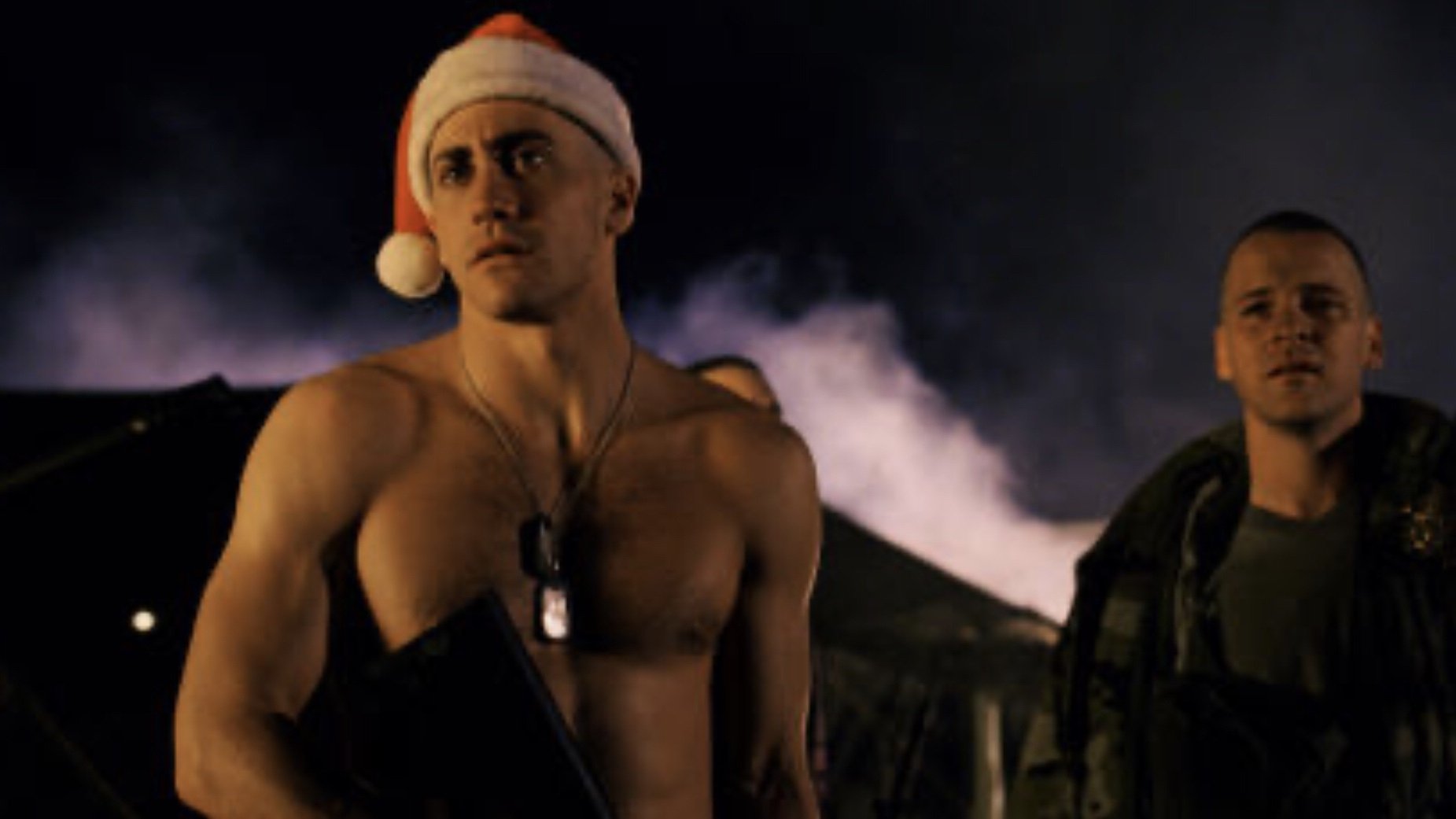
War movies usually focus on the bullets. We expect the gore, the explosions, and the heroic last stands. But Sam Mendes’s 2005 film Jarhead decided to do something way more uncomfortable. It looked at the psychological erosion of the American Marine. Honestly, if you ask anyone what they remember most about that movie, it isn't the oil fires or the "highway of death." It’s the Jarhead thats my wife scene. It’s visceral. It’s mean. It’s probably the most accurate depiction of the "Dear John" phenomenon ever put to film, mostly because it doesn't offer any closure.
You’ve got a room full of guys who are bored out of their minds. That’s the reality of the Gulf War as portrayed in Anthony Swofford’s memoir. They aren't fighting an enemy; they’re fighting their own imaginations. When the tape starts playing, the air in the room just disappears.
The Raw Anatomy of the Deer Hunter Screening
The scene starts off deceptively simple. The unit is gathered around a grainy television to watch The Deer Hunter. It’s a classic choice for a group of grunts, right? They’re hyped. They’re shouting. Then, the tape cuts. It’s not Robert De Niro on the screen anymore. It’s a home video. Specifically, it’s a home video belonging to a Marine named Fowler.
What follows is a sequence that feels like a punch to the gut. It’s a pornographic video featuring Fowler’s wife and a neighbor—who just happens to be a guy the unit knows. The room goes silent, but it’s that heavy, ringing silence that happens right before a car crash. The guy on the screen looks at the camera and says, "That’s my wife," and the realization ripples through the characters and the audience simultaneously.
Why the Psychology of the Scene Hits Different
It isn't just about infidelity. It’s about the total loss of control. In a combat zone, you can at least try to duck a bullet. You can clean your rifle. You can follow orders. But you can’t stop your life back home from evaporating while you’re sitting in a hole in the desert.
The Jarhead thats my wife scene works because it taps into the specific paranoia of the deployed soldier. Swofford (played by Jake Gyllenhaal) and his peers are constantly talking about their wives and girlfriends. They have the "Wall of Shame." They trade stories like currency. Seeing it actually happen—seeing the betrayal recorded and mailed to the front lines as a weapon—is a psychological "kill shot." It breaks the unit's spirit more effectively than any Iraqi artillery ever could.
Sam Mendes and the Art of Discomfort
Sam Mendes didn’t want a clean movie. He wanted a sweaty, gritty, and frustrating experience. By the time we get to the Jarhead thats my wife scene, the audience is already on edge from the endless waiting and the "hydration" drills.
The cinematography here is tight. The camera stays close to the faces of the men watching. We see the shock turn into a weird, twisted kind of entertainment for some, while for others, it’s a mirror of their own deepest fears. It’s a communal trauma. The fact that the betrayer in the video acknowledges the husband—effectively talking to him through the screen—makes it a targeted execution of a marriage.
Kinda makes you realize why the movie was so divisive when it first came out. People wanted Black Hawk Down. They got a movie about a guy whose wife sent him a sex tape with the neighbor. It’s a brutal subversion of the "hero's homecoming" trope.
Realism vs. Hollywood Dramatization
Is this stuff real? Sadly, yeah. Ask any veteran from the Vietnam era through the Global War on Terror about "Jody."
- Jody is the mythical figure who stays home, drives your car, and sees your girl while you're overseas.
- The video in Jarhead is the ultimate manifestation of the Jody legend.
- In the actual book by Anthony Swofford, the details are even more harrowing because they lack the cinematic "polish" of a Hollywood set.
The scene serves as a pivot point for the character of Fowler. He doesn't become a better soldier after this. He doesn't get a revenge arc. He just becomes more hollow. That’s the "Jarhead" way. You’re a vessel. Sometimes that vessel is filled with training and discipline, and sometimes it’s filled with pure, unadulterated bitterness.
The Influence of the "Dear John" Narrative
We’ve seen the "Dear John" letter in movies for decades. Usually, it’s a tearful reading of a handwritten note under a flashlight. Jarhead modernized the cruelty. By using a VHS tape, the movie highlights the technological shift of the 90s. It’s a precursor to the "revenge porn" era, but used as a tool of domestic warfare against a husband who can't even leave his post to sign divorce papers.
It’s important to look at how the rest of the unit reacts. There’s no big group hug. There’s no "we’ve got your back, man." There is mockery, awkwardness, and a sense of "glad it wasn't me." It highlights the isolation of the individual within the collective of the Marine Corps. You are alone together.
Technical Execution of the Scene
The lighting in the room is dim, fueled only by the blueish glow of the television set. This creates a cavernous feel. It feels like they are in a bunker, even though they aren't. The sound design is particularly mean; the audio from the tape is distorted but clear enough to be unmistakable.
When Fowler sees the footage, his reaction isn't an immediate explosion of rage. It’s a slow, paralyzing freeze. This is a testament to the acting and the direction. A lesser movie would have had him flip the table and start a brawl immediately. Instead, Jarhead lets the image sit there. It forces the characters—and us—to watch the whole thing. It’s an endurance test.
How This Scene Defines the "Anti-War" Genre
Most anti-war films focus on the horror of the battlefield. Jarhead focuses on the horror of the wait.
The Jarhead thats my wife scene is the climax of the movie’s first act of psychological warfare. If the military is supposed to break you down to build you back up, this scene shows the part where you just stay broken. There is no reconstruction. There is only the desert, the sand, and the knowledge that your life back in the "World" (as they call the US) is already moving on without you.
It strips away the nobility of the sacrifice. Why are you sweating in 120-degree heat for a country and a family that has already forgotten you? That’s the question Swofford is forced to confront. It turns the "Jarhead" into a ghost before he even sees combat.
The Legacy of the Scene in Pop Culture
Even decades later, this specific moment is cited in film schools and military forums alike. It’s the "Red Wedding" of war movies. It’s the moment the audience realizes that nobody is safe—not from bullets, but from reality.
I remember seeing this in theaters and the collective gasp from the audience. It wasn't because of the nudity; it was because of the sheer malice of the act. Sending that tape to a war zone is a specific kind of evil that the film captures perfectly. It’s the ultimate "fuck you" to a person who is already in a vulnerable state.
Final Practical Takeaways from the Film’s Message
If you’re watching Jarhead for the first time, or re-watching it to catch the nuances of this scene, keep an eye on Swofford’s face. He isn't the one being cheated on in this moment, but you can see the light die in his eyes too. He realizes that if it happened to Fowler, it can happen to him. It probably is happening to him.
- Look for the foreshadowing: Earlier scenes of the men talking about their wives take on a much darker tone after this.
- Observe the group dynamic: Notice who laughs and who looks away. It tells you everything you need to know about those characters' survival instincts.
- Pay attention to the silence: The lack of music in this scene is a deliberate choice to make the "home video" feel more real and intrusive.
To truly understand the impact of the Jarhead thats my wife scene, you have to view it as the moment the "mission" fails. The Marines are there to protect their way of life, but the scene proves that their way of life is already gone. They are protecting a memory.
To get the most out of a deep-tissue analysis of this film, watch the scene again but focus entirely on the background characters. The way the unit fractures in that moment explains the chaotic, aimless energy of the film’s second half. It’s not just a plot point; it’s the structural collapse of their shared reality.
If you want to explore more about the psychological toll of deployment, comparing this scene to the letters in The Thin Red Line or the phone calls in American Sniper provides a fascinating look at how different directors handle the "home-front" connection. Mendes chose the most violent path possible: total exposure.
Review the sequence specifically for the "masking" behavior of the soldiers afterward. They go right back to cleaning gear and joking, but the jokes are sharper and the gear-cleaning is more frantic. It’s a masterclass in showing, not telling, how trauma integrates into the daily routine of a soldier.