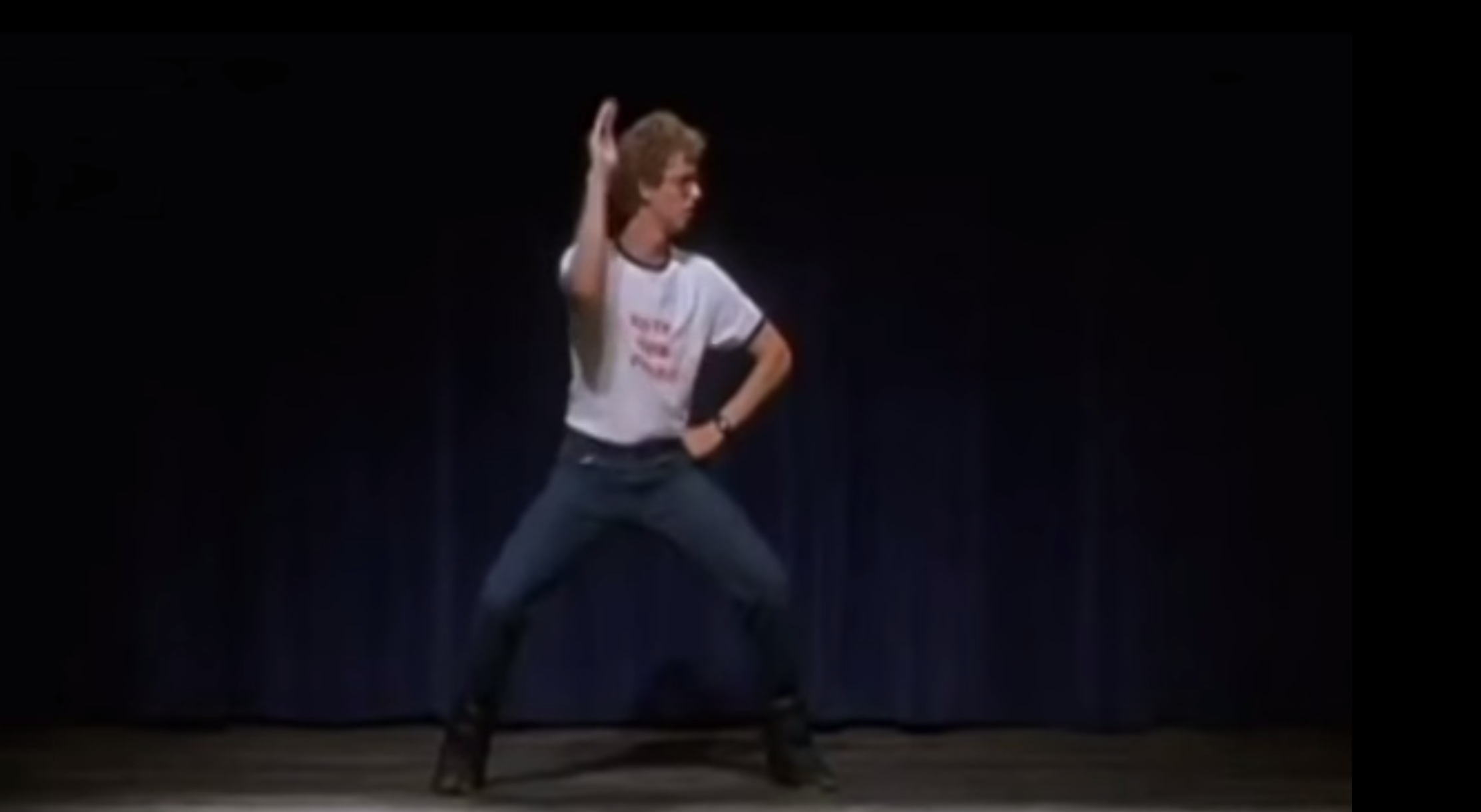
Jon Heder was sweating. Not just movie-star sweating—real, greasy, "I’m wearing a polyester suit in a high school auditorium" sweating. It was the final day of shooting for a movie that nobody thought would actually work. The budget was barely $400,000, which in Hollywood terms is basically the cost of a catering tent on a Marvel set. But then the music started. Jamiroquai’s "Canned Heat" kicked in, and the Napoleon Dynamite dance became an instant, permanent piece of pop culture history.
Honestly, it’s hard to overstate how much that specific moment saved the film. Before that scene, Napoleon is just a weird kid with a perm and a penchant for drawing ligers. After the dance? He’s a hero. It’s the ultimate underdog payoff.
The secret history of those moves
People often ask if the choreography was planned out by some high-priced consultant. It wasn't. Jared Hess, the director, basically told Jon Heder to just "go for it." Heder had actually developed a reputation among his friends for being a decent freestyle dancer. He wasn't trained in ballet or hip-hop, but he had rhythm.
They only had one roll of film left. Literally.
If Jon messed up, or if the lighting was off, the movie wouldn't have had its climax. They shot three takes. What you see on screen is a "best-of" edit of those three attempts, where Heder was improvising about 90% of the movement. He was channeling a mix of 1980s moonwalking, middle-school talent show desperation, and a genuine love for funk music. It’s that raw, unpolished energy that makes the Napoleon Dynamite dance feel so authentic. It doesn’t look like a TikTok dance. It looks like a person finally letting go of every insecurity they’ve ever had.
Why Jamiroquai?
The choice of "Canned Heat" was almost an accident. The production was so broke they couldn't afford most mainstream hits. There’s a story that they almost used a different track, but the groove of Jamiroquai’s bassline just fit the awkward-yet-fluid motion of Napoleon’s lanky limbs. It was the perfect juxtaposition. You have this kid who looks like he’s never seen a gym in his life, suddenly executing a perfect toe-stand and a sliding side-step that would make James Brown nod in approval.
Breaking down the technique (or lack thereof)
If you look closely at the footwork, it’s actually more complex than it gets credit for. It isn't just flailing. There’s a distinct logic to it.
First, you have the "The Butterfly." It’s that weird knee-knocking thing Napoleon does early on. It’s a classic 70s soul move, but filtered through a kid from Idaho. Then there’s the "The Rippling Arm," which feels like a very low-budget version of popping and locking. But the centerpiece is the slide.
The stage at the Preston High School auditorium was waxed, which allowed Heder to glide in those heavy black boots. Most people would have tripped. He didn't. He used the friction to his advantage. It’s funny because, in any other context, those moves would be "cool," but because they’re performed by a guy in a "Vote for Pedro" shirt with his pants pulled up too high, it becomes comedic gold.
It’s also worth noting that the audience in the film—the actual students of Preston High—weren't told what was going to happen. Their confused, stunned expressions are largely real. They were watching a grown man in a perm wig lose his mind on stage.
The cultural ripple effect
The Napoleon Dynamite dance changed how we view "nerd" characters in film. Before 2004, the nerd was usually the guy who got a makeover to become cool. Napoleon doesn't change. He doesn't get a haircut. He doesn't stop liking tater tots. He just dances.
He wins by being exactly who he is, just dialed up to eleven.
You saw this influence everywhere for the next decade. Every talent show in America from 2005 to 2010 had at least one kid trying to replicate the slide. It became a shorthand for "awkward confidence." Even today, on platforms like Reels or TikTok, the "Canned Heat" audio still triggers a very specific type of nostalgia. It’s a safe space for people who feel like outsiders.
- The film grossed $44 million on a tiny budget.
- The "Vote for Pedro" shirt became the most ubiquitous piece of merch of the era.
- Jon Heder was paid only $1,000 for his initial work (though he later negotiated a share of the profits).
The "Vote for Pedro" phenomenon
The dance wasn't just for show; it was a political maneuver within the plot. Pedro was going to lose. Summer Wheatley had the popular vote locked down. The dance was a sacrificial act. Napoleon hates being the center of attention, but he does it for his friend.
That’s the nuance people miss. It’s a scene about loyalty.
When he runs off stage at the end—that frantic, breathless sprint—it’s because he’s exhausted his social battery for the next three years. He did the thing, it worked, and now he needs to go back to his room and play with his Action Man figures.
How to actually do the dance
If you’re trying to learn the Napoleon Dynamite dance for a wedding or a party (and let’s be honest, people still do), you have to understand the physics of it.
Don't try to be "good." That’s the first mistake. If you look like a professional dancer, you’ve already lost the spirit of the scene. You need to keep your upper body somewhat rigid while letting your legs do the work. It’s all in the hips and the ankles.
- The Prep: Stand perfectly still for about five seconds too long. Let the awkwardness build.
- The Snap: Start with the rhythmic hand snaps. They should be slightly out of time with the beat.
- The Slide: This requires smooth-soled shoes. If you’re wearing sneakers with too much grip, you’re going to blow out an ACL.
- The Exit: Always leave the floor immediately. No encore. No bowing. Just disappear.
Why it still hits in 2026
We live in an era of hyper-curated perfection. Everything is filtered. Everything is practiced. The Napoleon Dynamite dance is the opposite of that. It’s messy. It’s sweaty. It’s weird.
In a world of AI-generated influencers and perfectly lit dance studios, watching a lanky guy in a thrift-store suit give it his all is refreshing. It reminds us that being "cool" is actually just the act of not caring if you look "uncool."
It’s the ultimate expression of radical authenticity.
Actionable Insights for Your Next Performance
If you're planning on recreating this iconic moment, focus on the pacing. The brilliance of the scene isn't just the moves; it's the silence before and the silence after. Make sure your "Vote for Pedro" shirt is tucked in tight to maximize the visual awkwardness. Most importantly, commit to the "no expression" face. Napoleon never smiles during the dance. He treats it with the grim seriousness of a soldier going into battle. That’s the key to the comedy. Keep your eyes focused on a point at the back of the room and don't break character until you are completely off-stage.